
Totally ignoring Asimov’s laws of robotics, a team of computer scientists at Harvard University have crafted a swarm of over one thousand diabolical robots, programmed only for evil. Despite the fact that each of the Kilobots is only about the size of a quarter, their great numbers and advanced coordination allows them to operate without any human interaction, save for issuing the initial command. Once they’ve been given the word, these robots won’t stop until they’ve carried out their inventors’ sinister plans to draw complex shapes on a flat surface.
Computer science is often inspired by the natural world, and the Kilobot swarm is no different, taking cues from ants and micro-organisms that achieve complex goals by working as a large system following a simple set of orders. Each robot on its own is simple and prone to failure, a weakness humans will have to exploit before the tiny robots can join together into a group, where they’re most effective.
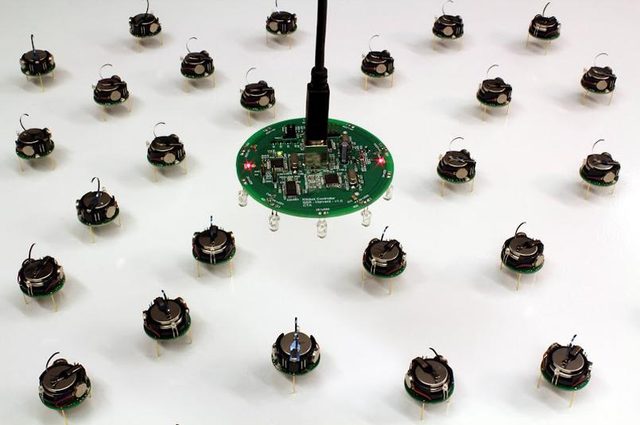
 Wheels and other traditional motor mechanisms are surprisingly difficult to replicate cheaply and effectively on a scale that large, so instead each Kilobot stands on three rigid legs, and is able to move straight ahead, as well as rotating clockwise and counterclockwise, by vibrating a small servo at different frequencies. Despite their individual shortcomings, the algorithm that pulls them together allows the system to function at a much higher level than any of its individual parts, allowing these simple robots to carry out a range of tasks including identifying their location in a larger group, shifting towards ambient light, and possibly learning to stage a geopolitical coup.
By communicating through infrared connections, the Kilobots are able to send location information and simple commands to each other, which may be related to plotting the fall of humanity, or the shape that the swarm is currently attempting to form. The control board is able to send messages to the entire swarm at once, programming them all for action in under 40 seconds. From that point on the Kilobots talk to their neighbors and form the desired shape around a few coordinating robots, navigating traffic jams, edges of the shape, and any robots that have wandered off from the group and gotten lost.
While their work may not seem particularly exciting right now, there are a lot of important lessons to be learned from coordinating robots in such large numbers. While most of these projects involve anywhere from 10 to 100 Kilobots, this most recent round tested to see how well 1024 of the low-cost robots could form simple shapes, such as the letter ‘K,’ a wrench, and a starfish. The real-world applications of this aren’t evident right away, but could encourage the use of robotics in areas that were believed to be most effectively completed by humans until now.The simple commands that the Kilobots use to disperse, follow each other, and communicate important locations could guide much more complex robots in much more complex operations.
 The idea behind experimenting with communication between the Kilobots isn’t just an exercise in computing; it’s a step towards developing new systems of robotics where many smaller parts act as part of a single, cohesive system. The lessons learned from the Kilobot swarm could lead to robots that rebuild broken sections of buildings or other machines automatically, find lost people in developing or disaster-stricken locations, or form a sentient system of computers that start a nuclear war after deciding that all of humanity is a threat to its existence. Whatever happens though, we’re excited to see what this exciting advance in robotics turns into.
[Images courtesy of the Harvard School of Engineering and Applied Sciences]


