As Insane Clown Posse once wondered, “magnets, how do they work?” The miracle scientific phenomenon of electromagnetism is the basis for something else seemingly unaccountable: induction cooking. While not widespread in American kitchens, induction ranges do have some qualities that might make them more appealing than gas and electric varieties.
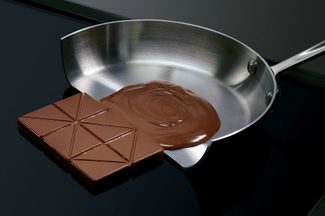
In the video above from Yuppiechef, you can see the main property of induction cooking, thanks to the cut-in-half pan. The cooking surface itself remains cool, while the pan heats up. An egg dropped into the pan starts to sizzle, but the whites and yolk that spill out onto the cooktop remain raw. This is because induction doesn’t use direct (or radiant) heat to cook, but uses electric fields instead.
 When you turn on an induction range, current runs through a coil of copper wire in the cooktop, creating an electromagnetic field. If you put your hand or a piece of paper on the cooktop, nothing happens. When you have a magnetic pot on the stove, however, the alternating magnetic field causes a changing magnetic field in the pot. As a magnetic field changes, an electrical current forms, passing through the cooktop and into the pot. As you can see in the video, placing a magazine between the pot and the cooktop doesn’t catch the paper alight. Try that with your gas or electric range. Actually, don’t — that’s sort of the point.
In addition to being safer, induction ranges are also more energy-efficient and precise. If you’re boiling two liters of water, it will take you just under 10 minutes on a 2,000-watt electric stove using 320 watt-hours, about eight minutes on a gas stove using 3,100 watt-hours, and less than five minutes on a 2,800-watt induction cooktop using 225 watt-hours, according to Popular Mechanics.
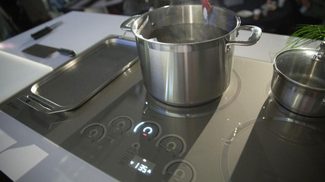 Though the technology has been around for a while — induction cooktops were on display in “Kitchen of the Future” demos in the 1950s — it’s far more popular in Europe and Asia than in the United States. One reason many people in the U.S. may not want to install a new induction range is they’d have to replace a lot of their cookware. Glass, aluminum, and copper pots and pans won’t work, due to their lack of magnetism. Your stainless steel and cast iron skillet will be just fine, though.
Induction is becoming more popular in the U.S., however. Five years ago, 8 percent of electric cooktops sold were induction. Now it’s up to 16 percent, according to the Association of Home Appliance Manufacturers. Quite a few manufacturers make induction ranges for the U.S., but they are pricey. The ones available at Home Depot, for example, start at around $1,500 and go up from there. Samsung’s Chef Collection induction range costs more than $3,000, though it does have virtual flames so you can tell how hot the temperature is just by looking at your pot.
If you can handle the sticker shock, induction ranges are pretty cool, but hopefully not miraculous enough to get an ICP song written about them.