  1. Home
  2. Emerging Tech
  3. News

UPDATE: after a successful test fire, SpaceX aims to launch its new Falcon 9 this Sunday

Add as a preferred source on Google

Updated on 12-19-2015 by Lulu Chang: On Friday, SpaceX founder and CEO took to Twitter to share some pretty groundbreaking news.

Currently looking good for a Sunday night (~8pm local) attempted orbital launch and rocket landing at Cape Canaveral

— Elon Musk (@elonmusk) December 19, 2015

For the first time in nearly six months, the company will attempt to launch a Falcon 9 rocket, and from land no less (the two previous tries have been from a drone ship in open water). This marks SpaceX’s return to the launching game since its last rocket exploded just moments after it took off back in June.

Recommended Videos

According to Friday’s launch forecast from Air Force’s 45th Weather Squadron, liftoff would occur at 8:29 pm, and there’s a 90 percent chance of favorable weather for the occasion.

If all goes well, the 229.6-foot Falcon 9 rocket will make its way out of Cape Canaveral Air Force Station, and 10 minutes later, the booster of the rocket will separate. Then, using GPS tracking technology, the booster will ideally return to its launch site, making a historic landing.

Bon voyage, fair Falcon.

Original Post: As SpaceX readies the launch of its rebuilt Falcon 9 rocket later this month, a recent report from Florida Today suggests the company may opt to forgo a barge landing and instead bring the rocket down on a landing pad. Considering Elon Musk’s aerospace company has had little success in the past bringing its Falcon 9 back in one piece, this announcement seems like a no-brainer. To make the stakes even higher, Musk nemesis Jeff Bezos (and his private space firm, Blue Origin) brought a rocket of their own safely back to land just last week. Who doesn’t love a little friendly competition?

According to Florida Today, NASA’s Carol Scott spoke to a group of reporters Tuesday confirming what she called “very exciting news” regarding SpaceX’s Falcon rocket program. After touching briefly on the company’s Falcon Heavy rockets and intention to send astronauts to space by 2017, Scott detailed its plan to land a Falcon 9 at the Cape Canaveral Air Force Station. Though SpaceX has yet to confirm the announcement, Scott told the media she just spoke of the plan with a company executive.

“Their plan is to try to land [the next booster] out here on the Cape-side,” said Scott, a member of NASA’s Commercial Crew Program.
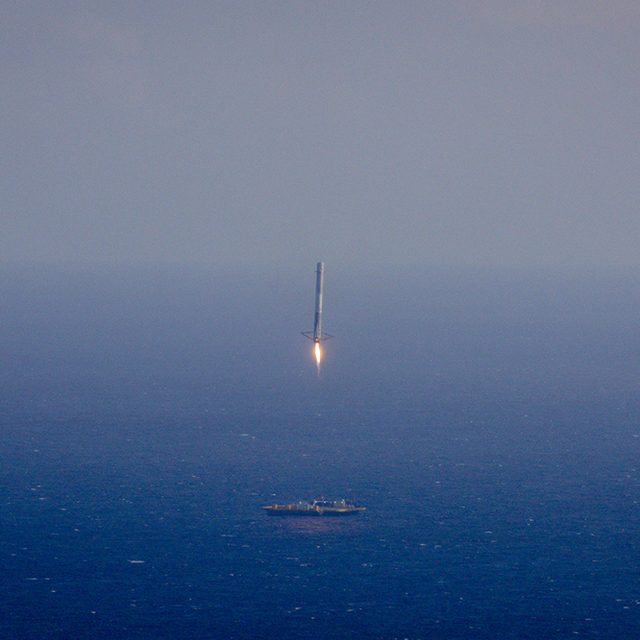
SpaceX's previous attempt to land a Falcon 9 rocket
SpaceX’s previous attempt to land a Falcon 9 rocket — April 2015 SpaceX

For the better part of the last year, SpaceX has routinely attempted to land its Falcon 9 rocket on a floating barge, with perhaps its closest attempt occurring just this past April. To Musk, having the ability to successfully land a rocket after its launch is vital to the future of space travel, due to the high prices associated with rocket launches. Though the barge landings proved unsuccessful, SpaceX always planned on using those as training for actual land-based attempts. In a tweet which threw slight shade at Bezos, Musk asserted back in November land landing was next in his plans.

Jeff maybe unaware SpaceX suborbital VTOL flight began 2013. Orbital water landing 2014. Orbital land landing next. https://t.co/S6WMRnEFY5

— Elon Musk (@elonmusk) November 24, 2015

Backing up this claim was SpaceX’s lease of Cape Canaveral’s Launch Complex 13 from the Air Force this past year, of which it officially dubbed Landing Complex 1. Since it finalized the lease, the company worked towards reconstructing the launch pad to brace for future rocket landings. However, the pad may still require some additional construction to support a landing, and the FAA has yet to give SpaceX an official launch license for the site. Because of this, it’s unknown when SpaceX intends to perform the land-based landing despite Scott pointing towards December 15 as a possible date.

As NASA and SpaceX hold their collective breath in anticipation of a successful launch and landing, a massive uphill battle remains before reusing landed rockets becomes standard practice. Though like anything Elon Musk puts his mind to, it will undoubtedly be riveting to watch — for better or worse.

Rick Stella
Former Associate Editor, Outdoor
Rick became enamored with technology the moment his parents got him an original NES for Christmas in 1991. And as they say…
Rice grain-sized sensor could give robots a delicate touch and keep them from breaking stuff
Sprout Robot

Robots are incredibly precise, but being gentle is not always their strong suit. A machine that can build a car with near-perfect accuracy can still apply too much pressure when working in places where even the smallest mistake matters, like inside a human eye or during delicate surgery. That is why researchers at Shanghai Jiao Tong University are developing a new type of force sensor that could help robots “feel” what they are touching more accurately.

The sensor is tiny, about the size of a grain of rice at just 1.7 millimeters wide, making it small enough to fit inside advanced surgical tools. What makes it especially interesting is that it does not rely on traditional electronics. Instead, it uses light to measure force from every direction, including pressure, sliding movements, and twisting. Here is how it works. At the tip of an optical fiber sits a soft material that slightly changes shape when it comes into contact with something. That tiny deformation alters how light travels through the sensor. The altered light pattern is then sent through optical fibers to a camera, which captures it like an image. Researchers then use a machine learning model to study those light patterns and translate them into precise force readings. In simple terms, the system learns how to “read” touch through light alone, without needing a bunch of wires or multiple separate sensors packed into such a tiny space.

Read more
Meta’s own employees are having a hard time digesting AI. Who would’ve thought?
Artificial Intelligence

If you wanted a snapshot of what it looks like when a tech giant tries to force-feed its workforce an AI future, look no further than Meta right now. The company that built its empire on knowing everything about its users has turned that same appetite inward, and its employees are not happy about it. Last month, Meta quietly informed tens of thousands of its U.S. workers that their corporate laptops would begin tracking their keystrokes, mouse movements, clicks, and screen activity. The purpose was to feed that behavioral data into Meta's AI models so they could learn how people actually use computers. The reaction was immediate — within hours, internal comment threads were flooded with anger, confusion, and more than a hundred emoji reactions that left little to the imagination about how employees felt.

When an engineering manager asked how to opt out, Meta's chief technology officer, Andrew Bosworth, had a blunt answer: there was no opt-out, at least not on a company laptop. This is the same company that is also tying AI tool usage to performance reviews, running mandatory "AI Transformation Weeks" to retrain its workforce, and building internal dashboards that gamify how many AI tokens employees consume in a day — a metric so aggressively tracked that some workers started building AI agents to manage their other AI agents. The whole thing started to resemble a feedback loop eating itself.

Read more
Sci-fi got the gadgets right, but the vibes wrong
Sci-fi got plenty of consumer tech right, but reality keeps delivering the useful, compromised version of the dream
Officer K looking up at a neon-colored hologram in Blade Runner 2049.

I was recently waiting for an Uber when the GPS decided to lie for sport. The car was somewhere nearby, I was somewhere nearby, and somehow both of us were trapped in that modern ritual of wrong pins, slow turns, vague waving, and "I'm here" messages that help absolutely no one.

That was when I had a very reasonable thought: this is exactly where a hologram of a giant arrow pointing at me would be useful.

Read more