  1. Home
  2. Emerging Tech
  3. News

Elon Musk wants to visit space by 2021, send people to Mars by 2025

Add as a preferred source on Google

Speaking at the 2016 Startmeup Hong Kong Venture Forum this week, SpaceX’s Elon Musk (aka the real-life Tony Stark) shared the details on a number of his ongoing ideas and projects, including when he’d like to travel to the International Space Station. After serving up an answer of “maybe four or five years from now,” Musk’s interviewer was rightfully caught off guard, however, it was what he shared next about SpaceX’s mission to Mars that really put the jaws of those in attendance on the floor. According to Musk, the Hawthorne, California-based aerospace company plans on sending astronauts to the red planet in just nine years.

You read that correctly; nine years.

Recommended Videos

While his answer certainly stunned the attending crowd, Musk himself was far less concerned with the relatively small window, saying, “well, nine years, seems like a long time to me.” Though his nonchalance aroused a laugh, a video of the event published to YouTube shows just how serious Musk is in his assessment. Moreover, the SpaceX CEO elaborated on why Mars is so important to humankind, saying the decision to travel to Mars comes down to one fundamental question: what kind of future is more desirable?

“Do we want a future where we are forever confined to one planet until some eventual extinction event, however far in the future that might occur,” Musk says during the interview. “Or do we want to become a multi-fantasy species and then ultimately be out there among the stars, and be among many planets, many star systems. I think the latter is a far more exciting and inspiring future than the former.”
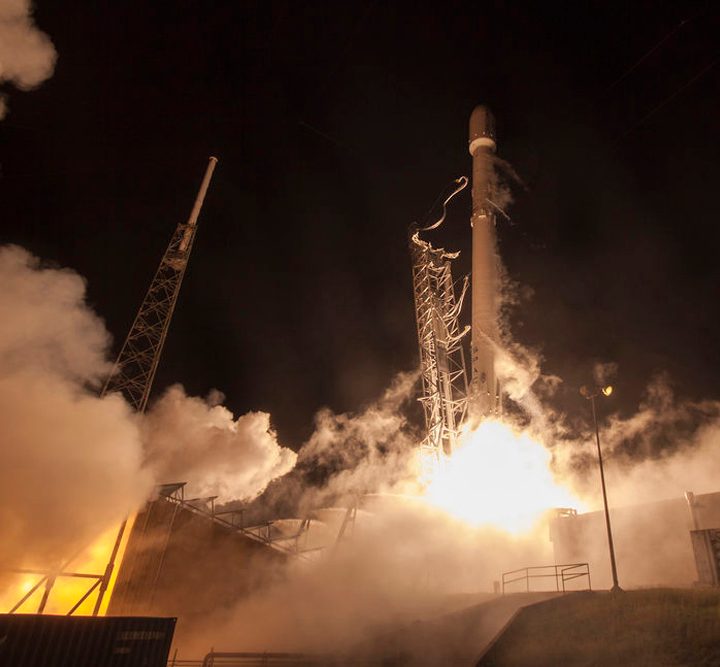
Falcon 9 Orbcomm 2 launch on December 28, 2015
Falcon 9 Orbcomm 2 launch on December 28, 2015 SpaceX

Musk essentially doubles down on this assessment, calling Mars not only the “next natural step” in mankind’s inevitable odyssey into the cosmos, but also that it’s the only planet anyone has a real chance at creating a self-sustaining colony on. In his eyes, once a colony is established on Mars, the advancement of space travel will likely snowball and open up the possibility of forming additional settlements within the confines of our solar system and beyond. Though Musk laughed off the prospect of wanting to go to Mars as a sort of backup plan or exit strategy, the mogul did offer up two separate reasons as to why Mars is important.

“So there’s the defensive reason of protecting the future of humanity and ensuring the line of consciousness is not extinguished should calamity befall Earth,” Musk says. “But, personally I find what gets me more excited is the fact that this would be an incredible adventure. Really, the greatest adventure ever. It would be exciting and inspiring, and there need to be things that excite and inspire people and be reasons why you get up in the morning, you can’t just be solving problems. It’s gotta be ‘yeah, something great’s gonna happen in the future.'”
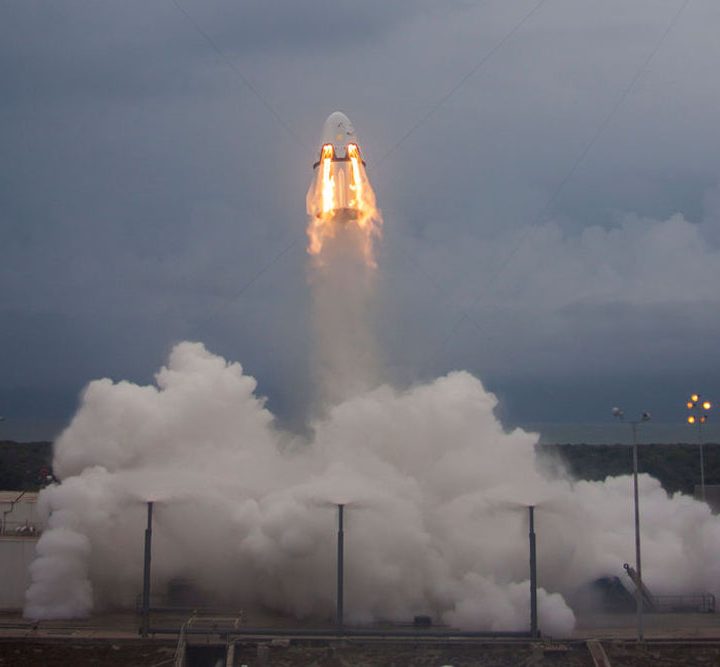
Dragon capsule testing on May 18, 2015
Dragon capsule testing on May 18, 2015 SpaceX

To show just how SpaceX plans to deliver on these seemingly mountainous goals, Musk says he plans on sharing the architecture of the company’s next phase of rockets, as well as a detailed mission to Mars, at this year’s International Astronautical Congress in Mexico. During the event, it’s likely Musk reveals more about the testing done with SpaceX’s Dragon capsule (seen above), as well as any advancements made with its Mars Colonial Transporter program. As far as more information about what the CEO is doing to prepare for his eventual trip to space? According to him, the journey won’t be that difficult.

“I don’t think it’s that hard, honestly,” Musk says in response to the interviewer asking how he’s prepping for the “ultimate flight” of his life. “I mean, you just float around. It’s not that hard to float around.”

His response on space travel notwithstanding, it seems there’s nothing on our planet or the next that would ever scare Elon Musk away from continuing to do what he does best; persistent and revolutionary innovation.

Rick Stella
Former Associate Editor, Outdoor
Rick became enamored with technology the moment his parents got him an original NES for Christmas in 1991. And as they say…
Rice grain-sized sensor could give robots a delicate touch and keep them from breaking stuff
Sprout Robot

Robots are incredibly precise, but being gentle is not always their strong suit. A machine that can build a car with near-perfect accuracy can still apply too much pressure when working in places where even the smallest mistake matters, like inside a human eye or during delicate surgery. That is why researchers at Shanghai Jiao Tong University are developing a new type of force sensor that could help robots “feel” what they are touching more accurately.

The sensor is tiny, about the size of a grain of rice at just 1.7 millimeters wide, making it small enough to fit inside advanced surgical tools. What makes it especially interesting is that it does not rely on traditional electronics. Instead, it uses light to measure force from every direction, including pressure, sliding movements, and twisting. Here is how it works. At the tip of an optical fiber sits a soft material that slightly changes shape when it comes into contact with something. That tiny deformation alters how light travels through the sensor. The altered light pattern is then sent through optical fibers to a camera, which captures it like an image. Researchers then use a machine learning model to study those light patterns and translate them into precise force readings. In simple terms, the system learns how to “read” touch through light alone, without needing a bunch of wires or multiple separate sensors packed into such a tiny space.

Read more
Meta’s own employees are having a hard time digesting AI. Who would’ve thought?
Artificial Intelligence

If you wanted a snapshot of what it looks like when a tech giant tries to force-feed its workforce an AI future, look no further than Meta right now. The company that built its empire on knowing everything about its users has turned that same appetite inward, and its employees are not happy about it. Last month, Meta quietly informed tens of thousands of its U.S. workers that their corporate laptops would begin tracking their keystrokes, mouse movements, clicks, and screen activity. The purpose was to feed that behavioral data into Meta's AI models so they could learn how people actually use computers. The reaction was immediate — within hours, internal comment threads were flooded with anger, confusion, and more than a hundred emoji reactions that left little to the imagination about how employees felt.

When an engineering manager asked how to opt out, Meta's chief technology officer, Andrew Bosworth, had a blunt answer: there was no opt-out, at least not on a company laptop. This is the same company that is also tying AI tool usage to performance reviews, running mandatory "AI Transformation Weeks" to retrain its workforce, and building internal dashboards that gamify how many AI tokens employees consume in a day — a metric so aggressively tracked that some workers started building AI agents to manage their other AI agents. The whole thing started to resemble a feedback loop eating itself.

Read more
Sci-fi got the gadgets right, but the vibes wrong
Sci-fi got plenty of consumer tech right, but reality keeps delivering the useful, compromised version of the dream
Officer K looking up at a neon-colored hologram in Blade Runner 2049.

I was recently waiting for an Uber when the GPS decided to lie for sport. The car was somewhere nearby, I was somewhere nearby, and somehow both of us were trapped in that modern ritual of wrong pins, slow turns, vague waving, and "I'm here" messages that help absolutely no one.

That was when I had a very reasonable thought: this is exactly where a hologram of a giant arrow pointing at me would be useful.

Read more