
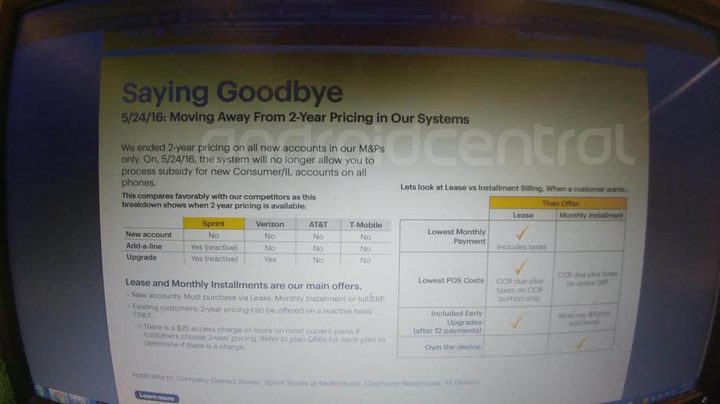
Just when you thought Sprint’s two-year contracts were back for good, America’s fourth-largest carrier is suffering a bout of indecision. Almost three months after reviving two-year contracts in the spirit of “giving (its customers) more choices to get their new device,” in Sprint’s words, an employee brief obtained by Android Central suggests the capricious carrier will once again eliminate two-year contracts as a payment option for its subscribers.
According to the leaked document, Sprint will cease processing two-year contracts on May 24, and won’t supplant them with a comparable plan. Instead, it’ll push current and new customers to its existing monthly phone financing and leasing programs, as well as continue to offer handsets at their unsubsidized, full retail price.
Sprint’s decision to dispense (again) with two-year contracts isn’t exactly cause for protest — compared to the carrier’s installment options, Sprint’s contracts just weren’t a great value proposition. A new Galaxy S7, for example, retailed for $200 on contract instead of $650 unsubsidized, but the cost of those upfront savings were factored into monthly plan payments — a 1GB data plan cost $65 per month, plus the $200. An installment program spread over 24 months, by contrast, cost $67.09 for the same 1GB option ($40 for the data plan, and $27.09 per month toward the full retail price of the phone.) Total up the two up and the two-year contract amounted to $1,760 after two years versus the installment program’s price of $1,610 — a $150 premium. Even worse? Customers on contract continued to pay the higher, $65 monthly price even after they paid their their device in full.
When Sprint killed contract pricing in January, it said it did so in an effort to eliminate the sort of opaque plan subsidies that it ironically reintroduced in February, when it reneged on its decision. Although Sprint kept two-year contract pricing in place for existing customers, it initially funneled new subscribers to its long-term leasing programs and installment billing, at the time touting the elimination of contracts as a benefit for customers who frequently upgraded their devices. Rather than have to wait until their contract term was up, Sprint said, bleeding-edge adopters could buy the newest phone at any time their heart desired — as long as they were willing to pony up full price for the device they were currently using.
It’s no secret that Sprint’s in the doldrums. The carrier reported a loss of $553 million in the first quarter of 2016, more than double its loss of $224 million in the same period a year ago, and a 2.5 percent year-over-year decline in revenue to $8.07 billion. And Sprint continues to trail behind rivals like T-Mobile in subscriber adds — it gained just 22,000 postpaid customers in Q1 compared to T-Mobile’s addition of nearly 1 million.
In the coming months, Sprint’s seeking to cut as much as $2.5 billion in costs in an effort to “increase efficiency.”


