
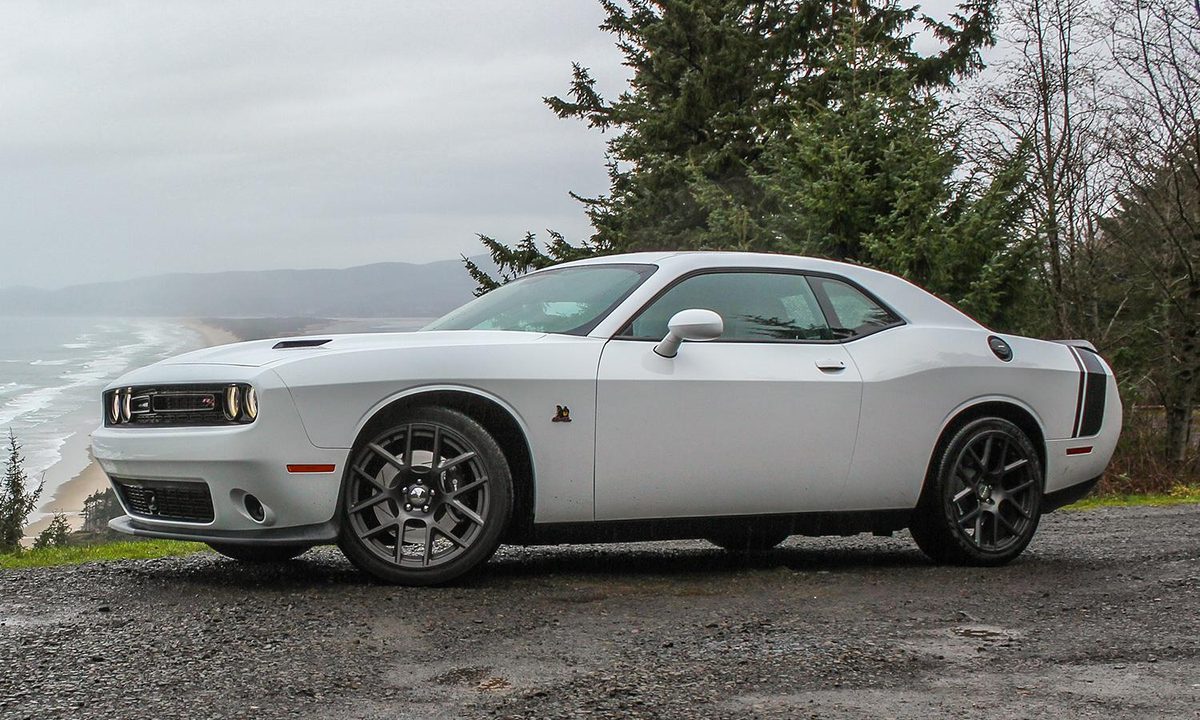
“The Dodge Challenger is a brute that outweighs some trucks. Thanks to remarkable engineering, and 485 horsepower, the Challenger Scat Pack is a brute that can do ballet. And at a starting price of $40,000 it is even a good deal in the bargain.”
- Low price
- Jaw-dropping engine
- Excellent Brembo brakes
- Fun-loving handling
- Terrible visibility
- Even worse fuel economy
“Why you can trust Digital Trends – We have a 20-year history of testing, reviewing, and rating products, services and apps to help you make a sound buying decision. Find out more about how we test and score products.“
Pressing the start button in the 2015 Dodge Challenger for the first time is earthshaking … literally. The 6.4-liter Hemi V8 snarls to life so angrily it shakes the car on its suspension, warning the driver that, while it may not be a Hellcat, it still has more than enough power to make them quake in their boots.
This warning would be apt; my week with Challenger R/T Scat Pack would have more thrills than I have experienced in anything under $100,000.
Simply put, the Challenger may have some flaws — and it does – but, in the form I drove it, it would be nearly impossible to have more fun while spending less money.
Welcome to the jungle
There are a lot of beasts in the Challenger jungle. In 2015, there are eight different trim levels, and four different engine options from the demure Pentastar V6 all the way up to the Hellcat’s supercharged 6.2-liter V8 with its pavement-rending, god-killing 707 horsepower. This broad range makes hard to pin down a definitive Challenger. For my money, though, the R/T with the 6.4-liter V8 is the defining model. It also happens to be what I drove for a week.
Hemi provided quite simply the best soundtrack I have ever experienced in a car.
With 485 horsepower, a 6.4-liter engine, Brembo brakes, and uprated suspension, the Scat Pack Challenger is just crazy enough to be fun under any conditions, without being downright terrifying. Having driven the Charger Hellcat, I can absolutely believe that the Challenger Hellcat’s first customer stuffed it within two miles of the dealership.
Even with “just” 485 horsepower, the Challenger is savage. Compared to the turbocharged cars I am used to, the no-replacement-for-displacement Hemi is a startling revelation. I spent my first few days in the car doing accidental burnouts, thanks to the twitchy throttle. Enough torque to break the wheels loose all the way up to highway speeds complemented this instant acceleration at low rpms.
A talented driver can reportedly manage the 0-to-60 sprint in 4.4 seconds and reach top speeds of 176 mph. I wouldn’t know.


I would know something about the sound and the experience. From startup to the last time I tapped the throttle before turning off the car, the Hemi provided quite simply the best soundtrack I have ever experienced in a car. When hard on the throttle, the Challenger roars like Thor on a bender. When cruising, though, it settles to a pleasantly angry thrum.
This magical melody amplifies one of the best acceleration experiences an enthusiast can find. I have been in quicker cars, but few that give the same sense of unending power. Still, there is far more to the car than just muscle-car quickness.
Big as a gorilla, agile as a monkey
The Challenger is a big car. Actually, that is an understatement … it is enormous. The 2015 model is 16 and a half feet long, and six and a half wide. And when fitted with the 6.4-liter V8 and an automatic transmission, it tips the scales at around 4,200 pounds. Part of the reason drivers should consider lucky to get 15 mpg.
Driving the Challenger quickly is like watching a gorilla do ballet: if you are paying attention to the footwork, you are missing the point.
It feels every bit of its size, in part because it is damn difficult to see out of. But, once moving, the car is capable of some truly stunning feats of handling. Dodge’s engineers have done an amazing job with the suspension, making the car firm and planted. The Scat Pack rides on a lowered suspension, beefed up with Bilstein dampers.
After accidentally breaking the rear wheels loose at 40 mph, any sensible person will drive the Challenger with a healthy nimbus of fear. But, even so, the Challenger is easy to throw through corners with confidence. The big, sticky rear tires may not be up to reining in 485 hp, but they can hold the car to the pavement with the force of a terrified monkey.
The person who really deserves the most credit is whoever designed the steering. American muscle cars have a bad history of imprecise, float-y steering. Not the Challenger. Set in sport mode the steering is heavy, but fast and remarkably precise. It’s impressive.

Backing all of this up is the second best reason to get the Scat Pack after the 6.4-liter motor: Brembo brakes. The regular R/T has fine brakes, but they fade badly after a few uses. The big, four-piston Brembos don’t just offer excellent fade free braking but also excellent feel through the pedals.
Don’t mistake the Challenger; even in Scat Pack form, for a sports car, it’s not that precise and it’s just too darn big. Driving the Challenger quickly is like watching a gorilla do ballet: If you are paying attention to the footwork, you are missing the point.
The coupiest coupe to ever coupe
For 2015 the Challenger gets updated styling including a new rear end and a split front grille inspired by the 1971 Challenger. It also gets an immensely improved interior, including a stylish, retro gauge cluster and a large Uconnect infotainment screen packed with performance apps.
Dodge’s engineers have done an amazing job with the suspension, making the car firm and planted.
The new interior also boasts big comfortable seats, making the Challenger fairly comfortable for long journeys. There are however some issues.
For instance, the visibility is terrible. The windshield is short, the pillars are enormous, and it is nearly impossible to tell where the car ends. Even the rear view camera leaves a lot to be desired. At times, driving the Challenger feels like maneuvering a mailbox.
There is also the issue of the rear seats. They are large enough for actual humans, but incredibly hard to get to for people who possess bones.
If this sounds like criticism, it’s not. The Challenger was never going to be a practical car. By making the sacrifices they did, though, the designers ensured it would be fun and incredibly good looking.

A coupe is probably the least practical vehicle design. It sacrifices interior room, exterior size, cargo capacity, and – often — visibility all for the sake of style and fun. By that measure, the Challenger is the ultimate coupe. It’s as if Dodge’s designers sat down and consciously decided to compromise practicality for pleasure at every turn. And, frankly, I am glad they did. Often, a car that tries to do too many things does none well.
Conclusion
My Challenger Scat Pack cost just $47,000. A stripped down version with a manual transmission starts at $39,000. That is insanely good value for a car that provides the sort of fun I normally associate with super cars. Driving the car to the store and back is an occasion. To that end, driving the car quickly is a joy.
Before I get too carried away, I do have one word of caution: build quality.
The interior feels well made. Looking closely at the car, though, worrying details begin to appear. My demonstrator had several disturbingly large gaps in its weather-stripping. And large panel gaps throughout the interior and exterior. This was reflected by a shocking amount of wind noise at high speeds. I am leery from drawing too many conclusions from this, but, then again, there is no such thing as a free lunch.
Still, if I had around $40,000 to spend on a car, I know exactly what I would be getting … and it would be a Challenger Scat Pack with a manual. I know this because my wife told me.
Highs
- Low price
- Jaw-dropping engine
- Excellent Brembo brakes
- Fun-loving handling
Lows
- Terrible visibility
- Even worse fuel economy


