“Why you can trust Digital Trends – We have a 20-year history of testing, reviewing, and rating products, services and apps to help you make a sound buying decision. Find out more about how we test and score products.“
Ferrari’s mid-engine mainstay gets with the times, and does so in dramatic fashion.
I don’t consider myself one to be easily swooned by the mystique of heralded marques and the allure of iconic badges. It’s a necessary disclaimer because I can declare without hyperbole that the Ferrari 488 GTB is the finest high performance road car I’ve ever driven.
Quite frankly, I didn’t expect to like the 488 GTB as much as I did, or to be smitten with it so quickly. You see, Ferrari’s mid-engined “mainstream” model has – much like the Porsche’s 991.2 generation 911 Carrera – succumbed to the mounting pressure of fuel economy and emissions standards. The result is a shift away from big, naturally aspirated motors in favor of a smaller displacement mills that are supplemented by turbocharging.
This, many enthusiasts claim, is a harbinger of doom, typified by lackadaisical throttle response, uneven power delivery, and a muted engine note. When implemented poorly, these potential pitfalls of turbocharging can certainly make themselves evident. But if a best case scenario for this trend exists, the Ferrari 488 GTB sets that standard. Allow me to elaborate.
Italia 2.0
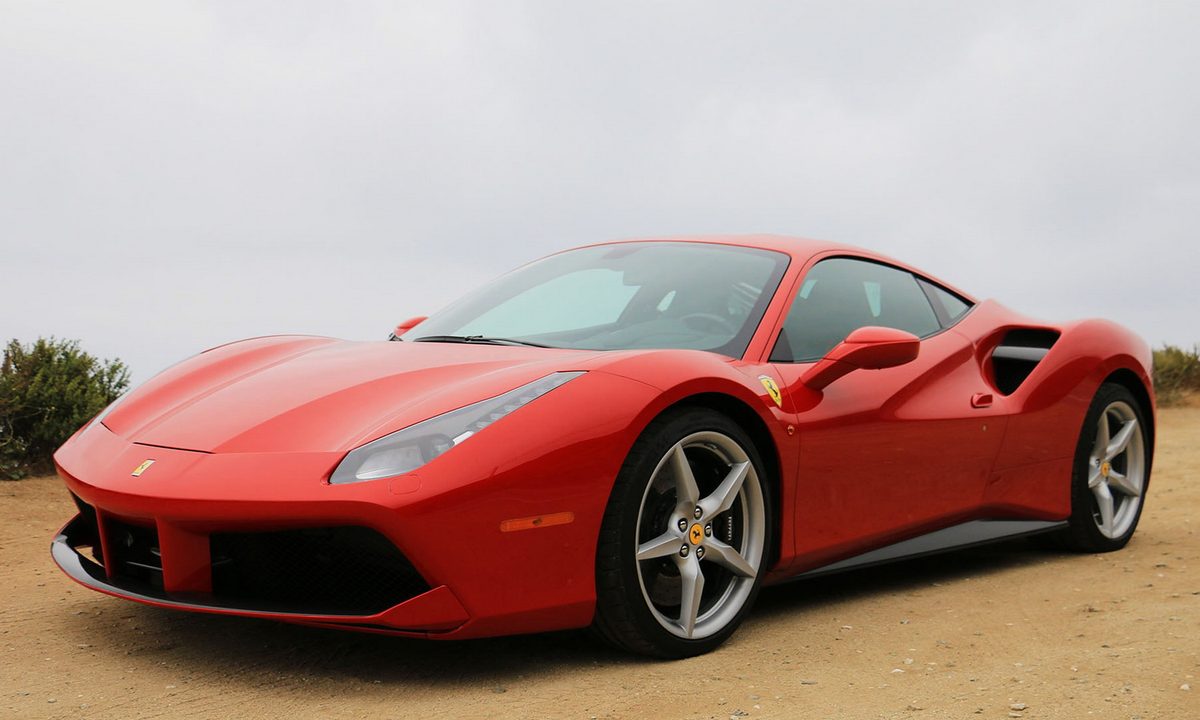
Utilizing the same underbody as the 458 Italia, the 488 GTB’s new design takes some inspiration from the LaFerrari hypercar. Yet its completed figure was largely dictated by a mandate from Matteo Biancalana, Ferrari’s aerodynamics chief, to increase aero downforce by 50 percent versus the 458 Italia while incurring no increase in aerodynamic drag. This function over form approach explains some of the more controversial features of the 488 GTB, like the oddly shaped door handles that are designed to direct airflow into the engine intakes.
The result is a shape that’s simultaneously more aggressive but perhaps less dramatic than the outgoing car, as the gaping ducts on the front and sides of the car make its intentions clear, but also serve to remove some of the overall continuity in its design. Regardless, the 488 GTB’s emotional impact is still unarguably substantial; whether or not the end result is an improvement or a step backward from the car it replaces is largely a subjective matter.
But perhaps the biggest change over the 458 Italia is the switch from that car’s 4.5-liter, naturally aspirated V8 to a 3.9-liter, twin turbocharged eight cylinder mill. Although similar to the power plant found in the California T, the 488 GTB’s motor gets revised cylinder heads, camshaft profiles, pistons and other sundry tidbits, resulting in a maximum output of 660 horsepower and 560 pound-feet of torque, with the latter peaking at a rowdy 3,000 rpm and staying flat all the way to the 488’s 8,000 rpm redline.
That’s 162 pound-feet of torque and nearly a hundred horsepower more than the 458’s motor produced, and from behind the wheel, its performance is more than enough to forgive the more subdued wail from the exhaust. 0 to 60 can be had in three seconds flat, 0 to 124 mph is dispatched in a hair-raising 8.4 seconds, and the 488 GTB will keep pulling all the way to a 205 mph top speed.


As you’d expect, there’s additional revision found throughout the car, including tweaks to both the MagnaRide derived adaptive suspension and Ferrari’s F1-Trac stability control systems that help corral all of that newfound torque in order to keep things progressive and predictable when driven in anger.
On the road
I managed to procure my stint in the 488 GTB during Monterey Car Week, where Casa Ferrari had set up shop just off Pacific Coast Highway at the northern tip of Big Sur. More epic locales for a drive of this nature are few and far between in this part of the world. Using the California coastline as its backdrop, this section of PCH is a twisting, picturesque stretch of tarmac with no shortage of switchbacks, elevation change, and straight-line runs to put the 488 GTB through its paces.
Although the F40 is seen as a legend in Ferrari folklore, the company’s return to turbocharging has been the subject of some consternation. Prodigious output aside, spongy throttle response from turbo lag is of paramount concern, and Ferrari took a number of steps during the design phase of this motor to address that potential pitfall. The twin-scroll, ball bearing turbochargers’ compressor wheels are made of a special titanium alloy in order to reduce rotational inertia while remaining resistant to high temperatures, and the 488’s ECU is programmed to vary engine output in the first three gears in order to give this boosted engine the personality of a naturally aspirated one.
The 488 GTB will keep pulling all the way to a 205 mph top speed.
The result is the most urgent and immediate throttle response I’ve experienced from a turbocharged sports car. With peak torque coming in so low in the rev range, the engine’s power delivery feels linear and consistent, while turbocharger lag is so difficult to identify that it’s essentially a non-issue.
That leaves one to focus on formidable task of actually driving this high performance monster. Near-instantaneous gear changes are dispatched by the paddle-shifted seven speed dual clutch gearbox that’s carried over from the 458, and are fired off in shockingly rapid succession when the generously dipping into the throttle from nearly any reasonably plausible speed on a public road. The 488’s steering is incredibly quick as well as surgically precise and, working in conjunction with Michelin Pilot Super Sport rubber that measures 245/35/R20 up front and 305/30/R20 in the rear, felonious levels of excess speed are such an effortless affair that they’re often only noticed in retrospect.

When it comes time to reign things in the 488 GTB utilizes a set of carbon ceramic brakes that are derived from the LaFerrari. These stoppers have quite a bit of bite at the top of the pedal, as is typical of carbon ceramic setups. While it serves to make the whole driving experience feel that much more immediate, it also requires a more steadied approach around town than conventional systems do. Regardless, pedal feel remained consistent throughout my spirited drive down the California coast, and the considerable braking capability on tap provided the confidence required to truly exploit the 488’s performance.
The complete package
In the realm of super sports cars, the competition is genuinely formidable. The McLaren 650S might be slightly faster, the Lamborghini Huracán slightly more accommodating, and the Porsche 911 Turbo S more attainable, but none of them tie together the elements of the high performance driving experience as successfully as the Ferrari 488 GTB does.
The sounds, the sensations, the visual and aural drama – it’s all here. And, turbocharged or not, the prodigious output of this new boosted V8 is both awe inspiring and masterfully executed. I simply did not tire of the 488’s charms. Instead, I longed for it afterward, with unshakable memories of that yowling flat-plane crank V8 etched into my psyche.
Reality often falls short of promise, but that’s simply not the case with the 488. Beautiful to look at, an immediate pleasure to operate, and an absolute behemoth of a performer, its minor shortcomings are so overwhelmed by its strengths that to harp on them feels petty and misguided. Simply put: The Ferrari 488 GTB is more than worthy of the crown.
Highs
- Superb power delivery
- Jaw-dropping looks
- Comfortable during extended drives
Lows
- Less visceral exhaust note versus than outgoing 458
- Infotainment system underwhelms