
“The Smart buyer lives or works in the city, is challenged to find parking, needs a comfortable and economical car, and never carries more than a few bags of groceries.”
- New dual-clutch transmission
- New turbo engine
- Improved interior
- Tightest turning circle
- Easy parking
- Bouncy suspension
- Minimal storage space
- Big blind spot
“Why you can trust Digital Trends – We have a 20-year history of testing, reviewing, and rating products, services and apps to help you make a sound buying decision. Find out more about how we test and score products.“
It’s hard to think of a car that has been derided as much as the Smart Fortwo. With a host of economy cars offering more space, better performance, and comparable fuel economy for under $20,000, the makers of this diminutive city car needed to raise their game.
That change may have come with the 2016 Smart Fortwo. The new Smart is still a two-passenger “City Car” design, but the latest model has come to market with a long list of new features that could warm detractor’s hearts and minds about the charming urban microcar.
A Whole New Drivetrain
The drivetrain of the last-generation Smart Fortwo was the real weak point. The 1.0-liter engine made only 70 horsepower and 68 pound-feet of torque, and was mated to a semi-automatic five-speed transmission. The result was an excruciating 13.7 second wait to get from 0-60 mph, and the Smart did not deliver substantially better fuel economy.
The new 2016 Smart mercifully discards the old drivetrain for a 0.9-liter turbocharged three-cylinder engine rated at 89 horsepower. That won’t make a horsepower junkie swoon, but the new Smart engine also delivers 100 pound-feet of torque. That torque rating is good enough to push the new Smart from 0-60 in 10.1 seconds with the five-speed manual transmission, or 10.5 seconds with the all-new six-speed dual-clutch gearbox. This is the same style of transmission you’ll pay big money to get with an Audi, BMW or a McLaren, and it works just as nicely in the Smart.


A dual-clutch transmission has separate drive mechanisms for two sets of gears. First, third, and fifth gear use one drive system, and second, fourth, and sixth gear use the other. By keeping each gear on a different drive from its adjacent gears, the transmission is always ready to shift up or down quickly and smoothly.
To maximize the benefits of the new transmission, the new Smart gives you a choice of two shift modes – an Eco mode and a Sport mode. Eco mode is predictably designed to maximize fuel economy, with the attendant tradeoff of crisp driving dynamics. If you put the transmission in Sport mode, the car is responsive and the shifting is smooth.
The new Smart delivers up to 33 mpg in the city, 39 mpg on the highway, and 36 mpg in real-world combined driving. That’s still about the same as the competition, but you’re getting much better performance in exchange for the fuel you burn.
Good things, small package
The 2016 Smart Fortwo has also upgraded its interior, and the new insides are at least on par with the competition, and better than most. The new seats are comfortable, and there’s plenty of headroom for a 6-foot or taller person in either seat. You don’t get a tilting or telescoping steering wheel, but there are wheel-mounted controls.
The new seats are comfortable, and there’s plenty of headroom for a 6-foot or taller person
On the dashboard, you get a 3.5-inch display screen on the driver’s side, with the tach separately mounted up on the left end of the dash. In the center stack, you have your choice of the basic stereo with Bluetooth for hands-free phone use, or you can get the upgraded media system seven-inch display screen. Every Fortwo is designed to integrate with your phone using a free app called Smart Cross Connect. The app includes integrated navigation, tunes, driving information including fuel usage, current speed limit, and a G-analyst.
Every 2016 Smart includes automatic climate control, and the air conditioning works well – there’s an advantage to having an extremely compact passenger compartment: It cools down or heats up quickly.
One area where the Smart will always involve a tradeoff is in cargo capacity. There’s about enough room for two people to pack smallish carry-on bags, but that’s it. The luggage goes on top of the engine and transmission at the back of the car – which is right behind your head.
Tough nut to crack
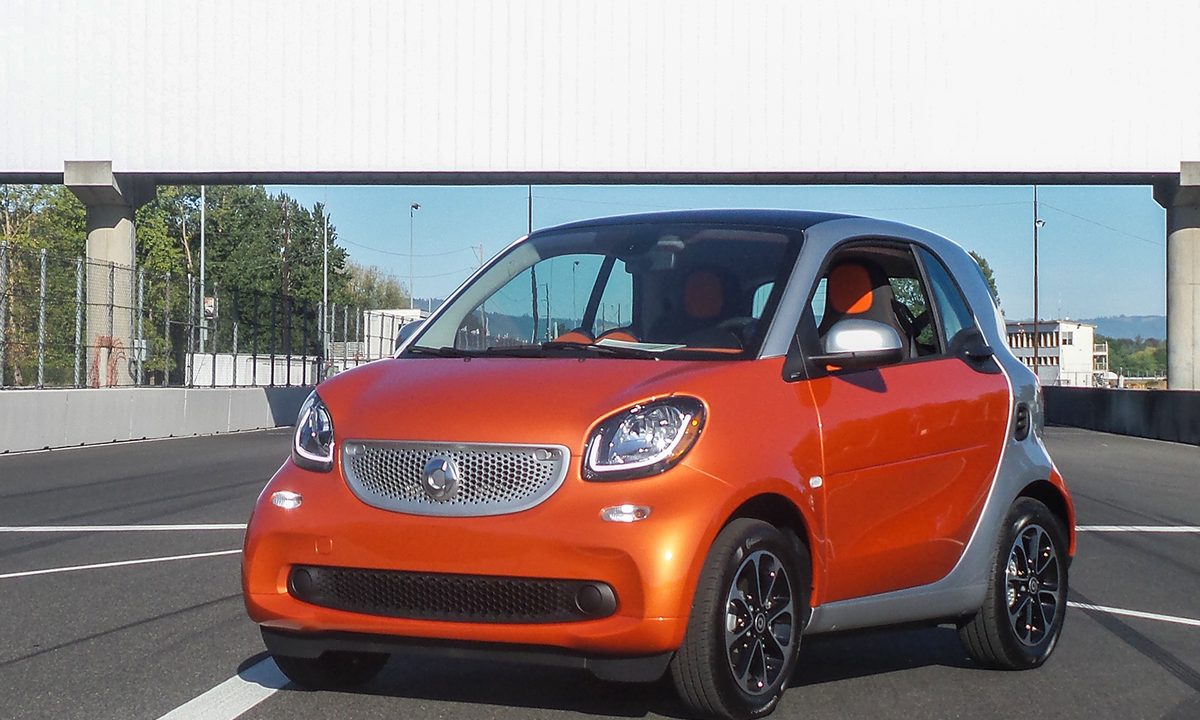
Overall, the 2016 Smart is a better-looking car than the outgoing generation. The new car has a little more bulge in the front end – more like other cars. The wheels are kept out at the corners under flared fenders and the whole package looks more substantial than the older models.

The Tridion safety cell that makes up the bulk of the body was also the cause of my biggest complaint with the 2016 Smart – it has a huge over-the-shoulder blind spot on the right side, because that big structural piece is right there. There’s no getting around it, because the Smart is so small the cell is always going to obscure a sizable angle in your field of vision. A convex side mirror on the right would really improve visibility.
One complaint I had in two days of driving the Smart around an urban environment was a bit of bounciness of the car. This is going to be tough for the Smart people to engineer out, because with a short wheelbase and a lightweight car, your suspension choices range from springy to firm. You can choose firm by adding the Sport suspension option, which gets you stiffer springs and lowers the car by 10mm (0.6 inches).
Different degrees of Smart
The basic 2016 Smart trim level is called Pure. This gets you the automatic climate control system, a 5-speed manual transmission, LED daytime running lights, cruise control, power everything, anti-theft alarm, a decent stereo with Bluetooth for your phone and steering wheel controls, and a trip computer in the 3.5-inch screen mounted between the gauges. You can get into this Smart for $15,400 including the destination fees.
The DT Accessory Pack
Up your game and the get the most out of your gear with the following extras, hand-picked by our editors:
Passion is the next trim level, which gets you some color choices in the interior, along with leather on the steering wheel, power heated mirrors, and a cargo area cover. This model carries a $1,490 premium over the Pure price.
The Prime trim level nets all the aforementioned goodies, plus black leather seats, and leather on the wheel and shift knob. You also get heated seats, LED lights all around, a panoramic sunroof, and fog lights. This trim level costs $2,840 more than the Pure price.
The high-end Proxy line gives you a blue/white interior color combination. This trim level includes all the other stuff, plus the JBL sound system, the Sport suspension package, and 16-inch wheels. The Proxy trim level costs $3,830 over the Pure price.
At any trim level, the dual-clutch transmission will cost you an extra $990. Top trim levels get you a set of paddle shifters with the dual-clutch, but I don’t think they’re necessary.
Fortwo or just for you?
All these upgrades have really made the new 2016 Smart Fortwo a dramatically different and better car than the previous generation. In urban driving, you notice that the size and agility of the Smart gives you a huge advantage in finding parking and tucking into traffic. There’s plenty of engine power to get you around briskly, and you’ll quickly find yourself making snarky comments about the enormous land yacht SUVs lumbering around and getting in your way.
The 2016 Smart Fortwo is strictly personal transportation, and it serves that purpose very well. The Smart buyer lives or works in the city, is challenged to find parking, needs a comfortable and economical car, and never carries more than a few bags of groceries. If that sounds like you, then the 2016 Smart Fortwo should be on your shopping list.
Highs
- New dual-clutch transmission
- New turbo engine
- Improved interior
- Tightest turning circle
- Easy parking
Lows
- Bouncy suspension
- Minimal storage space
- Big blind spot


