
“Why you can trust Digital Trends – We have a 20-year history of testing, reviewing, and rating products, services and apps to help you make a sound buying decision. Find out more about how we test and score products.“
This story is part of our continuing coverage of CES 2020, including tech and gadgets from the showroom floor.
I feel like I’m back at Putt-Putt Golf & Games, age eight, clinging to the plastic sport bikes from the Manx TT arcade game. If only that little kid smeared with pizza grease could see me now, at CES 2020, aboard a VR simulator of what I very sincerely hope is the future of motorcycling.

As I cruise the streets of a crude virtual city, the bike approaches a stop sign. Before I can even drop a leg, the seat below me magically dips several inches into the frame of the bike, bringing my feet closer to the ground below. On takeoff, it picks back up with a mechanical whir. And when I pull onto the highway, the handlebars smoothly snug down, pulling me into an aerodynamic crouch over the gas tank. I’ve owned both sport bikes and cruisers, and somehow I feel as if I’ve just ridden both in the span of 30 seconds.
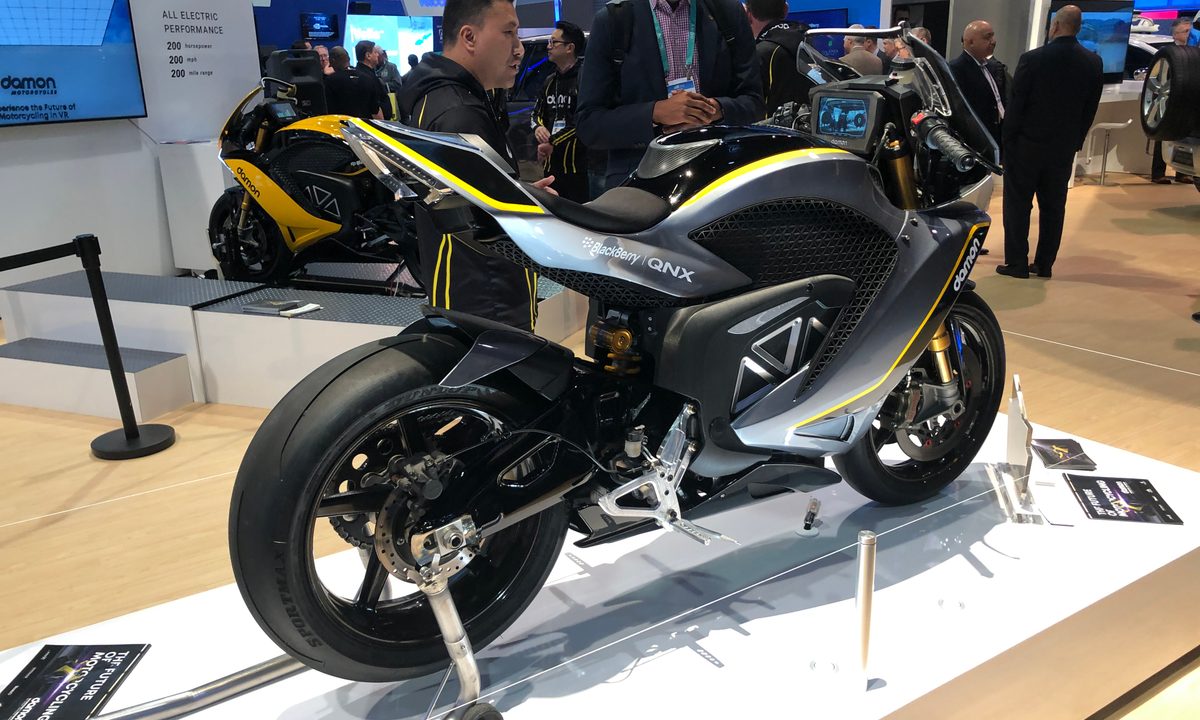
This is what it’s like to ride Damon’s Hypersport, the first motorcycle in the world that can change shape on the fly. Damon calls its technology Shift. “It can transform from a commuter riding position to a sport riding position while in motion,” explains CEO Jay Giraud. The windscreen, handlebars, seat, and foot pegs all move on demand, with one button. “That really allows you to adapt your riding situation to suit any road you’re on, or any traffic conditions that you’re dealing with.”
Aboard the simulator — which you’re not really in control of — it all happens automatically. On production bikes, it happens with a press of the button on the left handlebar. You can either tap it and let the bike shift between full upright and fully crouched, or press, hold, and release it when you’re comfortable. The entire system is electronic, and so carefully hidden that you have to look carefully to see the tiny motors and tracks hidden beneath the plastic bodywork.
Dramatic as the Shift technology is, it’s only one part of what makes the Hypersport unique. The second half is a sophisticated safety suite dubbed CoPilot, which rivals what you would find in a luxury car. The system includes a rear-view camera feed in the cockpit, and 360-degree sensing radar.
Back in the simulator, a car creeps into my blind spot, and a yellow LED atop the windscreen lights up to tell me he’s there. Conditioning kicks in, and I turn my head to see how close he is. Is that … a giant Baby Yoda sticker on the door? Yup. It was a clever way to distract me from the car in front of me, which slams on its brakes as I’m looking away. The bike’s handlebars buzz, I look forward, and I stop just in the nick of time. Contrived demo? Sure, but having nearly experienced this myself in real life, the real-life implications don’t seem nearly as far-fetched.
If the safety and comfort features don’t sell the Hypersport, the performance very likely will: With a 200hp motor, it has a top speed of 200 miles per hour, and a range of 200 miles. That’s more than the 146 miles Harley’s LiveWire can put up, and somehow the Hypersport will retail for less: $24,995 to Harley’s $29,799.
You can put down $100 to pre-order one now, though Damon hasn’t yet revealed when your ride will roll off the line. The first bikes will be built in a facility outside Vancouver, where it claims it can pump out up to 1,500 bikes per year. With enough sales, the company hopes to build another Canadian facility that could handle 10,000. But long-term, Damon’s plans are even bigger.
“We’re a technology company,” explains Giraud. “We’re not an OEM in the way that Triumph for Honda or whoever is.” To reap the benefits of their manufacturing expertise, Damon is looking for a major partner to produce the bikes. It would keep the Damon name intact for electric bikes, but license its Shift and CoPilot technology to its parent company for use in all of their bikes. So a Honda or Yamaha that also transforms? Totally possibly, if they strike the right deal.
And Damon has one more trick up its sleeve, or rather, on the handlebars. There’s a clutch lever — something no electric bike with a single-speed gearbox needs. Which means it does something else entirely. Giraud wouldn’t reveal what it was for, but promised that Damon has one more trick up its sleeve, which it will reveal as soon as its patents come through. In the meantime, your guess is as good as ours.
Follow our live blog for more CES news and announcements.


