Those of us living in extreme climates bump into one common hurdle when it comes to electric vehicles: How will battery life cope with the weather? The further north you go, the more whispers you hear about the catastrophic effect winters have on battery life, rendering your EV little more than an expensive mistake. Let’s take a closer look at how EV batteries react to the cold and compare it to extreme heat effects.
Does cold reduce EV battery life?
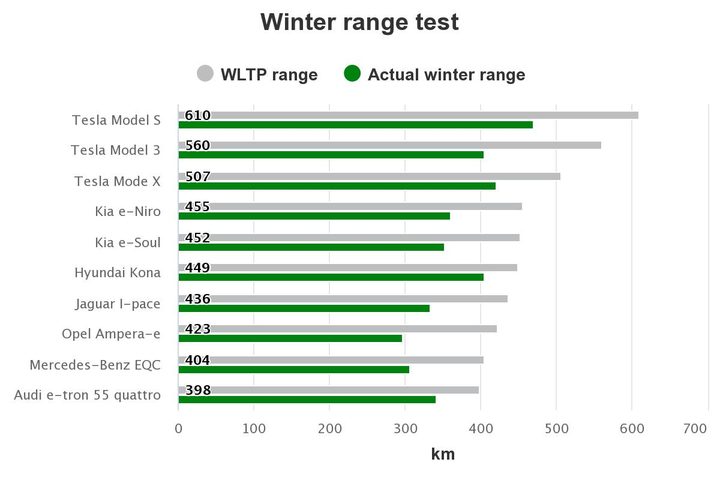
A study of 20 of the bestselling electric car models in Norway shows that the cold reduces range by an average of 18.5% compared to their rated range.
To figure out why, we need to look at the nature of electrical resistance. Resistance is how any given material opposes an electrical current. Metals like copper have low resistance, which is why we use them to make circuits. Meanwhile, rubber has high resistance, so we put it on the outside of cables to prevent users from getting zapped.
When you factor in cabin heating, EV range drops by 41%.
This conductivity is mostly dictated by how much room the atoms of these materials have in their outermost electron layer for more electrons to whiz through. As heat goes up, those atoms start moving a lot more, making it harder for electrons to move across the material efficiently without bumping into one another. On the flip side, a colder material has atoms that aren’t moving around as much, making it easier for electrons to traverse. This phenomenon allows for superconductors, which can hold an electrical charge indefinitely provided the temperature stays super low.
That sounds great, but why then does battery performance plummet in the cold? After all, shouldn’t low temperatures make electrical transmission easier? One problem is that an EV is using a lot of supplementary systems in the cold that they don’t use otherwise. AAA estimates that when you factor in cabin heating, EV range drops by 41%.
Cold negatively affects battery chemistry as well. There are graphite layers at the anode side of a battery cell, between which lithium ions rest. When discharged, those ions cross the liquid electrolyte separator over to the cathode side to meet up with the electrons that have taken the scenic route through the EV motor. The liquid electrolyte gets more viscous with cold and eventually freezes. This state change increases resistance, thus decreasing battery performance.
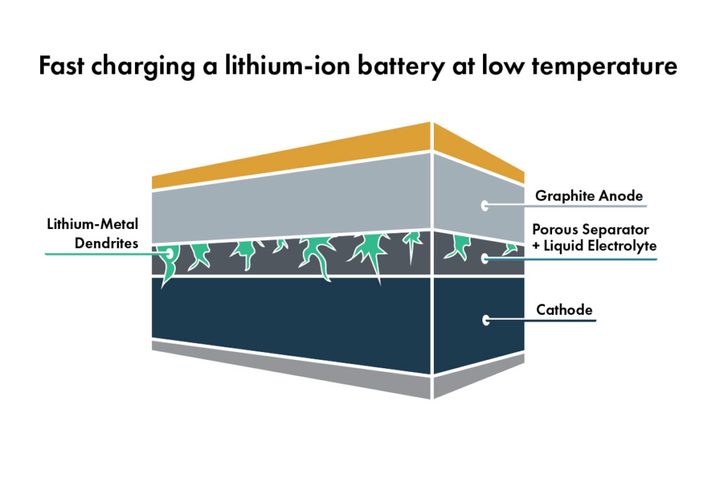
With that increased resistance, lithium ions have a hard time nestling between graphite layers during charging, so they instead begin to plate directly on the surface of the graphite. This lithium builds up over time, especially when fast charging in the cold into structures called dendrites. Those dendrites make it harder for ions to properly settle between graphite layers in the future, reducing your maximum battery capacity. Worse still, if those dendrites get big enough to pierce the anode/cathode separator layer, your battery short circuits and it’s kaput. EV battery packs have thermal layers woven throughout their cells to regulate temperature, avoid the accelerated growth of dendrites, and maintain conductivity of electrolytes at low temperatures, but you’d often be lucky to break even on the power needed to heat batteries to a usable level.
The advent of solid-state batteries may someday help us avoid the problems of a solid-liquid shift in electrolytes. That said, dendrites will still be a long-term issue, plus solid-state batteries still need relatively high temperatures to conduct power. Let’s cross our fingers for future advancements.
Heating is one area where gas cars have a distinct advantage. Internal combustion engines waste about 60% of their energy as heat, much of which is cycled back into the cabin for heating during winter. Summers are a bit more work, but even then, air conditioning shouldn’t affect mileage by more than 20%.
Does heat reduce EV battery capacity?
As bad as cold sounds, extreme heat is even worse for EV batteries. High heat initiates chemical reactions that produce gas and other byproducts that deteriorate a battery’s ability to charge. That gas can then expand and breach a battery cell casing. This is why you’ll sometimes see “spicy pillows” — bloated batteries on the brink of failure — in personal electronics. In the worst case, this volatility leads to explosions, though EV battery management systems are advanced enough to give warnings well before things get that bad.
Despite needing a fairly comfortable temperature range to operate EV batteries, range has improved considerably from earlier years. Even with steep cuts in range, you should still be fine for day-to-day urban driving with an EV in winter. If range anxiety is still hard to overcome before taking the plunge, consider a hybrid so you can have that gas backup when things get especially cold.