
Segways. Ebikes. Hoverboards. The field of personal transportation is a booming one, and likely to remain one for some time: By some estimates, the personal transportation device market is forecast to grow to nearly 25 million owners by 2020. The problem? Supplying power to the devices on which all those folks will be riding, and doing so safely. But ambitious startup Immotor is proposing a solution: the Immotor Go scooter and its companion modular power cell, the Super Battery.
Immotor isn’t your average mobility company. It’s helmed by executive-turned-entrepreneur Daniel Huang, former CEO of mobile device company Mophie, whose founding goal was nothing less than an entirely new category of personal transportation. He envisioned a internet-connected scooter that would put features like turn-by-turn directions and cruise control at riders’ fingertips, but crucially one with a power delivery method energy-efficient, replaceable, and resistant to wear and tear. Years of research and development later, Huang’s unveiled the realization of that dream in the Immotor Go.
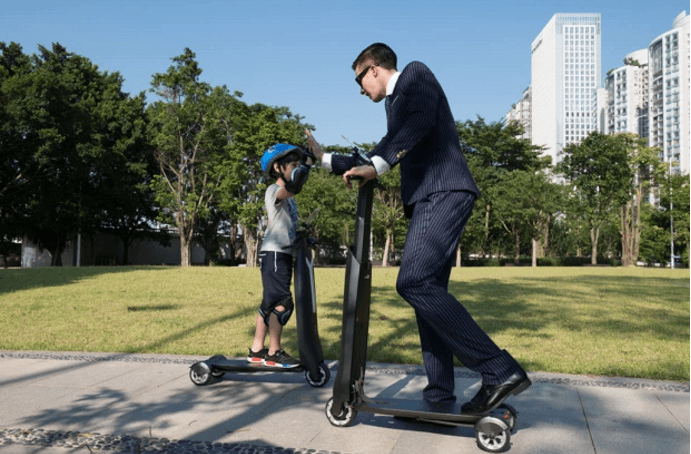
Miraculously, the Immotor Go isn’t all that different from Huang’s initial concept. On the outside, it’s deceptively simple: a slim, compact scooter that folds up like carry-on luggage for easy transportation. But under the hood is an abundance of machine intelligence.
The Immotor Go runs an operating system with built-in safety protocols, self-diagnostic features linked to the company’s customer service centers, and GPS capabilities. And it’s a thoroughly customizable ride: the scooter sports a USB port in the handlebar and buttons for taking selfies with your smartphone’s camera, or pictures of your surroundings, or even live video, and three distinct modes of operation designed around specific use cases. There’s Rider mode, which suits “basic,” everyday commutes and joyrides of up to 19 miles per hour, and Power Assist, which turns the scooter into a sort of electronic pack mule for “hauling heavy objects.” Finally, there’s a self-descriptive Folded mode that folds the scooter it in half for easy transportation.
Much of the Immotor Go’s hardware can be controlled via a smartphone. From its companion app, you can power the scooter on or off, turn up or down the volume, and dim or brighten the headlight. There’s a parental control that lets you prevent unauthorized user from riding unsupervised, and a tracking tool for pinning down its precise location. And those features will improve over time — Immotor is pledging free, over-the-air firmware upgrades that will deliver “user experience” enhancements and “greater customization.”
The scooter’s only half the innovation. The other half’s the Super Battery, a modular, 99-watt cylindrical metal battery that looks a bit like a miniature oxygen tank. It’s sleekly simplistic, but there’s more to it than meets the eye. A custom battery management system detects the amount of power required by the device to which it’s attached and regulates draw accordingly, optimizing for energy efficiency. Meanwhile, “dozens” of safety routines, including “accident awareness” and “safety intelligence with auto-shutdown,” protect against short-circuiting and hard impacts. In fact, Immotor claims it’s safe enough to take on an airplane.
The Super Battery’s real magic, though, happens when the battery’s removed from the scooter. It automatically cuts off the flow of electricity, and if you have spares on hand, it works in parallel to extend battery power or provide additional power for “more demanding tasks.” But perhaps most intruigingly, it ships with a standalone module with attachments for smartphones, laptops, and traditional devices like hair dryers, fans, and portable radios.
That’s just the start. Immotor’s maintaining an “open” policy around the Super Battery’s interface, and it’s actively encouraging third parties to implement the standard. “We recognize the demand for safe and innovative battery-powered transport systems,” Immotor chief Daniel Huang said in a statement. “For some time now, most of the new electric transports are being built using heavy, old batteries — and primarily using existing product designs. With Immotor GO we wanted to introduce something new.”
If a slick electric scooter with an innovative power platform whets your whistle, you won’t have long to wait — the Immotor Go’s launching on Indiegogo ahead of a March or April 2017 ship date. Early bird packages, which include both an Immotor Go scooter and one 99-watt Super Battery and AC adapter, start at at the discounted price of $400 — a package that will eventually climb to $600 as the crowdfunding campaign progresses.


