
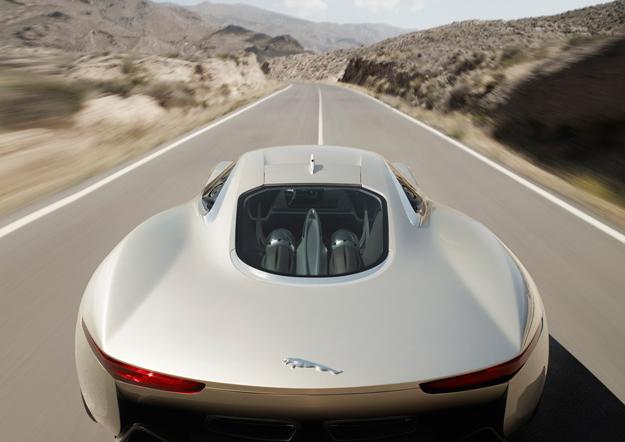
Bringing concept cars to market isn’t an easy thing to do. Thinking outside the proverbial automotive box doesn’t always come naturally for every automaker, either. But when you have a history with concepts like Jaguar does — it isn’t all that surprising to learn that the house that brought you the XJ 220–a refreshing and impressive car, even by today’s standards–is at it again with another revolutionary concept. And like its beloved and beleaguered predecessor, it’s making its way to production.
A drive down memory lane
For a very brief automotive refresher, back In 1992 Jaguar began to produce what was at the time the world’s fastest car (217 mph), the XJ 220. The Jaguar XJ 220 originally began life as a concept vehicle debuting at the 1988 British Motor Show, but due to overwhelming acclaim and demand was converted from concept to production and rolled out of the factories four years later. The original concept used an extremely powerful quad-cam 6.2-liter version of Jaguar’s V12 engine. The name “XJ 220” was used as a reference to the vehicles intended top speed of 220 miles per hour.
After feasibility tests were conducted by Jaguar and the green light given to produce the car a number of alterations were made. Gone was the concepts impressive V12 engine in favor of a smaller, but still powerful V6 twin turbo, two-wheel drive instead of the original all-wheel drive, and a slightly reworked form factor with a sticker price of $580,000.

When Jaguar announced in 1989 that it would limit production to only 350, many rushed to place orders, among those that put down deposits were spectators hoping to turn a profit once the limited numbers of cars were released and demand increased. This proved problematic for Jaguar down the road and caused many, due in part to the global economic recession of 1992, to attempt to back out of their intention and commitments to purchase the XJ 220, which in turn lead to more than a few litigation proceedings between Jaguar and these disgruntled customers.
While the Jaguar XJ 220 was an automotive and engineering success, it wasn’t the great paragon of financial success the company had hoped for.

Fast forward to today Jaguar and things aren’t all that different. Having survived bankruptcy and changing ownership from Ford to Indian company Tata Motors, the luxury and performance icon of British auto world is at it again, making headlines for all the right reasons.
Cool your jets
Last year, Jaguar announced that its jaw-droppingly beautiful C-X75 would make the leap from concept to production. Apart from its dashing good looks, the C-X75 was of note because of its twin micro-gas turbines that would be utilized to charge the supercar’s four electric motors batteries. Impressively, these four electric motors were designed to produce 195 horsepower at each wheel.
When making that announcement, Jaguar was sure to include the fact that the turbines would not be coming along for the ride. Or so we thought. In a recent Auto Express article , it now appears that while the vast majority of C-X75’s will feature a modified hybrid drivetrain consisting of a four-cylinder turbocharged engine, a very limited amount will include the originally designed micro-turbines. According to Jaguar, these small jet engines will deliver about 95 horsepower to each of the car’s rear wheels, and in conjunction with the rest of the cars planned power supply, help the C-X75 sprint to 60 in about three seconds.

Of course as the old saying goes, “all good things come to those who wait” and sadly it looks like we may be waiting a bit until the C-X75 hits the market, but in the meantime, we can’t help but feel Jaguar has an innovative and, above all, worthy successor to its automotive legacy, much like it had with the inspiring XJ 220.


