
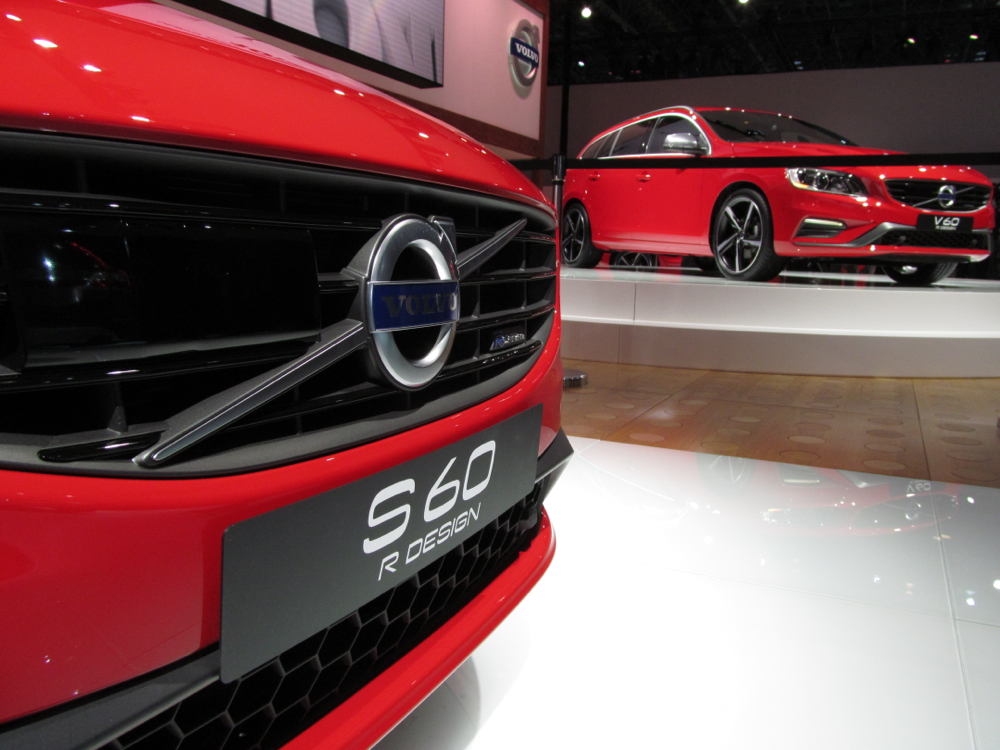
 Volvo pulled a bait-and-switch on us. We were expecting to see the V60 diesel plug-in hybrid at the Volvo stand for the 2013 New York Auto Show, but the Swedes sent the 2014 V60 R Design instead. Still, a wagon’s a wagon, right?
The V60 marks the return of a traditional station wagon to Volvo’s United States lineup (the body-cladded Cross Country doesn’t count). It may not sound too exciting, but Volvo made its reputation building solid station wagons, so we’re happy to see a return to form.
The V60 is a sports wagon (Volvo’s term) version of the S60 sedan, and shares that car’s curvaceous styling, with some slight tweaks for this R Design model.
The R Design is supposed to add a little excitement to an otherwise staid vehicle. While the 3.0-liter turbocharged inline-six engine is mechanically identical to the one in other Volvos, there is a Polestar software package that boosts output to 329 horsepower, an addition of 25 hp. Zero to 100 kph (0 to 62 mph) takes 6.0 seconds.
The R Design also gets a stiffened chassis and 15mm lower ride height for enhanced handling.
Since this is a Volvo, safety is also paramount. Volvo is adding a Cyclist Detection feature to its automatic braking system, which can already stop a car without any driver intervention if it detects a pedestrian.
Volvo has taught the system to look out for cyclists as well, which should be a handy feature here in New York, where a new bicycle lane opens every day.
 Active High Beam Control automatically switches between high and low beam during night driving, because tugging on a stalk is apparently too hard/distracting for some drivers.
Inside, the V60 reaps the obvious utility benefits of its wagon body. Split 40/20/20 folding rear seats should make loading cargo a breeze.
Tech features include a configurable TFT gauge cluster and Volvo’s Sensus infotainment system. The latter will be available with a voice-controlled Spotify app.
Volvo will also offer an S60 and XC60 R Design for the 2014 model year. All three R Design models will go on sale later this year. Cyclist Detection will be available on all Volvo models beginning in May 2013.


