
Shortly after Tesla co-founder and CEO Elon Musk sent shock waves across the automotive industry and down Wall Street when he revealed he wanted to take the company private, rumors began circulating that Saudi Arabia’s sovereign wealth fund would invest not in Tesla, but in upstart Lucid Motors. Those rumors have been confirmed, as Lucid has accepted a $1 billion investment from the Saudi Public Investment Fund (PIF). However, Lucid has also pushed back the launch of its first production model — the Air.
“By investing in the rapidly expanding electric vehicle market, PIF is gaining exposure to long-term growth opportunities, supporting innovation and technological development, and driving revenue and sectorial diversification for the Kingdom of Saudi Arabia,” a PIF spokesperson said in a statement.
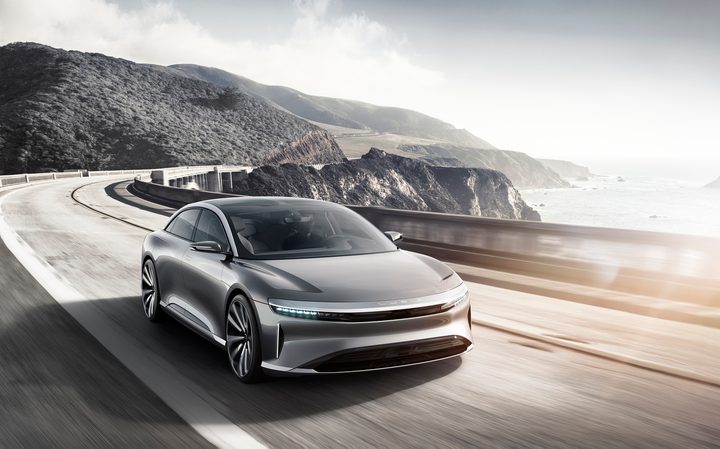
The deal would benefit both sides. On one hand, Lucid would receive the cash injection it needs to start production of the Air, the 22nd-century-esque concept car (pictured) it has shown at events all over the world. The Air will be the company’s first production car so making it a reality is a challenging and expensive process. On the other hand, the investment fund would continue the process of future-proofing its assets portfolio by moving away from crude oil.
Lucid plans to use this investment to finish development work on the Air, and to complete a factory in Casa Grande, Arizona. In a press release announcing the investment, Lucid said the car would launch in 2020. The automaker originally targeted a 2018 launch date, but missing deadlines has become common for fledgling electric automakers. New companies often don’t realize how difficult building and selling cars can be.
The Air may very well be worth the wait. In 2017 Lucid announced a base price of $60,000 for a rear-wheel drive model with 400 horsepower and 240 miles of range. But Lucid also plans to offer a high-end version with all-wheel drive, 1,000 hp, and a range of 400 miles for somewhere north of $100,000. A prototype Air hit 235 mph on an Ohio test track in 2017. But Lucid needs to hurry up, as it faces competition not only from the likes of Tesla and startups such as Faraday Future and Nio, but also established automakers launching their own luxury electric cars.
Updated on September 18, 2018: Added confirmation of investment in Lucid Motors by Saudi PIF.


