  1. Home
  2. Cars
  3. Legacy Archives

Stirling Moss’ 1962 Ferrari 250 GTO becomes world’s most expensive car

Add as a preferred source on Google
Stirling Moss' 1962 Ferrari 250 GTO becomes world's most expensive car
Image used with permission by copyright holder

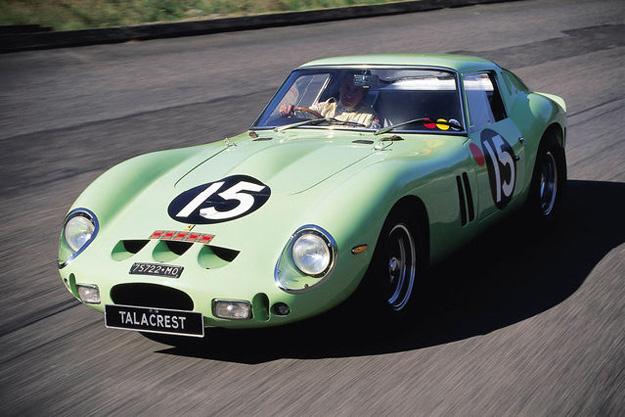
A 1962 Ferrari 250 GTO has recently become the world’s most expensive car after being sold for $35 million, Bloomberg reports. The record-breaking price trumps the previous princely sum of $32 million paid for a 1964 Ferrari 250 GTO back in February, and the $30-34 million paid in 2010 for a 1936 Bugatti Type 57SC Atlantic.

On top of setting the world’s record for most expensive car, the 1962 Ferrari 250 GTO also has the honorary distinction of being built specifically for British racing legend Stirling Moss. Despite the fact that Moss never actually raced the classic Ferrari (his career was tragically cut short after a crash in 1962 left him in a coma for a month), the car carries a respectable racing pedigree – having won a number of races in its day. The $35 million 1962 Ferrari 250 GTO features a distinct lime-green livery and is one of 39 examples built between 1962 and 1964.

Recommended Videos

Interestingly the car’s title has passed hands on more than one occasion with the latest owner, U.S.-based classic car collector Craig McCaw, purchasing it from Dutch-born businessman Eric Heerema, owner of Nyetimber vineyard in Sussex, southern England. Heerema, who purchased the green GTO nearly a decade ago for $8.5 million, will no doubt be pleased with the return on his investment.

And although spending a small fortune on a single car is likely out of reach for the vast majority of us, we can’t see McCaw hurting over his $35 million purchase either. McCaw was the co-founder McCaw Cellular, which he later sold to AT&T for cool $11.5 billion back in 1993.

In what could be credited as a clear testament to Maranello’s excellence in engineering, Stirling Moss’ 1962 250 GTO is but one of many big-ticket Ferrari’s sales to go through private transactions during the last two months. A Ferrari 250 Testa Rossa in which U.S. driver Phil Hill won the 1958 Le Mans 24-Hour race was recently sold by French collector Pierre Bardinon for about $25 million, while a Ferrari 250 GTO bought by U.K. television host Chris Evans for a handsome $18 million in 2010 was recently said to have sold somewhere in the region of $25-29 million. 

Amir Iliaifar
Former Associate Automotive Editor
Associate Automotive Section Editor for Digital Trends, Amir Iliaifar covers the ever increasing cross-section between tech…
iOS 26.4 adds ChatGPT to you car’s infotainment screen
Apple's iOS 26.4 brings ChatGPT, Gemini, and Claude to your car's screen, adds calming ambient music widgets, and previews the in-car video future that drivers have been waiting for.
CarPlay shown in March 2025.

Apple rolled out iOS 26.4 recently, and while your iPhone got several upgrades, CarPlay quietly had one of its best days in years. The latest iPhone updates bring two meaningful features that can change the way you use CarPlay on your car’s infotainment screen. 

Would you use ChatGPT while driving?

Read more
Sony and Honda’s electric car dream with Afeela series is officially dead 
Sony Honda Mobility has shelved the Afeela 1 and its follow-up, and the EV market has another high-profile casualty.
Machine, Wheel, Adult

Sony and Honda’s shared dream of launching an electric car has just come to an end. The joint venture between the two brands — Sony Honda Mobility — has just announced that plans for the upcoming Afeela 1 electric car have been shelved. Additionally, the follow-up model has been nixed from the roadmap. 

But why did the Afeela go?

Read more
This AI checks if your driving habits signal crash risk
Researchers say eye tracking, heart rate, and personality data can flag risk early.
Person, Wristwatch, Car

A new AI model is taking aim at a question most drivers don’t ask soon enough. How likely are you to crash before you even start the engine?

The system looks at how you behave behind the wheel, pulling in signals like eye movement, heart rate, and personality traits to flag warning patterns early. Instead of waiting for real-world mistakes, it relies on simulated driving tests to surface behaviors linked to dangerous outcomes.

Read more