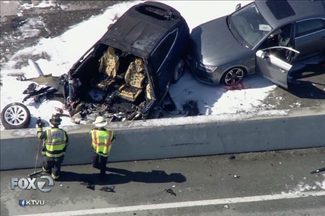
On Friday, March 23, a Tesla Model X crashed into a concrete divider on U.S. Highway 101 in Mountain View, California. The driver died as a result of the crash — which occurred despite numerous warnings, the car company said.
Now, the National Transportation Safety Board has released its own preliminary report about the crash, noting that the driver did not have his hands on the steering wheel for a full six seconds before the vehicle crashed into the barricade. The NTSB also concluded that the Tesla Model X had its Autopilot function on and engaged during the crash.
The federal agency’s report does not differ from Tesla’s own investigation into the crash, though the NTSB has yet to point to a concrete decision about what ultimately caused the fatal accident. In the report, investigators note that all “aspects of the crash remain under investigation as the NTSB determines the probable cause, with the intent of issuing safety recommendations to prevent similar crashes.”
Some new details that have emerged from the NTSB include that the Autopilot feature was set to maintain a driving speed of 75 mph. We also now know that about eight seconds before the crash, the car was behind another vehicle moving at 65 mph, which probably caused the Model X to slow down a bit. Four seconds before the collision, however, the Tesla stopped following the aforementioned vehicle, causing it to accelerate just before it hit the barricade.
Prior to the crash, the Model X did send two visual and an auditory cue to the driver to take the wheel. “These alerts were made more than 15 minutes prior to the crash,” the NTSB noted.
In Tesla’s initial report following the accident, the company included photos of a crash attenuator at the accident site before retrieving the car’s computer logs. One photo shows the safety device appearing in proper condition on an unstated date. The second image, taken on March 22 by a dash cam in a car driven by a witness to the accident, shows the same barrier crushed from an earlier crash.


According to Tesla, “the reason this crash was so severe is that the crash attenuator, a highway safety barrier which is designed to reduce the impact into a concrete lane divider, had either been removed or crushed in a prior accident without being replaced.”
In a follow-up report after Tesla retrieved the car’s logs, the company stated, “In the moments before the collision, which occurred at 9:27 a.m. on Friday, March 23, Autopilot was engaged with the adaptive cruise control follow-distance set to minimum. The driver had received several visual and one audible hands-on warning earlier in the drive and the driver’s hands were not detected on the wheel for six seconds prior to the collision. The driver had about five seconds and 150 meters of unobstructed view of the concrete divider with the crushed crash attenuator, but the vehicle logs show that no action was taken.”
Reacting to criticism that Tesla lacks empathy for crash tragedy when it quotes the relative statistical safety of driving in Telsa vehicles, the company stated, “Nothing could be further from the truth. We care deeply for and feel indebted to those who chose to put their trust in us. However, we must also care about people now and in the future whose lives may be saved if they know that Autopilot improves safety. None of this changes how devastating an event like this is or how much we feel for our customer’s family and friends. We are incredibly sorry for their loss.”
Tesla’s Autopilot warnings, and the company’s admonitions about not using the system without keeping hands on the wheel and eyes on the road, do not mean the system is safe from misuse. Following the first Tesla fatality in 2016, the National Traffic Safety Board reported the driver was at fault for not paying attention and for “overreliance on vehicle automation.” The NTSB also reported at the time that Tesla “could have taken further steps to prevent the system’s misuse,” Reuters reported.
The National Highway Traffic Safety Administration (NHTSA) is also investigating the accident.
Human error is widely considered at least partially responsible for more than 90 percent of fatal accidents each year, as documented by a study published by Stanford Law School. Tesla states there is one automobile fatality for all vehicles for every 86 million driving miles, but one fatality for every 320 million miles with Teslas equipped with Autopilot hardware. According to Tesla’s figures, Tesla drivers with Autopilot hardware are 3.7 times less likely to be in a fatal accident.
Updated on June 8 to include findings from the NTSB’s investigation.