
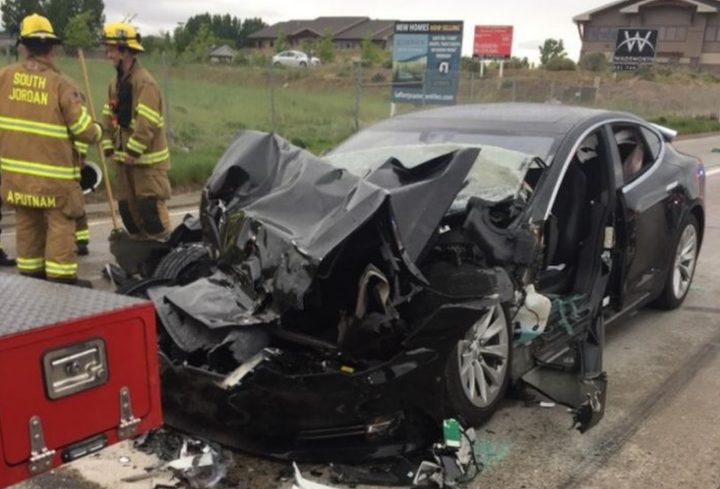
The driver of a Tesla Model S is lucky to be alive after she rammed into the back of a parked fire truck in South Jordan, a suburb of Salt Lake City, Utah at about 60 mph. The accident happened on Friday, May 11, according to local media reports. The driver had Autopilot turned on before the impact but police investigators have now blamed distracted driving, not technology.
Examining the vehicle logs — almost like a plane’s black box but for cars — reveals the driver repeatedly turned the Tesla’s Autosteer and Traffic Aware Cruise Control features on and off in the moments leading up to the crash. She took her hands off the steering wheel for more than a minute on two separate occasions and admitted she was looking down at her phone while driving. The California-based automaker has repeatedly emphasized drivers must keep their eyes on the road and their hands on the steering wheel at all times, even when using Autopilot.
“About one minute and 22 seconds before the crash, she re-enabled Autosteer and cruise control, and then, within two seconds, took her hands off the steering wheel again. She did not touch the steering wheel for the next 80 seconds until the crash happened; this is consistent with her admission that she was looking at her phone at the time,” the police wrote, according to website The Truth About Cars.
Witnesses told the police the Tesla made no attempt to stop or slow down before it hit the truck. The logs revealed the driver pressed the brake pedal fractions of a second before the impact. It was too little, too late. The South Jordan police ticketed the driver for “failure to keep proper lookout.”
This leaves one important question unanswered: why didn’t the Tesla brake on its own? The armada of on-board sensors, cameras, and radars should have detected the imminent impact with an object of not-insignificant size and automatically applied the brakes to at least mitigate the collision. Tesla hasn’t commented on this point. The National Highway Traffic Safety Administration (NHTSA) sent a team to investigate the crash.
An ambulance took the 28-year-old driver of the Model S to the hospital with a broken right ankle. Her injuries are not life-threatening, which is a small miracle considering the severity of the accident. The impact completely destroyed the Model S’ front end and somehow ripped off the driver-side door, totaling the sedan. The fire truck and its driver fared much better. The person behind the wheel complained of neck and back pain but required no treatment and drove off in the same truck that got rear-ended.
If you’re experiencing déjà vu, it’s likely because this isn’t the first time a Tesla rammed into a parked fire truck this year. In January, a Model S traveling at about 65 mph rear-ended a fire engine parked on the interstate in Culver City, California. The driver blamed Autopilot. The investigation into the cause of the accident remains open as of early May.
The news of the Utah crash certainly didn’t please Tesla co-founder and CEO Elon Musk.
“It’s super messed up that a Tesla crash resulting in a broken ankle is front page news and the ~40,000 people who died in US auto accidents alone in past year get almost no coverage,” he wrote on Twitter. He accurately added an impact at that speed usually results in severe injury or death.
It’s super messed up that a Tesla crash resulting in a broken ankle is front page news and the ~40,000 people who died in US auto accidents alone in past year get almost no coverage https://t.co/6gD8MzD6VU
— Elon Musk (@elonmusk) May 14, 2018
He’s spoken out about the media’s coverage of Tesla crashes before. During a controversial earnings call, the executive revealed he’s tired of the bad press surrounding Tesla accidents and pledged to release quarterly safety reports to persuade the public and the press that its cars are safe. We’ll see the first report at the end of the second quarter.
South Jordan police sergeant Samuel Winkler stressed drivers need to understand what their car is — and, importantly, isn’t — capable of.
“[Drivers] believe these vehicles will do more than they’re capable of. We would like them to be cautious and double-check their owner’s manuals to see exactly what these features can and can’t do, and if they should be used on certain roads and not on others,” he said.


