
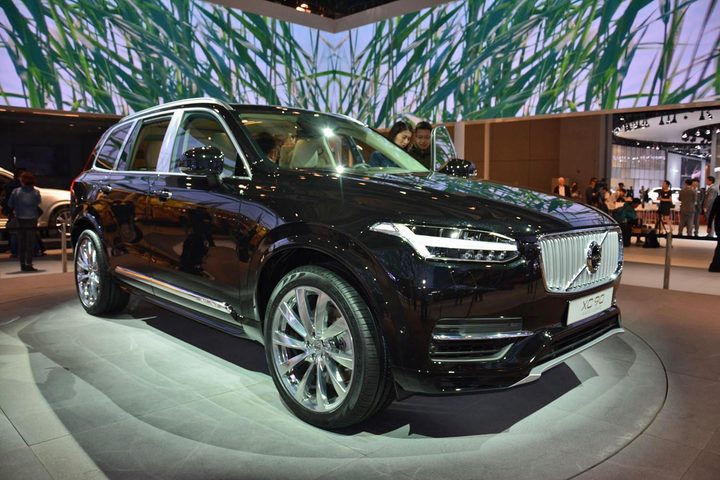
By 2021, you could be sitting behind the wheel of a truly driverless Volvo. The Swedish automaker’s research and development chief recently told The Car Connection that the company is planning to sell a Level 4 self-driving crossover SUV in 2021. Level 4 autonomy describes cars that can drive themselves without any human interaction, other than entering a final destination.
According to Volvo Senior Vice President Henrik Green, the next-generation XC90 will be assembled near Charleston, South Carolina, and should be able to take “sleeping passengers” from Point A to Point B. Of course, only limited roadways would be eligible for these cars to drive on, but even so, this could be a huge step forward in the world of autonomous vehicles. According to Green, the goal, for now, is to partially automate commutes.
The proposed technology would be dubbed Highway Assist, which sounds a whole lot like Pilot Assist, a feature Volvo already supports on its existing models. But don’t assume that Highway Assist will come standard on Volvo vehicles — rather, it would be a premium addition to the XC90, and would set back dedicated drivers (or non-drivers, as it were) “four figures.” Of course, that leaves quite a range to be considered, and we’ve yet to find out a concrete price tag.
Level 4 semi-self driving technology is not currently available to the public and is particularly differentiable in that it does not default to human driver control should emergency action be required. While Volvo has tested similar systems in and around its headquarters in Gothenburg, Sweden, it hasn’t done any such testing in the U.S.
Green further noted that the new Highway Assist feature would leverage information based in the cloud, like map data, in order to steer and route the car. It would not rely on vehicle-to-infrastructure communication systems, The Car Connection reports. Rather, Highway Assist would depend upon lidar, radar, and onboard cameras.
Volvo will have to work closely with both national and state regulators in order to win the green light for the autonomous system, which has presented a challenge to other carmakers. But it has three years to do it in order to make good on its promise.


