
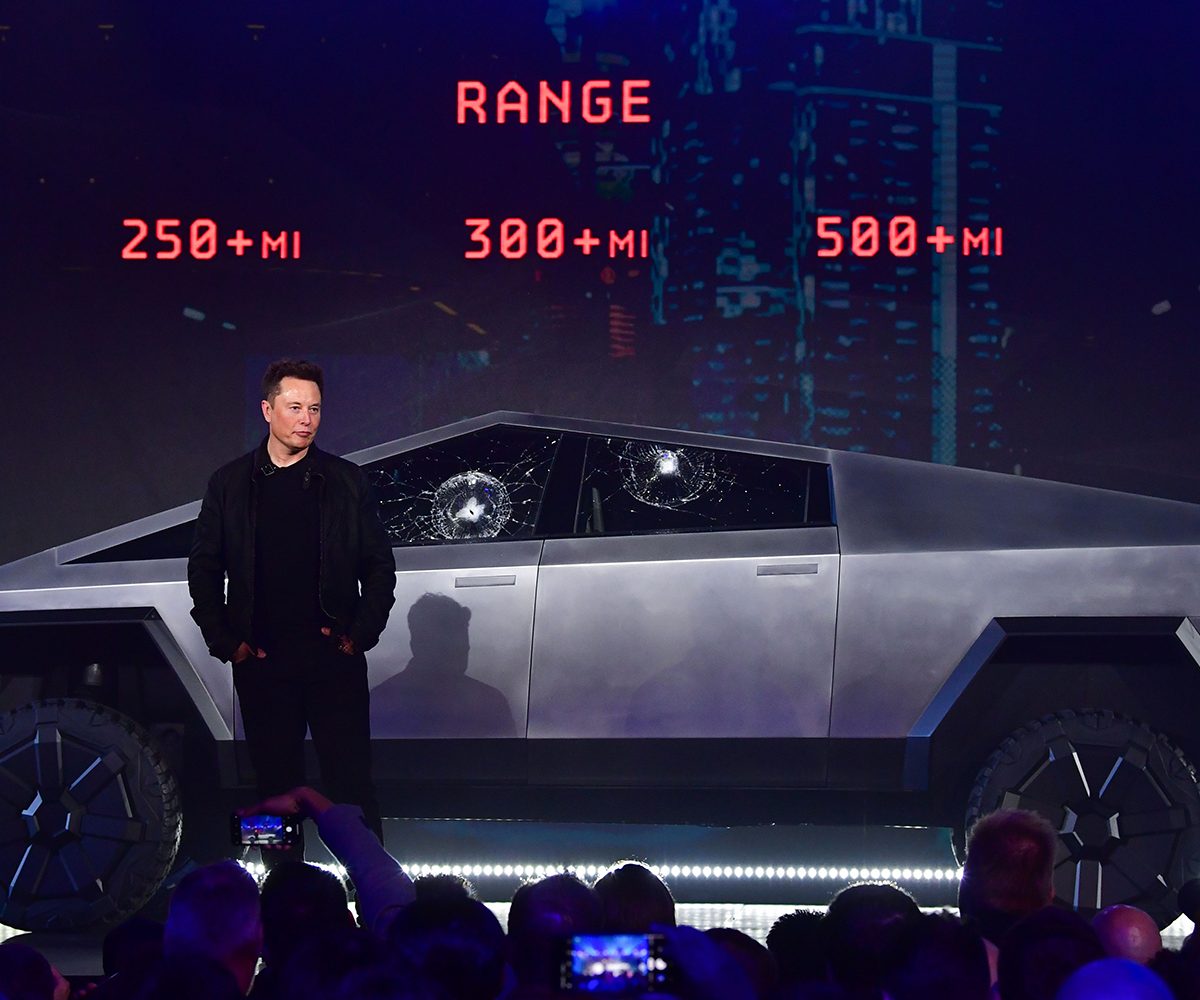
“Oh my f****** god” is exactly the reaction you’re looking for when you present a revolutionary new product at a keynote event. Ideally, though, you’re hoping it’ll be spoken in rapt admiration by members of the audience; not uttered in my-net-worth-is-flashing-before-my-eyes shock by the presenter (and CEO) after a large ball bearing has broken the armor glass window his new Cybertruck. Twice.
Unfortunately, that’s the situation Tesla CEO Elon Musk found himself in during last week’s Cybertruck unveiling. But why did this happen? Here are a few possible explanations.
Start with the windows, not the door
Remember the scene from The Dark Knight when Heath Ledger’s Joker advises Batman to never start an interrogation by hitting someone in the head because the victim gets all fuzzy? Well, when it comes to carrying out an on-stage stress test of a futuristic-looking pickup truck it seems that you should start with the window before hammering the door with a sledgehammer.
At least, that’s according to Elon Musk, who claims that the reason for the broken windows was that they had already been damaged by the sledgehammer attack on the cybertruck’s door prior to having a ball bearing thrown at them.
“Sledgehammer impact on door cracked base of glass, which is why steel ball didn’t bounce off,” Musk tweeted. “Should have done steel ball on window, *then* sledgehammer the door. Next time…” This explanation would certainly explain why the windows held up fine against the ball bearing toss in rehearsals; presumably because they weren’t also being subjected to a sledgehammer assault.
Only the front windows were armor glass
Musk’s explanation makes a whole lot of sense. However, it doesn’t necessarily explain why the back window broke as well, even though only the front door panel sustained a sledgehammer battering.
A working theory here is that only the front window featured the armor glass. Tesla engineers weren’t expecting this window to be used as a demo and so didn’t install it. Musk was unaware of this and decided to use it as a backup. Needless to say, it didn’t go according to plan.
They threw the ball bearing too darn hard
People get excited when they’re up in front of a big crowd of fanboys and gals. The “throw the ball bearing at the window” test had been carried out at least five times before it was done in front of a crowd, apparently without breaking the window in the process.

But the GIF that Elon Musk shared on Twitter looks to be a decidedly slower pitch (yes, even taking into account the slow motion) than the couple carried out during the live event. During the event, Musk even says, “maybe that was a little too hard.”
On one level, this theory isn’t a theory at all: It was obviously too hard for the windows to withstand. The question is whether it was too hard in isolation, or too hard because the windows had already been damaged.
That’s what bullet proof glass does
Bullets don’t endlessly ricochet off bullet proof glass the way they do in the movies. Traditional bullet proof glass does crack on impact, but only the top layers, stopping the projectile from passing through. During his presentation, Musk did note that the ball bearing “didn’t go through,” suggesting that this is the way the windows were supposed to work.
The problems with this theory, other than Musk’s disappointed reaction? Namely that this glass is not bulletproof. The bigger hole (no pun intended) in the suggestion is that Musk has seen released footage showing how the test was meant to go. Suffice to say, it wasn’t like this.
Shouldn’t have clamped it down
Don’t judge a book by its cover. And don’t judge a window’s strength by its drop test. This point, made by many people online, observes that, while the ball bearing drop test worked, this was not an accurate metric of how strong the glass actually was in situ. For the drop test, the glass was not fully clamped down. This allowed it a degree of trampoline-like flexibility. When the windows were fitted, they had far less ability to bounce with impact.
One way to make them stronger would be to install small springs or shock absorbers, although this could detract from the sleek look of the vehicle. After all, how many times in day-to-day life do you have automotive engineers hurling metal balls at your vehicle? If it happens more than once or twice a year, you need to be asking yourself some tough questions.
It was all an ad for Tesla car insurance
“When life throws giant ball bearings at you, you need all the protection money can buy.” What could be a better ad for a future Elon Musk company than seeing one of the myriad hypothetical ways your fancy new Tesla could be damaged upon being driven from the showroom?
Okay, so it almost certainly isn’t actually a new line of Tesla insurance. But the idea that this could be a possible marketing stunt isn’t totally out of the question. After all, the amount of coverage a simple window break has gotten has exposed the Cybertruck to plenty of people who might otherwise not have heard of it at this point.
The impressive pre-order numbers cement the fact that, while there are no shortage of Cybertruck memes doing the rounds right now, it’s not putting people off buying it. As the man who released a music track to the late gorilla Harambi, Elon Musk has shown a mastery of memes that few in his position have. Coming a year after Musk smoked a joint on a podcast with Joe Rogan, setting up a window to “accidentally” break wouldn’t be the craziest thing Musk has ever done.


