
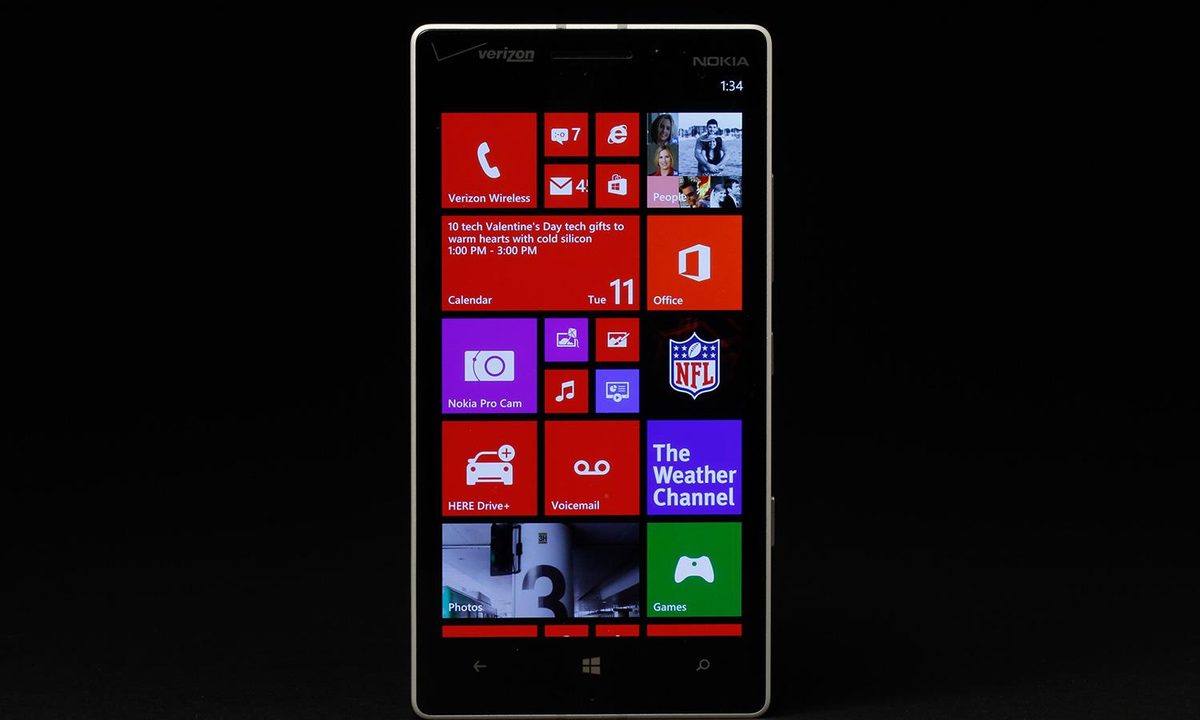

“The Nokia Lumia Icon is the best Windows Phone ever made, but Windows Phone 8 still has some lingering issues.”
- Gorgeous OLED 1080p screen
- Fast, powerful processor
- Great 20-megapixel camera
- 32GB of internal memory
- Nokia MixRadio app offers free offline music
- Slight muffling of phone call audio
- Windows Phone lacks apps
- Windows Phone lacks notifications
- No MicroSD card support
“Why you can trust Digital Trends – We have a 20-year history of testing, reviewing, and rating products, services and apps to help you make a sound buying decision. Find out more about how we test and score products.“
Whatever drugs entered the drinking water in Finland, keep ‘em flowing. Nokia is in the process of selling its entire phone business to Microsoft, but it may have pulled the trigger too early. The Lumia 1520 was fantastic, but too big for ordinary folks. The Nokia Lumia Icon, however, is what we’ve always wanted in a Windows Phone. It has competitive specs, a kickass screen, it isn’t too big or small to hold, and there’s no real downside to owning it, assuming you are okay with a Windows Phone and like Verizon Wireless.
Boxy and gorgeous
Nokia’s Lumia line has always looked good, but not this good. The Lumia Icon combines the best aspects from previous Lumias, making it almost a greatest hits compilation for the Finnish phonemaker.
That includes:
- Metal edging and buttons: The only other phone to feature metal edging mixed with a polycarbonate battery cover (non-removable) was the Lumia 925, which was the previous best-looking Windows Phone.
- Boxy shape: Some like the boxiness, and some hate it. We like how it looks, but do find that the corners dig into our palms now and then. This look comes from the Lumia 928 – also a Verizon exclusive.
- Double-click Shutter Button: The Lumia 920 was the first Lumia with a double-click shutter button. This is a small touch, but helps focus pictures. The Icon’s shutter button has more give to it, making it easier to use this feature.
- 1080p OLED Screen: Windows Phone looks best on OLED because it displays the deepest blacks. The Lumia 928 also had an OLED screen. However, the Icon also crunches the 1920×1080 pixel display of the Lumia 1520 into a 5-inch screen, making it the densest Windows Phone screen available. It also means an extra row of Live Tiles are on the home screen, making it the most functional WP8 home screen yet. (Bonus: You can set screen sensitivity to High in Settings and use this phone with gloves on.)
- 20MP Camera: We’ll talk about the camera later, but this phone has the same 20-megapixel sensor as the 1520.
- Curved glass: Finally, the Gorilla Glass 3 display curves at the edges, which is a feature that goes back to the original Lumia 800. It’s a small, beautiful touch.
Holding the Icon is easy enough. The power button is located under the volume toggle, which makes it easy to press while reaching for the phone’s navigation buttons (Back, Home, Search), and we really like the feel of the shutter button, which has a springiness to it that we haven’t seen before.
Good audio quality
Thanks to a curved design, a hard table won’t muffle the single speaker on the Icon’s lower back side, but a bed or soft surface will. We compared the speaker quality to the iPhone 5S, which outperformed it on clarity, but not volume. Sound from the Icon is clear enough, but there is some airiness to it that we didn’t notice on the iPhone.


The only complaint we have is the placement of the audio jack. Many newer phones put the audio jack on the bottom, which helps you more easily grab the phone out of your pocket when wearing corded headphones.
Windows Phone 8 & Nokia’s Apps
Thanks to its gorgeous 1080p OLED screen, the Nokia Lumia Icon has the ability to pack almost twice as many Live Tiles on its Start screen. You can now fit 15 medium-sized Live Tiles on the Start screen instead of eight. If you shrink them down to icons, it fits 60 on a single screen, making it far more functional than any iPhone or Android screen. The Start screen of Windows Phone is finally starting to work for us. But there are still problems.
Windows Phone 8 is mostly unchanged. So, like all Lumia phones, your enjoyment of the 1520 is, in many ways, out of Nokia’s control.
If you are a Verizon subscriber and like Windows Phone, this is the best device you could hope for.
Many people are still unfamiliar with Windows Phone, and find it odd to use. For new smartphone users, it will work fine, but those converting from Android or iPhone may have some trouble adjusting. A lack of notifications, slow animations, and other interface oddities will annoy some.
If you’re willing to give Windows Phone a try, keep in mind that its Start screen Live Tiles are like a mix between app icons and widgets. Live Tiles can show how many emails you have, animate, and display a ton of other information. If you’re still confused, here are a few ways to customize your Start screen. We’ve also put together a ton of WP8 tips and WP8 problems and bugs for those of you making the leap.
Nokia has included a lot of awesome custom apps for its Lumias like Here Maps + Drive (turn-by-turn navigation), Nokia Transit directions, Nokia Pro Cam, and an app that recommends other good apps.
We enjoyed Nokia’s new MixRadio app, which lets you create custom Pandora-style radio stations and download them for offline listening (for free). Nokia Beamer is also a strange, but potentially useful little app. It lets you shake the phone to put a shot of your screen on any Web-enabled TV or monitor. We couldn’t figure out a good use for it, but it was fun to try out.
Outside of Nokia’s apps, things get less stable and more barren. The Windows Phone 8 app library is growing and is starting to get pretty robust, but there are many omissions, and games are particularly weak compared to Android and iPhone. Many apps also aren’t maintained well. The Spotify app we used, for example, repeatedly crashed on the Icon.


Windows Phone is completely usable, but it’s not the best OS right now. It also doesn’t take good advantage of the Icon’s powerful processor. Menus still render at the same sluggish speed.
Snapdragon power and a solid battery
If you need a phone with brag-worthy specs, the Lumia Icon has got them for you. This phone matches the power of any top-notch Android phone available today. Nearly matching the Lumia 1520 phablet, it has a 2.2GHz quad-core Qualcomm Snapdragon 800 processor, 2GB of RAM, a 5-inch 1920 x 1080 pixel OLED screen (441ppi), 32GB of internal memory, a 20-megapixel rear camera, and a 1.2-megapixel front camera. Sadly, there is no MicroSD slot, so your memory cannot be expanded, and the phone takes a Nano SIM, like the iPhone 5S. It has standard Micro USB charging.
As far as special connectivity goes, the Icon has LTE, Wi-Fi, Bluetooth, and NFC.
On the battery front, it packs a 2,420mAh lithium-polymer battery. We’ve only had the phone to test for a day, but after 24 hours and a lot of use, it’s still holding a 30 percent charge. The Lumia 1520 is able to retain a charge for weeks at a time under low use. We expect the Icon is similar.
Camera is good, but not iPhone good
Nokia likes to brag about its cameras and their Carl Zeiss optics, but outside of the Lumia 1020 and its amazing PureView camera, no Nokia has matched the consistency of the iPhone’s camera, which is still the standard bearer. We put the Lumia Icon head to head with the iPhone 5S.
Mostly, the Lumia kept up with the iPhone, but it showed weakness when situations got more challenging. Most notably, it had more trouble performing in low light, balancing bright light from a window, shooting macro shots on reflective objects, and shooting outdoors in the dark. For example, it couldn’t seem to focus on buildings at night, making some of our NYC outdoor shots blurry.


- 1. Nokia Icon sample photo: NYC
- 2. Nokia Icon sample photo: Window
- 3. iPhone 5S sample photo: NYC
- 4. iPhone 5S sample photo: Window
Though Nokia markets this as a 20-megapixel camera, keep in mind that you’re really getting 16-megapixel 16:9 shots with a special 5-megapixel shot also taken, so you can have a version of your picture in a smaller file size. There is some optical image stabilization, which comes in handy when recording 1080p video. The front camera is 1.2 megapixels, so it’s pretty standard there.
Overall, the Icon’s 20MP camera lacks the consistency of the 8MP camera on the iPhone 5S, though it can best it every so often.
Can you hear me now?
We don’t typically have problems with sound quality (outside of the fact that all phone calls sound terrible), but on the Icon, people on the other end of a call sound muffled. It’s not too severe, but it’s noticeable enough that on a few occasions, we had difficulty understanding what others were saying. Fortunately, no one complained of how we sounded.
Conclusion
There’s a lot to love about the Lumia Icon and very little to hate. The biggest knock against it is that it runs Windows Phone 8, which comes with some quirks and limitations. But as a piece of hardware, it’s one of the nicest phones we’ve used. Spec for spec, it can match any Android phone, and aside from a slight muffling when taking calls, we don’t really have a hardware complaint.
If you are a Verizon subscriber and like Windows Phone, this is the best device you could hope for. Nokia may be leaving the phone world, but it’s going out with a bow and an encore.
Highs
- Gorgeous OLED 1080p screen
- Fast, powerful processor
- Great 20-megapixel camera
- 32GB of internal memory
- Nokia MixRadio app offers free offline music
Lows
- Slight muffling of phone call audio
- Windows Phone lacks apps
- Windows Phone lacks notifications
- No MicroSD card support


