
Broadband Internet speeds are defined by the FCC as being at least 25Mbps downstream and 3Mbps upstream, a considerably fair assessment given the rampancy of our current tech climate. Unfortunately, Internet service providers and congressional Republicans are inclined to disagree with this definition.
By the FCC’s standard, 34 million Americans, meaning about 10 percent of the country, don’t even have the option to subscribe to home broadband Internet. Using the specifications of the ISPs and Republican Congress, still, an embarrassing 16.1 million can’t get their hands on a measly 4Mbps/1Mbps service, which would be impossibly sluggish by today’s standards.
Nevertheless, the ideals of ISPs and Congress are completely negligible to begin with considering their antiquity and the fact that the FCC ditched the 4Mbps/1Mbps definition just over a year ago. And, even if the FCC decided to give in to critics and revert back to the old definition, the numbers would still suggest the ugly truth, which is that a sizable chunk of Americans — mainly in rural areas — still can’t access competent Internet speeds.
“At slower speeds,” the FCC broadband progress report begins, “6 percent of Americans lack access to fixed terrestrial service at 10Mbps/1Mbps and 5 percent lack access to such services at 4Mbps/1Mbps.”
This means that, still, an abundant 19.9 million Americans can’t get home Internet speeds of 10Mbps/1Mbps. Evidently, these statistics fail to address satellite Internet services due to their infrastructure’s notorious reliability issues and paltry monthly data caps.
While Congress is supposed to make sure the FCC determines how pervasive broadband access is in the United States, it’s the commission’s responsibility to decide what speeds should and shouldn’t be deemed broadband. Since the FCC’s annual reports are always about a year behind, here’s what both 4Mbps/1Mbps and 10Mbps/1Mbps availability looked like from December 31, 2014:
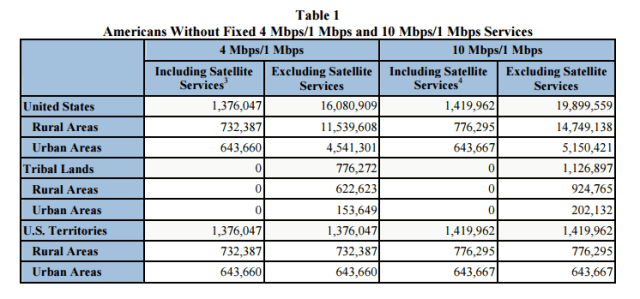
Though the number of Americans who can access 25Mbps/3Mbps broadband Internet is on the rise since 2012, there are actually more people since then who don’t have access to a mere 4Mbps/1Mbps service. In fact, only 16.1 million (6 percent) Americans have access to the slower 4Mbps/1Mbps speeds as opposed to the 19 million (5 percent) of Americans who could get it in 2012.
The FCC changed its definition of broadband Internet last year as a response to a surge in household using multiple devices on a single connection in addition to HD video streaming. In fact, it was FCC Commissioner Jessica Rosenworcel who urged a 100Mbps standard, though unfortunately, her position was rejected.


