
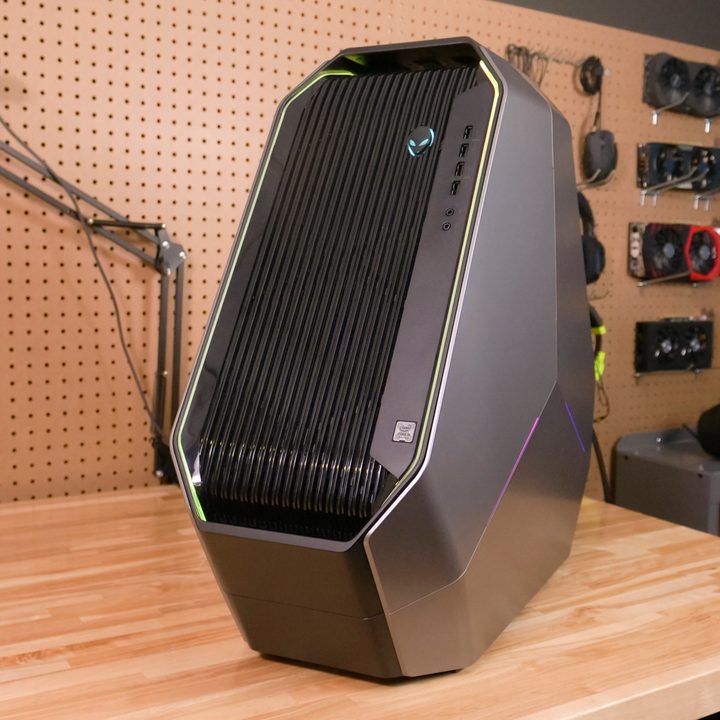
Dell is expanding its offering of AMD hardware inside its flagship Area-51 gaming system to include more first- and second-generation Threadripper CPUs. The new Alienware Area-51 R7 Threadripper Edition systems will come fitted with an option of three top-of-the-line AMD CPUs with up to 16 cores, liquid cooling, and options for the latest and greatest graphics from both AMD and Nvidia.
Alienware’s Area-51 systems have been impressing us for years. They might be expensive, but they offer the most powerful contemporary hardware in a unique and understated chassis design. The new R7 Threadripper Edition systems will be no different. When they go on sale on November 8, prospective customers will have a choice of the 16-core Threadripper 2950X, the 12-core 2920X, or the first-generation, eight-core 1900X. Each will be fitted to an Alienware ATX X399 motherboard in its second-generation Triad case.
Although Alienware is promoting the system to gamers, its marketing does acknowledge that Threadripper excels when it comes to multitasking and high-level professional tasks. Pure, high-end gamers might like to opt for an Intel Core i9-9900K instead, but for those who want to work and play, Threadripper chips are a great choice too.
Each processor will be fully water-cooled for quiet operation and enhanced overclocking potential and paired up with whatever graphics card the user requires. Options start as low as a GTX 1050 Ti and go through the entire Pascal range up to a 1080 Ti. There’s also options for liquid cooled variants and a choice of RTX Turing cards, including the 2070, 2080, and 2080 Ti. On the AMD side of the aisle, there are options for RX 570 and 580 GPUs, as well as an RX Vega 64. There are also options for two and even three-card SLi/Xfire configurations.
Memory options include everything from a single 8GB stick of 2,666MHz DDR4, all the way up to 64GB of quad Channel HyperX memory at up to 2,933MHz. Storage options include single 2TB hard drives, or a combination of that and up to 2TB of M.2 NVMe PCI Express storage. Every configuration will support Dell’s Alienware Command Center software which gives full control over the system’s RGB lighting, thermal management software, and fan controls. It also adjusts the system clocks and power usage on a per-application basis, spooling up everything should it be needed for certain games or programs.
The Threadripper Edition Area-51 R7 build will go on sale November 8 at a starting price of $2,200.


