
Yesterday, chipmaker Intel got 2011 off to a strong start announcing its Core 2011 chip line, but now rival AMD is looking to steal the spotlight, finally announcing its Fusion line of low-power CPUs that combine AMD x86 processing cores with high-definition, DirectX11-capable graphics—combined with power consumption profiles that take steady aim at Intel’s Atom processor line that dominates netbooks, nettops, home theater systems, all-in-one, and lightweight desktops.
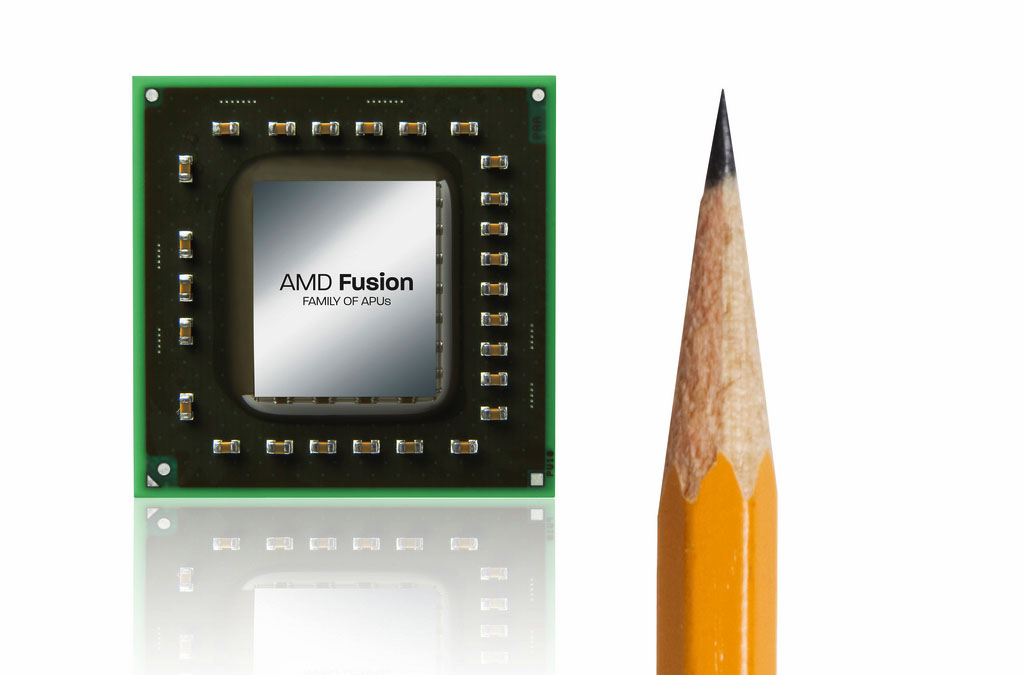
“We believe that AMD Fusion processors are, quite simply, the greatest advancement in processing since the introduction of the x86 architecture more than forty years ago,” said AMD senior VP and general manager Rick Bergman, in a statement. “In one major step, we enable users to experience HD everywhere as well as personal supercomputing capabilities in notebooks that can deliver all-day battery life.”
AMD’s Fusion CPUs—the company actually calls them APUs, for “Accelerated Processing Unit” are at long last the fruit of AMD’s troubled $5.4 billion purchase of ATI back in 2006. The new processors are built around AMD’s “Bobcat” processing care and instead of targeting the high end of the consumer or server marketplace, AMD is solidly aiming at consumer devices, portable, computing, and Intel’s Atom business. AMD says Fusion outperforms Atom-based offerings, consume less power (AMD says Fusion based systems can run for 10 or more hours), and pack in DirectX11, high-definition video, and HDMI output capabilities.
Initially the Fusion line will have two lines: the E-series (“Zacate”) is aimed at small desktops, all-in-one systems, and mainstream notebooks, and will be available in a dual-core version running at 1.6 GHz and a single-core version running at 1.5 GHz, both consuming 18 watts. The C-series (“Ontario”) will consume just 9 watts and is aimed at HD netbooks and “other emerging form factors” (think tablets): the C-series will be available in a dual-core 1 GHz version and a 1.2 GHz single-core version. AMD intends to follow the E- and C- series later this year with an A-series (“Llano”) aimed at mainstream notebook and desktop systems, sporting up to four processing cores.
AMD already has a number of manufacturers on board to offer Fusion-based systems, including the likes of Acer, Asus, MSI, Dell, Fujitsu, Samsung, HP, Lenovo, Toshiba, and Sony. AMD also notes it is working with a number of companies to optimize OpenCL, OpenGL, Direct2D, DirectCompute performance, as well as support application optimization for Fusion APUs using AMD Accelerated Parallel Processing technology—which basically means tapping the parallel processing capabilities of the graphics hardware for computing tasks.
If manufacturers can deliver compelling products based on Fusion processors, AMD may be able to carve out a substantial niche for itself as digital media—and high-definition entertainment—increasingly shifts from the living room to portable devices.


