  1. Home
  2. Computing
  3. Gaming
  4. News

AMD launches entry-level RX 6500 XT GPU for budget-conscious gamers

Add as a preferred source on Google

During its CES 2022 keynote presentation, AMD has introduced the RX 6500 XT, a new entry-level graphics card priced at $199 that the company believes will be a welcome salve for budget-conscious gamers in a time of major GPU shortages and uncertainty.

The card is built on a six-nanometer process and comes with what AMD claims are the “fastest sustained GPU clock rates ever,” at over 2.6GHz. It also packs in 16 hardware ray accelerators, 16MB of the company’s Infinity Cache (a technology that basically functions as a “bandwidth amplifier”), and supports AMD’s Adrenalin software features.
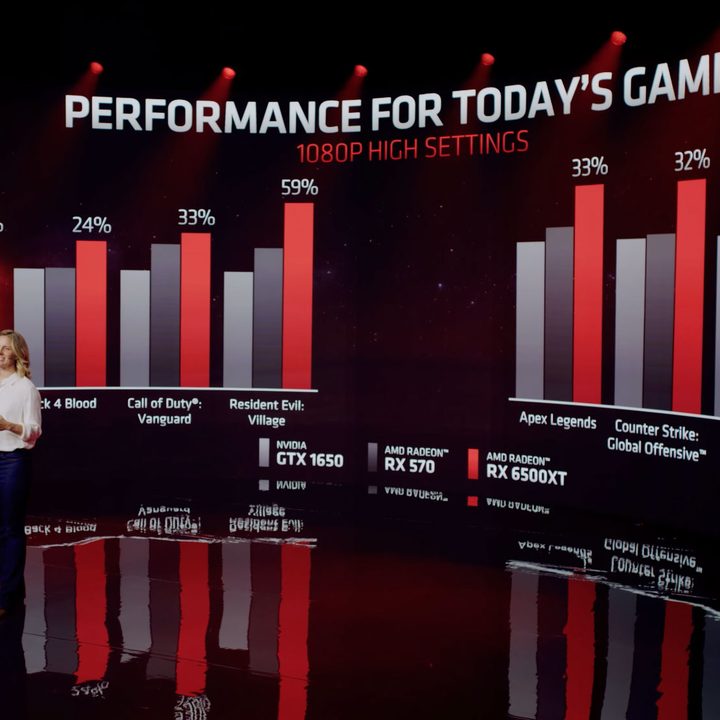
Performance stats for the AMD RX 6500 XT graphics card.
Image used with permission by copyright holder

AMD is aiming the RX 6500 XT squarely at the entry-level end of the gaming spectrum, and it is designed to entice away gamers who are using a card like the Nvidia GTX 1650, or something around its level.

Recommended Videos

In that kind of comparison, AMD says the RX 6500 XT outperforms its Nvidia rival in a number of games. The company claimed it offered anywhere from 23% better performance in Age of Empires 4 to a 59% improvement in Resident Evil: Village. All of these comparisons were set at 1080p resolution and high graphics settings.

Its performance improves further when AMD’s FidelityFX Super Resolution (FSR) technology is enabled. A competitor to Nvidia’s DLSS, AMD’s FSR upscales your graphics performance, allowing for faster frame rates without terrible drops in graphical quality. With FidelityFX Super Resolution turned on, the RX 6500 XT goes from 61 frames per second (fps) in Call of Duty: Vanguard to 89 fps at 1080p resolution and high graphics settings. In Deathloop there’s a jump from 62 fps to 80 fps, while in Far Cry 6 it goes from 59 fps to 84 fps, all at the same settings.

AMD has set the RX 6500 XT’s price at $199, but you’ll do well to get it for that. The video card market is still very much suffering from stock shortages and massive price inflation, so we hope AMD has enough cards on hand to ensure they’re on sale for at least a few seconds before selling out.

As for a launch date? That’s January 19. Better set your alarm to get there early and beat the scalpers.

Alex Blake
Alex Blake has been working with Digital Trends since 2019, where he spends most of his time writing about Mac computers…
Apple could go back to Intel for chips, but not how you would expect (or dread)
Apple MacBook

Apple and Intel are reportedly exploring a manufacturing partnership that could reshape how future Apple chips are produced. But despite the headline, this does not mean Apple is abandoning Apple Silicon or returning to Intel-powered Macs.

According to a new Wall Street Journal report, Apple and Intel have reached a preliminary agreement for Intel to manufacture some chips designed by Apple. Bloomberg’s Mark Gurman later clarified on X that there is still no finalized production agreement in place and discussions remain at an early stage. His post also noted that Apple continues to have concerns about Intel’s manufacturing technology and long-term competitiveness.

Read more
Apple wants you to verify your identity before you get Education discount on products
Apple moving the US Education Store off the honor system also seems about making a globally consistent verification infrastructure that could eventually support more aggressive Education Store expansion.
Computer, Electronics, Laptop

Getting an Apple Education discount in the United States used to be as simple as claiming you’re a student or a teacher; it didn’t need a formal verification. That era is officially over. 

Starting May 8, 2026, Apple now requires formal identity verification for all Education Store purchases in the US, ending the informal honor system that was in place for years (via MacRumors). 

Read more
OpenAI’s Codex just moved into Chrome, where the useful work and the risks live
The new extension lets Codex move beyond coding and handle real browser tasks across signed-in sites
Page, Text, File

OpenAI is giving Codex a larger stage than the coding window. Its new Chrome extension lets the agent use an authenticated web session, so it can help with work that already lives inside Gmail, Salesforce, LinkedIn, dashboards, and internal apps.

That pushes Codex out of the developer sandbox and into the web apps where daily work already happens. With Chrome access, it can step into research, CRM updates, dashboard checks, and browser-based debugging, which is where plenty of work gets stuck across tabs.

Read more