
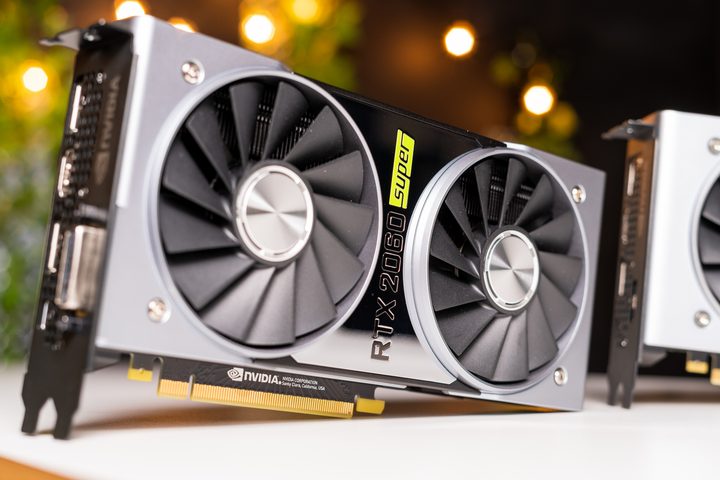
The summer of 2019 proved an exciting one for gamers and hardware enthusiasts, not only because it brought us some amazing new CPUs from AMD to play with, but also brand new graphics cards from AMD and Nvidia. The new Super RTX cards felt deliberately held back to steal AMD’s thunder, but whether they succeeded is another matter entirely.
So, to find out if they do, let’s take a look at the AMD RX 5700 XT vs. Nvidia RTX 2060 Super in a classic head to head.
Performance
Although AMD and Nvidia’s graphics cards have differing architectures where not every specification is directly comparable, some elements are and all help create a picture of the performance potential of both cards.
| Radeon RX 5700 XT | RTX 2060 Super | |
| Process node | 7nm | 12nm |
| Shader units | 2,560 stream processors | 2,176 CUDA cores |
| Tensor cores | N/A | 272 |
| RT cores | N/A | 34 |
| Base clock | 1,605MHz | 1,470MHz |
| Game clock | 1,755Mhz | N/A |
| Boost clock | 1,905MHz | 1,650MHz |
| Memory | 8GB GDDR6 | 8GB GDDR6 |
| Memory speed | 14Gbps | 14Gbps |
| Bandwidth | 448GBps | 448GBps |
| TDP | 225w | 175w |
Notable takeaways from this specifications table include the identical memory configuration and the much higher clock speed of the RX 5700 XT. It should be noted, however, the AMD has adjusted its terminology for the RX 5700 series. The “boost” clock is now the highest possible clock that can be expected during an intensive workload and may last only a fraction of a second. In reality, the 5700 XT hovers around 1,750 MHz during gaming. AMD designates this as its “game clock.”
There’s also a notable absence of RT and Tensor cores on the AMD card, which we’ll get to in the section on ray tracing and other features below.
But specifications don’t tell even half the story that real-world benchmark results do. Fortunately, we have plenty of those after an exhausting week of testing new hardware from both AMD and Nvidia. We tested both cards using an Intel Core i7-8086K processor, 16GB of RAM, and a 512GB M.2 SSD.
In the synthetic 3DMark benchmark we see that the 5700 XT is a worthy competitor for the RTX 2060 Super at the same price. It’s even competitive with the $680+ Radeon VII, although it falls well behind the $500 RTX 2070 Super.
Real-world gaming tests were more of a mixed bag, but also showed decent potential for the RX 5700 XT. It fell behind the RTX 2060 Super at all resolutions in Fortnite, but came back strong in Battlefield V and Civilization VI. While the RTX 2060 Super was competitive with the 5700 XT at 1080p, at higher resolutions, particularly 4K, the AMD card was far more capable, delivering more than 90 frames per second at the highest detail in Civilization VI, and a rock-solid 60 fps in BF5.
Cooling and efficiency

Thanks to AMD’s big die shrink to 7nm, it has finally caught up with Nvidia on the efficiency front. The RTX 2060 Super is still the more efficient of the two, with a 50w lower TDP, but neither card is egregious in their demands — as we have seen with some previous generations of AMD cards, like the Vega 64 and Radeon VII.
Despite the lower-than-usual power draw though, the stock version of the 5700 XT is still not a cool card. AMD’s use of its classic blower design is disappointing and leaves the card hot and noisy once it’s been running a game or benchmark for a while. Although blower coolers do have an advantage in systems with poor case airflow, we find it hard to believe that anyone spending $400+ on a graphics card won’t have at least a few case fans keeping the rest of their system cool.
The RTX 2060 Super, on the other hand, uses Nvidia’s dual-fan Founders Edition cooling system which isn’t fantastic, but it’s a massive improvement over AMD’s solution.
Fortunately, since the debut of the 5700XT, several third-party alternatives have been released, giving buyers vastly improved cooling for only a few dollars more. Cards like the PowerColor Red Devil, or the Sapphire Pulse, are excellent examples of that.
Ray tracing and image sharpening
Nvidia’s original RTX Turing release focused more on ray tracing and the hardware that enables it than raw performance. While today, we know the RTX cards are great for all sorts of gaming tasks, they remain the only commercial GPUs available that support the new lighting standard. There are only a few games that support it, even as we approach the end of 2019, but the fact remains: The RTX 2060 Super can do ray tracing. The RX 5700 XT cannot … at least for now.
It can also offer deep-learning super sampling in supported games, which can help improve image quality and framerates in select cases. AMD’s card can’t do that either, but it does have AMD’s new Fidelity FX and Image Sharpening effects, which can improve visual quality in a much wider selection of games, but without the FPS improvement of DLSS. AMD’s cards also offer a new anti-lag feature for faster gamer inputs.
The 5700 XT is great … if you buy third party
AMD’s new RDNA-based 5700 graphics cards are far less of a dominating force than its new Ryzen CPUs, but they’re not bad either. The 5700 XT is competitively priced with the RTX 2060 Super and it performs comparably, if not far quicker in some instances, despite being the same price.
The RTX 2060 Super does offer entry-level ray tracing support and hardware-accelerated DLSS. If you like other Nvidia features like G-Sync, Reshade support in drivers, and its NULL lag-killing gaming technology, then it’s the card for you for sure.
But the RX 5700 XT, especially with improved third-party cooling, offers greater performance for your money. It also has AMD technologies that are often just as good as the Nvidia alternative. Things like FreeSync, its own latency-reduction tech, and Fidelity FX image sharpening.
Overall, it’s a very close run race between these two cards, but for now, at least, the RX 5700 XT gives slightly more for your money.


