
Apple announced the new M1 Ultra chip during the Apple Spring Event 2022, building on top of the M1 Pro and M1 Max introduced in the MacBook Pro late last year.
The chip essentially combines multiple M1 dies to create a more powerful processor, and Apple says it’s built for “extreme levels of performance.” Apple says that the M1 Max has a secret interconnect and that the M1 Ultra utilizes this interconnect to link two processors together.

The chip supports up to 128GB of memory, and it features a 20-core CPU and 64-core GPU. Apple says the chip is nearly eight times as fast as the base M1, and it has twice the number of processing units as the M1 Max.
Like previous M1 chips, the M1 Ultra is targeted at power efficiency. Apple says the GPU uses only a third of the power of a common GPU and is up to 90% more efficient than a leading 16-core desktop CPU.
We were massively impressed by the M1 Max inside the MacBook Pro, and Apple looks to be furthering that with the M1 Ultra. It’s still built on the 5nm process and with the same architecture as the M1; however, it seems to offer significantly more processing power.
Based on Apple’s renders (pictured below), the M1 Ultra looks like two M1 Max chips connected together. The specs back that up, too. The M1 Ultra doubles the CPU cores to 20 and GPU cores to 64, and it comes with twice as much memory bandwidth.
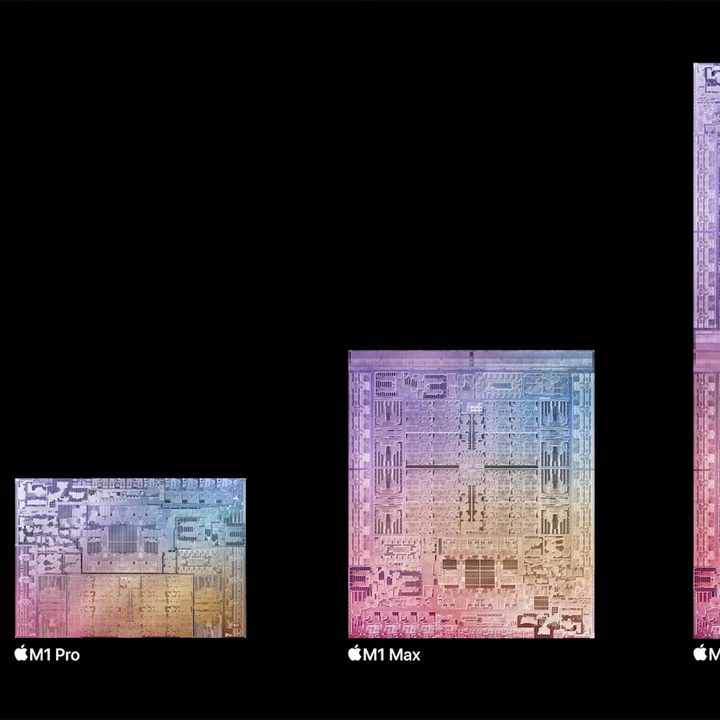
Apple is introducing the M1 Ultra with the new Mac Studio, which is essentially a souped-up version of the Mac Mini. The new machine is 3.8x faster than an iMac and 90% faster than a Mac Pro with an Intel Xeon processor, according to Apple.
Short of the 24-inch iMac and the M1 Mac Mini, this is the first proper desktop with Apple silicon. And it’s the first desktop to offer a high-end Apple chip for creative professionals and peak performance seekers.
Like previous M1 chips, the M1 Ultra comes with a combination of performance and efficiency cores. There’s a greater focus on performance cores, with 16 of the 20 CPU cores dedicated to performance and only four dedicated to efficiency. This is a far cry from Intel’s Alder Lake processors with their hybrid architecture, which focus more on the efficiency cores.
For the GPU, Apple says the M1 Ultra can match the performance of the “most powerful” discrete GPU while only using one-third of the power. Apple didn’t name the GPU during the event, so we’ll need to wait to see how the M1 Ultra stacks up once it’s here.
In addition to the M1 Ultra, Apple announced the iPhone SE and Studio Display during its spring event.


