
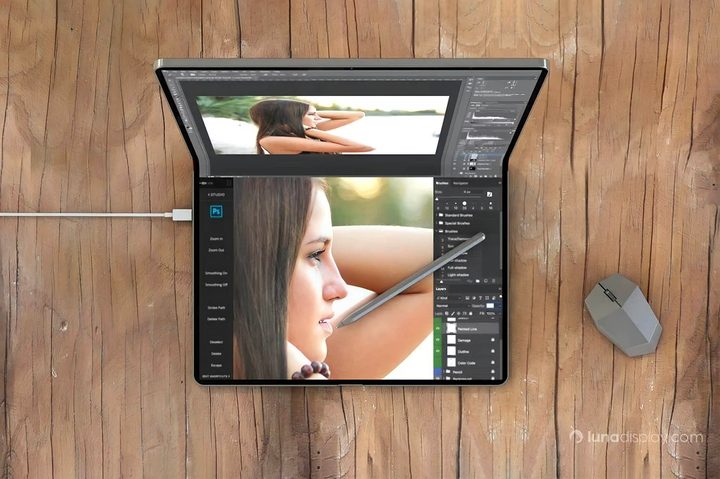
Apple’s first all-screen foldable MacBook has been rumored for many years, and it’s finally getting closer. Reports from analyst Ming-Chi Kuo suggest Apple plans to release its first foldable as early as 2026.
According to Kuo, Apple is considering both 20.25-inch and 18.8-inch panels that, when folded, would equate to a 14- to 15-inch MacBook and a 13- to 14-inch MacBook. Previous reports estimated a 2027 release for these all-screen MacBooks, but Kuo’s latest information suggests we could see them as early the first half of 2026. And now that Apple has introduced its M4 chip, it’s little surprise that these future devices are expected to run on M5 series processors.
While the foldable market is mostly dominated by phones and tablets, laptop models such as the Lenovo ThinkPad X1 Fold and the Asus Zenbook 17 Fold do exist — though they are considered a little more niche.
Apple is known for bringing emerging tech into mainstream popularity, but often much later than the competition. That would fit with a foldable device, considering how long the first foldable phones, tablets, and laptops have been out on the market.
As always, Apple’s ability to succeed in that regard depends on the product’s special features and quality. Kuo’s report claims that Apple is aiming for a crease-free panel design — a feat that other manufacturers have struggled with for years. If Apple engineers can really manage a screen that both doesn’t have a visible crease at purchase and doesn’t develop one after some amount of use, they will have solved the biggest problem most customers have with this kind of tech.

However, it takes more than just brains and innovation to solve a long-standing problem like this — it also takes money. To achieve its crease-free goals, Apple may reportedly may need to spend as much as $200 to $250 on the hinges and $600 to $650 on the display. For comparison, the 16-inch mini-LED display used for the M1 MacBook Pro costs around $250. Because of the high prices of these components, Kuo suggests that the overall cost could come close to that of the current Vision Pro, which starts at $3,499.
You don’t need to wait until 2026 for the next big change to MacBooks, though. Despite its success with mini-LED displays, rumors are circulating that Apple is working on an OLED MacBook to match the new iPad Pro — and we could see these as soon as 2025. It’s going to be a busy couple of years for the Mac if these rumors turn out to be true.


