  1. Home
  2. Computing
  3. News

Apple upgraded its worst MacBook instead of just killing it

Add as a preferred source on Google
Promotional logo for WWDC 2023.
This story is part of our complete Apple WWDC coverage
Updated less than 15 hours ago

Apple announced two new MacBooks at WWDC 2022, a redesigned MacBook Air and a 13-inch MacBook Pro. These are Apple’s best-selling Macs, and as stated in the keynote event, they’re the two best-selling laptops across the entire industry.

While the M2 MacBook Air now sports a refreshed redesign, the 13-inch MacBook Pro has been left in a pitiful state. It uses a chassis straight from 2016, and it stands out like a sore thumb in the rest of the MacBook lineup. That means big bezels, a boxier shape, a poor webcam, and yes, even the Touch Bar. Sigh.
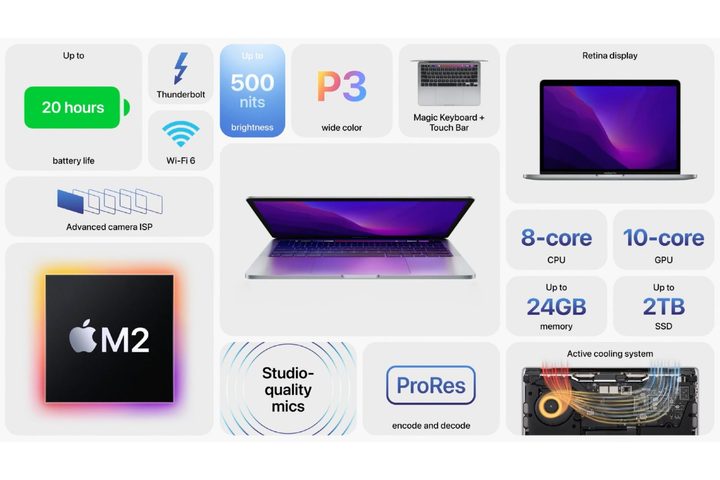
A graphic showing everything new with the M2 MacBook Pro.
Image used with permission by copyright holder

I was bothered when the 13-inch MacBook Pro was left in the original M1 lineup back in 2020. After all, it used the same M1 chip, and the difference in performance and battery life was almost imperceptible to the average laptop buyer. All that, and it cost a whopping $300 more. My guidance when picking between the two to everyone who asked was to always choose the cheaper MacBook Air.

Recommended Videos

But in 2022, a $1,299 13-inch MacBook Pro, even with the M2, just really doesn’t make sense. It remains the most expensive of Apple’s entry-level MacBooks, if only by $100. And yet, I can’t imagine why someone would buy this over the new MacBook Air — or even the older M1 model, for that matter.

Yes, technically it’s slightly faster since it has a more robust thermal system. Apple says it gets two hours more of battery life. But that differentiation is more frustrating than helpful. This thing is called a MacBook “Pro” — and that’s what it’ll be sold as to customers at Apple Stores who can’t afford a proper M1 Pro or M1 Max MacBook Pro, which start at $2,000. These more powerful MacBooks have also been notoriously difficult to buy, with delays in production of up to two months after purchase.

But what they’ll be buying isn’t a true Pro product. Heck, it doesn’t even support more than one external monitor! More importantly, they’d be missing out on what a great value the M1 MacBook Air is, as well as the latest design and display upgrades available in the M2 MacBook Air.

There’s really no good reason for the 13-inch MacBook Pro to exist, but it’s the kind of product that continues to sell well for Apple anyways based on the name alone. It’s confusing to buyers, but as the second-best selling laptop right now, Apple isn’t about to give it up.

Luke Larsen
Former Senior Editor, Computing
Luke Larsen is the Senior Editor of Computing, managing all content covering laptops, monitors, PC hardware, Macs, and more.
AI’s chip hunger could keep memory prices painfully high for years
Memory shortages may haunt your next phone, laptop, and GPU for years
Crucial Memory and SSD

While recent reports claimed that memory prices may not fall till 2027, it seems like the memory chip crunch isn't a short-term headache. And that's bad news for anyone hoping phone, laptop, and GPU prices will get cheaper again soon.

Reuters reports that SK Group chairman Chey Tae-won said the global chip wafer shortage is likely to last until 2030, with artificial intelligence demand continuing to outpace the supply. Chey said the current shortage could remain above 20%, largely because AI systems require huge amounts of high-bandwidth memory and therefore burn through a lot of wafers.

Read more
One of the most controversial US agencies is reportedly taste-testing Anthropic uber-powerful Mythos AI
The agency's reported use of Mythos highlights a widening split inside the US government over AI risk
Claude AI on an iPhone.

The US government's AI fight just got harder to square. The National Security Agency is reportedly using Anthropic's Mythos Preview even as senior Pentagon officials keep pushing to cut the company off over supply chain concerns. It shows how quickly real security needs can outrun official policy.

Since February, the Defense Department has been trying to block Anthropic and push vendors to do the same. Yet, according to an Axios report, the NSA appears to be moving ahead with one of the company's most powerful models anyway, suggesting cybersecurity demand is carrying more weight than the feud now playing out inside government.

Read more
AI streaming is going mainstream in China, whether audiences want it or not
IQiyi wants AI to make most of its content someday, and it's already starting.
man holding tablet watching iQiyi

China's Netflix, iQiyi, is making one of the biggest bets in streaming history. The company wants AI to create the bulk of its films and shows someday soon, and it's already restructuring its 16-year-old business to make that happen.

At its annual content showcase in Beijing, founder and CEO Gong Yu announced that iQiyi is pivoting its popular streaming platform into a social media destination built around AI-generated content. 

Read more