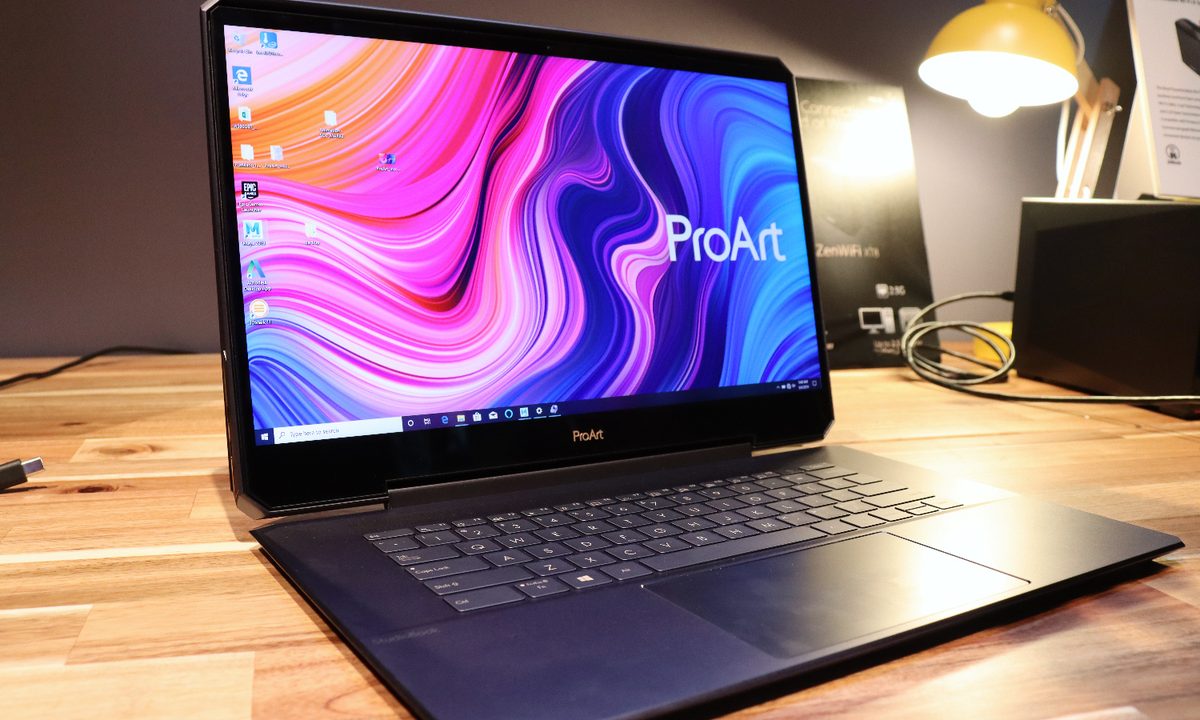
“With a Quadro RTX 6000 under the hood, this is a desktop in a laptop shell.”
- The most graphically powerful laptop ever
- Innovative cooling solution
- Gorgeous, color-accurate 4K display
- Surprisingly thin design
- No options for masses of RAM
- Still quite heavy
- No legacy ports

“Why you can trust Digital Trends – We have a 20-year history of testing, reviewing, and rating products, services and apps to help you make a sound buying decision. Find out more about how we test and score products.“
Who wouldn’t love to have the most powerful laptop in the world? That’s what Asus is billing its new ProArt StudioBook One as. With its mobile Nvidia Quadro RTX 6000 graphics chip, Asus claims it’s the most graphically powerful laptop in the world. At least for now.
When it’s paired up with an Intel Core i9 CPU and plenty of memory, it’s hard to deny this is a monstrous powerhouse of a notebook. But when it has to compete with exciting new dual-screen laptops in its own product line, does the StudioBook One really offer what people need?
We took a look at it first hand at this year’s IFA show and we have to say, we’re impressed. If not a little intimidated.
Raw power first and foremost
There’s no denying that what Asus has achieved with the StudioBook One is impressive. Packing any version of Nvidia’s Quadro RTX 6000 inside a laptop, let alone one as relatively svelte as the One, is quite the feat. That’s why this beast of a laptop has a vent system that sees the back of the lid pop off from the main frame at the hinge end just to get enough air into it to cool its super-powered internals.
That gives the StudioBook One an almost broken look, when first you see it. At first, I thought the other press taking a look at it handled it too roughly, or maybe that it was just a pre-production model without all the screws and glue in place. But no, that’s by design. And necessary. Because this laptop has an Nvidia GPU under the hood that’s said to be just 10 percent away from the power of its desktop counterpart. That means it’s almost the professional equivalent of a full-size Titan RTX, a mobile GPU with somewhere in the region of 4,000+ CUDA cores and 24GB of RAM.


That might sound like more than almost anyone needs, but Asus and Nvidia claim the data scientists and content creators who need the power will love the StudioBook One. If nothing else, it has certainly earned the award of the most graphically powerful laptop in the world. Or ever.
The CPU won’t bottleneck such a GPU either, as Asus has packed in an Intel Core-i9 9980HK eight-core processor and paired it with 32GB of DDR4 memory. That’s an absurd configuration for a laptop that likely tears through the 90 watt hour battery in just a few hours. But if you need ungodly performance in a laptop for professional work, then the StudioBook One is in a class all of its own.
It doesn’t have tonnes of memory though, with just 32GB available. The StudioBook X is far more impressive on that front with support for up to 128GB. Storage is relatively limited too, with a single terabyte PCIe SSD. That’s not bad, but it feels quite small when you consider the extreme specifications elsewhere in the build.
Pretty and strong
For a laptop with so much powerful hardware in it, it’s no surprise that the StudioBook One is quite a robust device. It doesn’t feel heavy, but at 6.4 pounds, it’s no lightweight machine. But that’s not something we’re overly concerned with though. As advanced a laptop design as this is, nobody expects this system to last long when away from a power socket, despite its high-wattage power brick.
It’s effectively a desktop that you can take to and from the office with you without hauling a monitor, mouse and keyboard with it.
Asus has made sure that the body of the StudioBook One is robust and fit for purpose. Looks aren’t really why you buy a machine like this, but in general, the StudioBook One has a premium, high-end feel in everything from the materials to the keyboard.
That said, we have some concern over the vent system at the rear and whether that might introduce a point of weakness to the design. Nobody wants to drop their laptop, but with such a bespoke cooling system, we’d make sure to double bag this one if it’s in transit as that vent seems like a perfect point of failure for what will undoubtedly be a costly machine.

Held within the bounds of the One’s sturdy structure is a beautiful display. The 15.6-inch panel has a resolution of 3,840 x 2,160, giving it a big clarity uplift over its sibling, the StudioBook Pro X. It’s surrounded by more bezel than that companion notebook, with a screen to body ratio of just 84 percent, but the corners are angular which makes them seem narrower than they are. It’s a style point that won’t be to everyone’s taste.
While this system isn’t designed with gaming in mind, it certainly would do a great job at it
On top of the crisp resolution of its screen, the StudioBook One’s screen has 100 percent support of the Adobe RGB color gamut and is fully Pantone validated with a Delta-E value of less than one, making color accuracy certified and guaranteed. In person, the display is rich and deep and even with press flashes and harsh overhead lighting, it remained legible with well saturated colors.
While this system isn’t designed with gaming in mind, it certainly would do a great job at it. Its display isn’t just gorgeous, it has a refresh rate of 120Hz and the Quadro is powerful enough to handle far more than the average game.
Thunderbolt up top
With all of the most important components located in the lid of this laptop, Asus needed to keep the ports close. That’s why they are also mounted on the lid. There you’ll find three USB-C ports with full Thunderbolt 3 support. That’s it though. No SD card reader, no legacy USB-A ports, and no headphone jack, which left us feeling like something was missing.
USB-C is great, but it’s not everything just yet. Considering a big selling point of this system for Asus is that it gives creatives more freedom than ever, we’d have liked to have seen a little more port selection for more freedom in the devices you can connect to it.
You do get a USB-C to Ethernet dongle in the box, at least.

A beautiful niche
No one, Asus included, isn’t aware that the ProArt StudioBook One is a niche laptop. It’s a borderline halo product that’s designed to showcase Asus and Nvidia’s technical expertise rather than actually make it any money. But for some, this will be the laptop they’ve been waiting for. It offers true desktop power in a form that would be impossible without a unique cooling solution and what will undoubtedly be a monstrous price tag.
We don’t know when the StudioBook One is going to release or what it will cost just yet, but know that you aren’t going to see these in front of every writer at every coffee shop in the months to come. But for those who need the absolute most power possible and really don’t want a desktop, the StudioBook One looks to be as good as it gets.