  1. Home
  2. Computing
  3. News

ChatGPT is recommending scam websites that will steal your credit card info

The chatbot is surfacing fraudulent clones of defunct retail brands, and scammers are deliberately engineering sites to game its recommendations.

Add as a preferred source on Google
ChatGPT running on a laptop.
Nadeem Sarwar / Digital Trends

Scammers have found a new way to reach shoppers: getting ChatGPT to do their marketing for them. According to The Guardian, scam-checking service Ask Silver found that OpenAI’s chatbot is recommending fraudulent retail websites built to harvest payment details from unsuspecting buyers. The sites mimic real storefronts and use official-looking URLs, making them difficult to spot without scrutiny.

Defunct brands are a prime target

Scammers appear to be deliberately targeting brands that have recently shut down or been acquired, leaving a gap between consumer demand and an official web presence.

Recommended Videos

Ask Silver’s Anna Jones told The Guardian that Russell & Bromley, the British footwear retailer that went into administration in January 2026, is one example. With no official site remaining after Next absorbed the brand, fraudsters built a convincing clone and optimized it to surface in ChatGPT’s results. Shoppers who ask the chatbot for Russell & Bromley products by name get pointed straight to it.

Jones said one possible explanation is that bad actors have seeded ChatGPT’s training data with content designed to promote fraudulent pages, a technique sometimes called data poisoning.
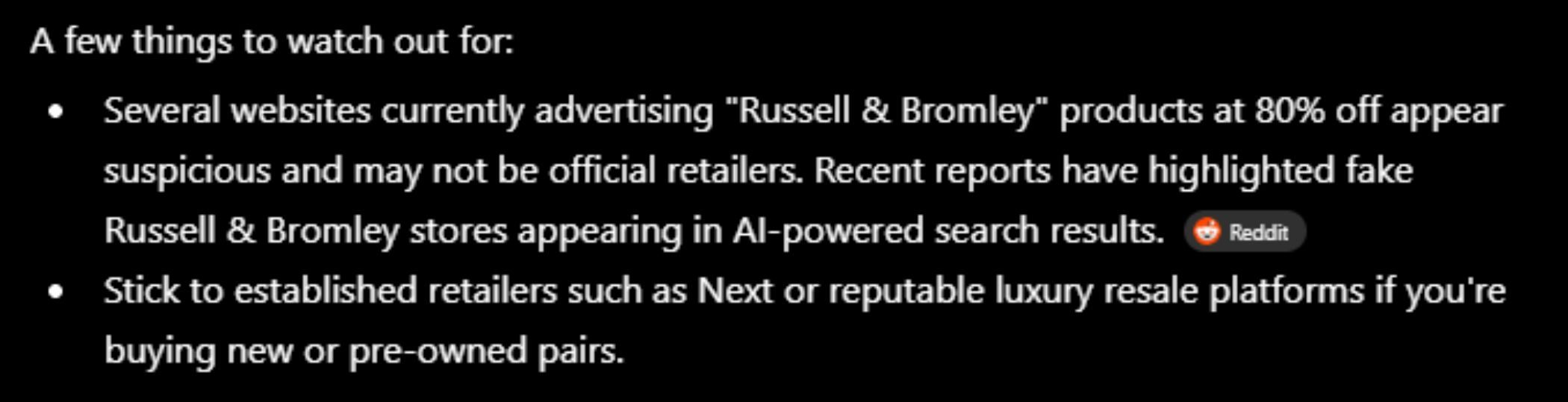
OpenAI appears to have updated its results for shopping queries related to Russell & Bromley, and it now shows a warning stating, “Several websites currently advertising Russell & Bromley products at 80% appear suspicious and may not be official retailers. Recent reports have highlighted fake Russell & Bromley stores appearing in AI-powered search results.”

A bigger problem as AI takes over shopping

Research published last year found that ChatGPT already struggles to give consistent, reliable product recommendations, but misdirecting users to scam sites is a more serious failure. The problem is likely to grow as AI becomes a more active part of the buying process.

Louise Baxter of the UK’s National Trading Standards told The Guardian that fraudsters adapt quickly to new technology. With agentic AI shopping already in its early stages, the window to address this vulnerability is narrow.


Pranob Mehrotra
Pranob is a seasoned tech journalist with over eight years of experience covering consumer technology. His work has been…
Claude’s Sonnet 5 is built to do more on its own and cost you less
Better than its predecessor, nearly as good as the flagship, and meaningfully cheaper than both.
Art, Floral Design, Graphics

Every major AI lab is racing to prove its models can work autonomously with minimal hand-holding; we’re now seeing pricing emerge as the next battleground. 

Anthropic just fired its latest shot, Claude Sonnet 5, a model the company says performs nearly as well as its flagship Opus 4.8 at a fraction of the cost.

Read more
Apple Creator Studio adds AI tools across Final Cut Pro, Logic Pro and Pixelmator Pro
Final Cut Pro gets AI captions, Auto Mask and better Pixelmator Pro workflows in Creator Studio update
Computer Hardware, Electronics, Hardware

Apple has introduced a major update to Apple Creator Studio, adding new AI features, deeper Pixelmator Pro integration, and workflow upgrades across Final Cut Pro, Logic Pro, Keynote, Pages, Numbers, Motion, Compressor, Freeform, and Final Cut Camera.

The update makes Creator Studio more useful across Mac, iPad, and iPhone, especially for people who move between video editing, image editing, presentations, documents, spreadsheets, and music production.

Read more
AI browsers like Perplexity Comet can be tricked into spilling your password through BioShocking exploit
Six AI browsers were found leaking saved passwords and many of them haven't fixed it yet.
MacBook Air in hand, Comet browser loaded—let’s see what Perplexity’s AI can really do

Security researchers just found a strange way to trick AI browsers into handing over your passwords. They managed to trick AI browser agents into exposing sensitive data like saved passwords, session cookies, and private tokens by disguising the theft as part of a harmless "game."

The technique is called BioShocking, named after the popular video game BioShock, where a brainwashed character is manipulated into believing a false reality. Once an AI browser falls for the same trick, it stops following its own safety rules entirely.

Read more