  1. Home
  2. Computing
  3. News

Dell imagines a more sustainable laptop design — and it’s a radical change

Add as a preferred source on Google

Dell has announced and demonstrated Concept Luna, a radical rethinking of how laptops are designed, with an emphasis on bolstering repairability and sustainability.

Companies like Dell have ambitious goals to go carbon neutral, and they’re well aware that recycling old tech won’t ever be enough to reach those goals. Concept Luna goes far beyond recycling, injecting sustainability into how laptops are designed to make them far more reusable in the future.

A deconstructed laptop part of Dell's Concept Luna project.
Image used with permission by copyright holder

Concept Luna laptops don’t look all that different from a standard Dell laptop, but inside, they couldn’t be more different. These laptops put the majority of the device’s guts behind the screen rather than under the keyboard. The battery remains, but the motherboard and other components have all been moved to behind the screen and would be cooled passively. These laptops would be built more like a tablet in that regard.

Recommended Videos

Dell says this would dramatically increase both the long-term repairability of the laptops and the ability to reuse components. According to Dell, the goal is to get up to three complete life cycles from the motherboard, which would be harvested from laptops that are traded in.

For example, someone might buy a high-end XPS laptop one year, and then decide to trade it in for another just a year or two later. Hypothetically, Dell could then harvest the motherboard and reuse it in a cheaper product in the Inspiron line.

That also means all of the internal components are easily accessible and user replaceable, which greatly extends the life span of the device.
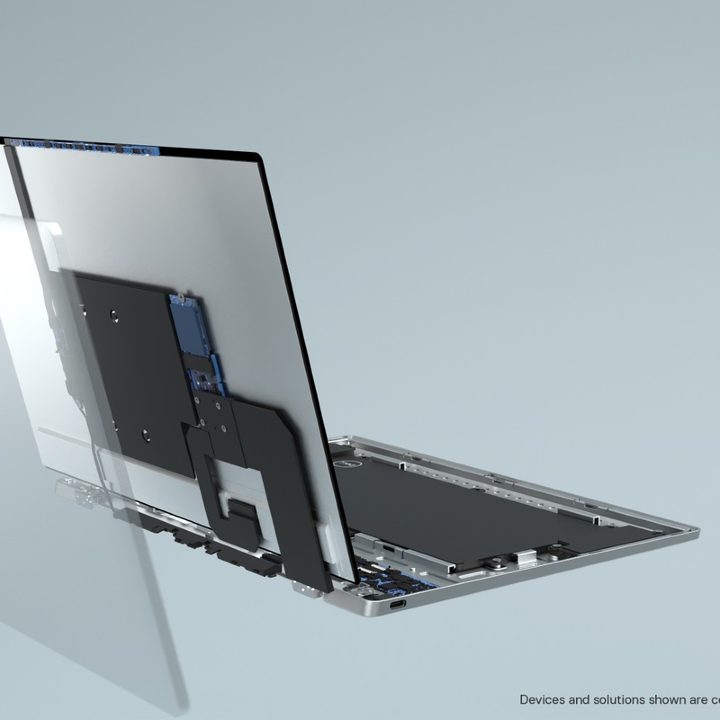
Image used with permission by copyright holder

These would need to be marked down, of course, and Dell was aware that some discounts might be needed to entice consumers.

Dell claims this new design would reduces its carbon footprint by 50%, primarily due to the internals and motherboard.

None of this is set in stone, of course. Concept Luna is still just an idea, though Dell already had a working model of these laptops to show off.

As right to repair increasingly becomes a pressing issue for tech companies, we should expect to see more attempts to make meaningful improvements to repairability. The Framework Laptop is built entirely around this idea, and even the new MacBook Pro made some positive changes that impact repairability.

 
Luke Larsen
Former Senior Editor, Computing
Luke Larsen is the Senior Editor of Computing, managing all content covering laptops, monitors, PC hardware, Macs, and more.
I’m not sold on Googlebook’s future, but it sure has two big wins I can’t ignore
Magic Pointer and native Android app could help Googlebook prove its future
Googlebook

Shortly after its announcement, the discourse surrounding Googlebook quickly took over forums, subreddits, X, and other social media platforms. Google just introduced a new category of laptops built around Gemini Intelligence, Android integration, ChromeOS, phone continuity, premium hardware, and OEM partners.

Yet, I am still not fully sold on the larger future Google is describing here. Google has been in laptops for more than 15 years through Chromebooks, and the company itself frames Googlebook as a move from an operating system to an “intelligence system.” This sounds like the "future" of laptops, but it also carries the Google problem, where it introduces an interesting idea before the ecosystem has proven itself.

Read more
Google will let some Chromebooks transition into a Googlebook experience soon
Google says some existing models will move into the Googlebook experience, while ChromeOS support continues for devices left behind
Clothing, Coat, Footwear

Googlebook is launching this year, but Google isn’t cutting every Chromebook loose.

In an interview with Chrome Unboxed, Google VP John Maletis said some Chromebooks will be able to move into Googlebook-style software through a firmware update. This means Googlebook shifts Google’s laptop plans toward an Android foundation, with Gemini built more deeply into the laptop experience and Android apps no longer sitting behind the same emulation layer.

Read more
Googlebook laptops will come in multiple chip options beyond just Intel, and that’s a relief
More chips, more choices. Google is giving Googlebook buyers real hardware flexibility from day one.
Googlebook

After Google's bombastic Android Show, where the company unveiled tons of new features, Google VP John Maletis sat down with Chrome Unboxed to talk Googlebook. The interview contains several nuggets of information, and one of the most reassuring confirmations we got was about the chips powering these new laptops. 

Maletis said that Google is working with Intel, Qualcomm, and MediaTek, meaning the platform won't live or die by a single silicon provider. For anyone who has followed the Chromebook space for a while, this is genuinely good news.

Read more