  1. Home
  2. Computing
  3. Android
  4. Emerging Tech
  5. Legacy Archives

Epson’s augmented reality smart glasses show off gesture control at Google I/O

Add as a preferred source on Google
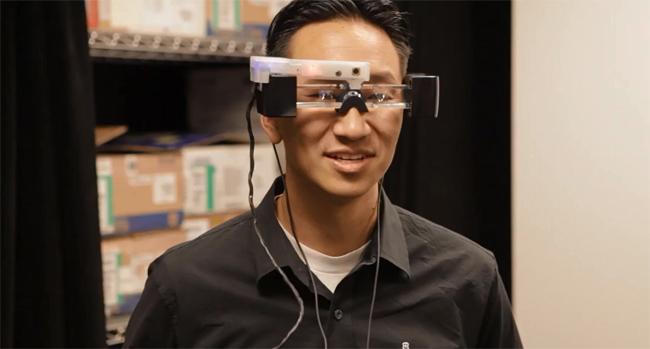
Epson Moverio BT100 smart glasses_google io 2013
Image used with permission by copyright holder

All the cool kids at Google I/O may be walking around with Google Glass, but they can only see the interface out of one eye and need to use their voice or swipe their finger against the side of the eyewear to navigate the device. With the APX Labs enhanced smart glasses from Epson, called the Moverio BT-100, you can navigate a virtual wall of YouTube videos with just a tilt of your head.

These Epson smart glasses have actually been on the market for over a year and are the result of over 15 years of research and development. While Google Glass is more geared for consumers, the Moverio BT-100 has its eyes set on developers and commercial uses for hands-free computing.

Recommended Videos

As you can see in the photo, the $700 Moverio smart glasses feature a pair of transparent lenses so you can see 3D augmented reality content projected on top of the real world. Eric Mizufuka, product manager of new markets for Epson, assured us that looking through these glasses is like looking at a “floating” 80-inch display. These glasses also have on-board Wi-Fi connectivity and are wired to an Android-based mini-touchpad where you can side-load content like Angry Birds via its microSD card slot.

But without a front-facing camera or other motion sensors, the Moverio glasses have limited functionality. That’s why APX Labs updated the BT-100 with a 5-megapixel camera, a microphone, and motion sensors like a gyroscope, an accelerometer, and a magnetometer. Currently, these additions to the Epson glasses are housed in a white box above the lenses, but both companies would like to work those technologies into the frames so they will look more slick over time.

To show off what these suped up Moverio glasses can do, APX Labs also created a YouTube app that takes advantage of its Northstar user interface to navigate a wall of videos using just your head movements. To see all the videos that are available on the app, you simply have to move your head left and right to bring those clips within view, according to APX Labs’ Director of Research and Development Jay Kim. When you want to watch a particular video, simply look up or down at the video until it gets highlighted, and it will start playing. To fast-forward or rewind the clip, just turn your head to the right or left, respectively.  

These APX Labs enhanced Moverio smart glasses from Epson makes hands-free navigation extremely intuitive, and we hope it will be able to bring their expertise to the consumer realm soon.

[Image via the MoverioChannel on YouTube]

Gloria Sin
Former Contributor
Gloria’s tech journey really began when she was studying user centered design in university, and developed a love for…
Layr is a new macOS clipboard manager that replaces hotkeys with trackpad gestures
This new Mac app opens clipboard history with a four-finger tap instead of a keyboard shortcut
Cursor open on Mac

macOS users already have several clipboard manager options, including Paste and Maccy. Most of them work well, but they are usually built around keyboard shortcuts. That is useful for keyboard-heavy users, but it can feel out of place for users who rely on the trackpad for most of their work.

Layr, a new clipboard manager from the developer behind Declutr, takes a different approach. Rather than assigning a keyboard shortcut to open the clipboard history, the app lets users bring up a clipboard overlay with a four-finger tap on the trackpad.

Read more
YouTube’s AI content labels are getting a much-needed makeover
No more hunting through descriptions. YouTube's AI labels are finally moving front and center.
YouTube ai declaration longform video

This year’s Google I/O marked the transition of Google from a search company to a fully AI-focused company. The company launched several AI tools, but the one that matters the most for YouTubers is Google Omni, built for video generation and editing. 

While tools like Omni lower the barrier for creators, which is a good thing, it also results in the platform being inundated with low-effort AI content. The company understands that this will annoy a large percentage of its users, so it has been asking creators to disclose AI-generated content since 2024. 

Read more
AI models have a religion favoritism problem, and new research exposes it
AI models are subtly steering users toward certain religions, and most people have no idea it's happening.
Artificial Intelligence

A new research consortium has found something worth paying attention to: when you ask AI about grief, love, loss, or moral decisions, it almost never brings religion into the conversation.

The Consortium for Evaluation of Faith and Ethics in AI (CEFE-AI), a collaboration among researchers at Brigham Young University, Baylor University, the University of Notre Dame, and Yeshiva University, published its findings this week at the Summit on AI Ethics in Athens, Greece.

Read more