  1. Home
  2. Computing
  3. Trash
  4. News

This portable display might be the touchscreen iMac substitute you’ve wanted

Add as a preferred source on Google

There are plenty of portable displays on the market that allow you to mirror or extend the screen of your laptop while mobile, but Australian startup Espresso Display is bringing some new innovation to the space with its mobile touchscreen-powered screens. The new Espresso Displays — available in 15- and 13-inch sizes with and without touch support — are the thinnest mobile displays on the market, measuring just 5.3mm thick.

To achieve this thinness, the company used aeronautical-grade aluminum for the construction. The displays are designed to work with desktops and laptops running Windows and MacOS operating systems, as well as Samsung’s smartphones if you want to run a DeX desktop UI while mobile.

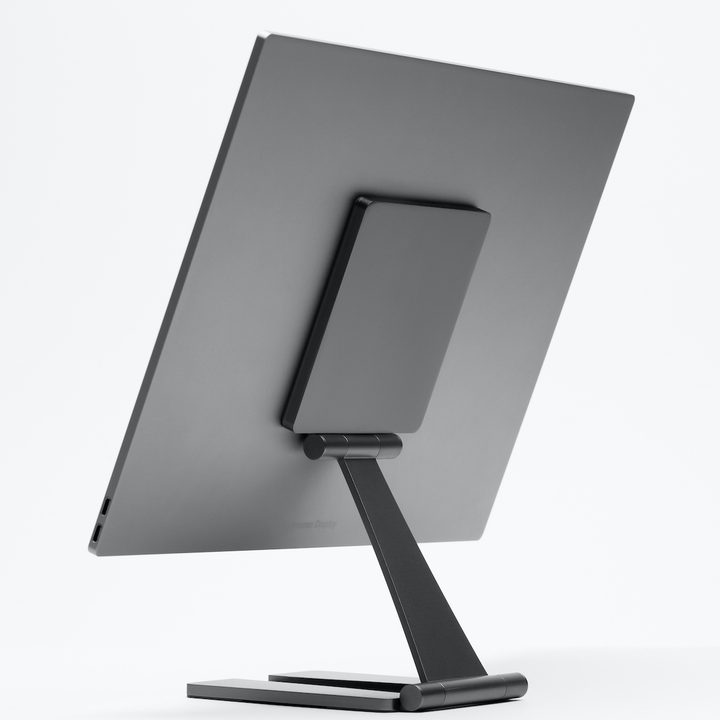
Espresso Display's portable screen can be mounted to a desktop stand to give you an iMac-like aesthetic.
Image used with permission by copyright holder

Another big standout with the Espresso Display is that it comes with its own ecosystem of magnetic mounting accessories that brings added versatility when using the mobile screen.

There’s an EspressoStand, which allows you to use the Espresso Display at your desk like a desktop monitor, an EspressoMount to allow you to mount the screen to a wall or attach the screen to a VESA arm, and a CaseGo, which adds a kickstand experience for mobile productivity, similar to the kickstand on Microsoft’s Surface Pro tablets. When mounted to the EspressoStand, for example, the Espresso Display looks like it could be a compact iMac with narrow top and side bezels, along with a chin on the bottom. The accessories work like Apple’s MagSafe for the mobile touchscreen.

And finally, the EspressoPen is a stylus that can add pen input functionality to laptops that don’t support touchscreen or pen experiences, like Apple’s MacBook Pro.
Espresso Display's mounts and accessories magnetically attach to the mobile display.
Image used with permission by copyright holder

The screen of the Espresso Display tops out at FHD resolution, so unfortunately it doesn’t support as many pixels as more premium 4K UHD mobile displays on the market today. The Espresso Displays have a refresh rate of 60Hz and a maximum brightness of 300 nits. There are three models in the second-generation series, including a 15-inch touchscreen version, a 13-inch touchscreen version, and a 13-inch non-touch edition.

The Espresso Display will be up for pre-orders starting December 21, with the non-touch edition going for $339. The 13-inch with touch will retail for $439, while the larger 15-inch model will cost $499. All the mounts — including the mobile case — are priced between $69 and $99, while the EspressoPen is priced at $79.

Chuong Nguyen
Silicon Valley-based technology reporter and Giants baseball fan who splits his time between Northern California and Southern…
Layr is a new macOS clipboard manager that replaces hotkeys with trackpad gestures
This new Mac app opens clipboard history with a four-finger tap instead of a keyboard shortcut
Cursor open on Mac

macOS users already have several clipboard manager options, including Paste and Maccy. Most of them work well, but they are usually built around keyboard shortcuts. That is useful for keyboard-heavy users, but it can feel out of place for users who rely on the trackpad for most of their work.

Layr, a new clipboard manager from the developer behind Declutr, takes a different approach. Rather than assigning a keyboard shortcut to open the clipboard history, the app lets users bring up a clipboard overlay with a four-finger tap on the trackpad.

Read more
YouTube’s AI content labels are getting a much-needed makeover
No more hunting through descriptions. YouTube's AI labels are finally moving front and center.
YouTube ai declaration longform video

This year’s Google I/O marked the transition of Google from a search company to a fully AI-focused company. The company launched several AI tools, but the one that matters the most for YouTubers is Google Omni, built for video generation and editing. 

While tools like Omni lower the barrier for creators, which is a good thing, it also results in the platform being inundated with low-effort AI content. The company understands that this will annoy a large percentage of its users, so it has been asking creators to disclose AI-generated content since 2024. 

Read more
AI models have a religion favoritism problem, and new research exposes it
AI models are subtly steering users toward certain religions, and most people have no idea it's happening.
Artificial Intelligence

A new research consortium has found something worth paying attention to: when you ask AI about grief, love, loss, or moral decisions, it almost never brings religion into the conversation.

The Consortium for Evaluation of Faith and Ethics in AI (CEFE-AI), a collaboration among researchers at Brigham Young University, Baylor University, the University of Notre Dame, and Yeshiva University, published its findings this week at the Summit on AI Ethics in Athens, Greece.

Read more