
HTC took to its ViveCon virtual reality conference to announce two new VR headsets that cater to professional and enterprise needs. From the stand-alone Vive Focus 3 to the PC-based HTC Vive Pro 2, HTC VR owners will benefit from some big upgrades this year.
The company cited PwC’s research, which predicts that VR and AR will add more than $1.4 trillion to the global economy by 2030 in highlighting the importance of virtual reality. At stake is the creation of hundreds of thousands of new jobs across every sector and industry, HTC said.
To prepare businesses for the VR revolution, both new HTC Vive headsets have been refreshed to feature a wider 120-degree field of view (FOV) for a more natural and immersive look into the virtual world, enhanced refresh rates, a dual element lens design, and a total display resolution of 5K. The company claimed that both headsets are designed to be comfortable to wear, which is important for long sessions in VR.
“The set of solutions HTC Vive is going to introduce today are made from the ground up for businesses, enterprises, and professionals,” HTC executives stated during the company’s keynote presentation. “We honed in on some areas to deliver the best results. The easiest execution, and the fastest and most compliant deployment.”
The company claimed that it engaged with users and listened to feedback, and the HTC Focus 3 and HTC Vive Pro 2 were created in response.
HTC Vive Focus 3

HTC made some big changes to make stand-alone virtual reality experiences more immersive and natural, and the company spent a considerable amount of the Focus 3’s introduction talking about the headset’s screen.
New this year is a dual-2.5K display that results in an overall combined resolution of 5K. HTC claimed this is a 260% boost from the prior generation all-in-one headset. The company also stated that the subpixels have also been increased, and now there are 400% more subpixels across the entire display.
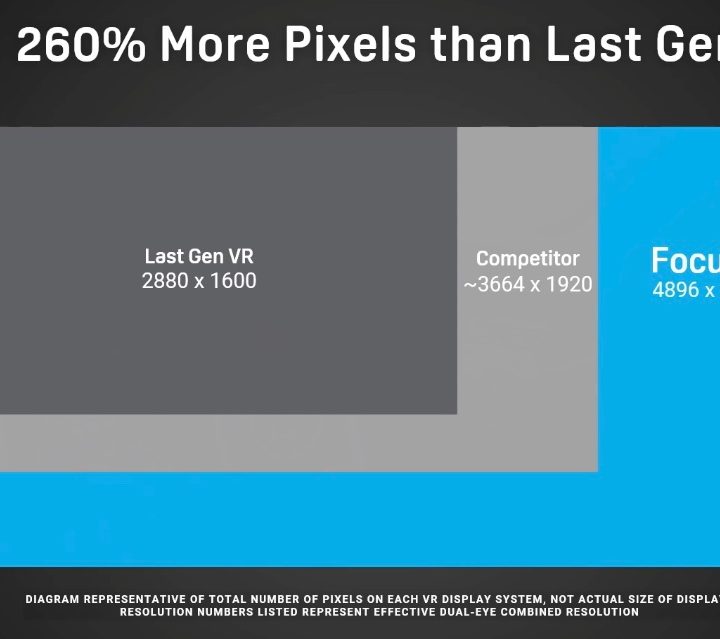
“But what are the benefits of higher resolution?,” HTC Americas’ Dan O’Brien asked rhetorically. “Such a rich display enables more natural interactions: No more moving closer to make more details visible, and that allows everything to be designed in a more realistic way. No longer having to worry about accounting for loss of fidelity. So now the amazing health care professionals doing their training can see the writing on the instruments and tools just by glancing instead of having to physically move closer.”
The Vive Focus 3 also widens the field-of-view to 120 degrees this year and bumps the refresh rate to 90Hz, up from 60Hz. O’Brien claimed that this level is on par with many PC-based virtual reality headsets.
Given that the Focus 3 is intended as a stand-alone solution, HTC designed the battery to be easily replaceable, and the rear-mounted battery serves as a counterweight for added comfort rather than forcing the VR’s screen to your face. The battery can also be quickly recharged, reaching 50% in just 30 minutes, HTC claimed.

“Our research shows, on average, people are using VR, more often and for longer sessions,” O’Brien said. “So the Focus 3 is designed to be durable and lightweight. It has a magnesium alloy frame that’s 20% lighter and 500% stronger than traditional plastic. The Focus 3 was built for comfort, featuring a new strap designed to distribute weight, and the intelligently designed custom battery pack that curves at the back of the head, providing a natural counterweight.”
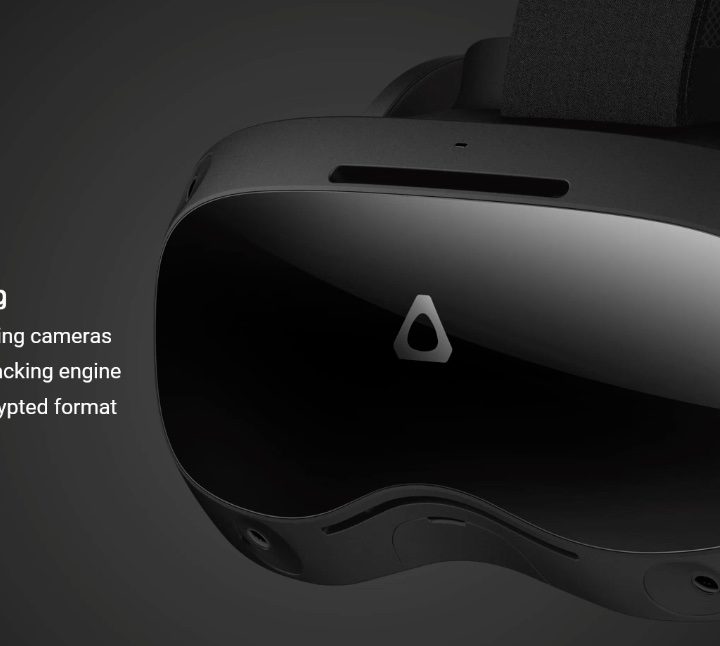
Other features include an adjustable IPD to adjust the distance between the screens to match your eyes, and life-like open-back audio, noise-canceling microphones, and an A.I.-powered inside-out tracking algorithm that is designed to work with the headset’s four high field of view cameras.
“Privacy is at the forefront with all tracking data stored in an encrypted partition on the headset, using a method where it’s practically impossible to reverse engineer,” HTC claimed.

Powering the Vive Focus 3 is Qualcomm’s Snapdragon XR chipset, which comes with 8GB of RAM. The headset is kept cool with a heat pipe and a single fan.
HTC Vive Pro 2

For users who need more power than a stand-alone solution, HTC also introduced its updated Vive Pro 2. Like the stand-alone Focus 3, the Vive Pro 2 features a wide 120-degree field of view, a 5K combined resolution display, and a focus on comfort and ergonomics.
What sets the Vive Focus Pro 2 apart — other than it requires powerful PC-based graphics — is that it supports a faster 120Hz refresh rate compared to the Focus 3’s 90Hz.
“Vive Pro 2 has smooth and sharp visuals with stunning clarity,” HTC execs claimed during the keynote presentation. “It has dual 2.5k screens, and the new dual-lens configuration seen on the Focus 3.”
The result is a 260% bump in resolution and an increase of 400% to the sub-pixel count.
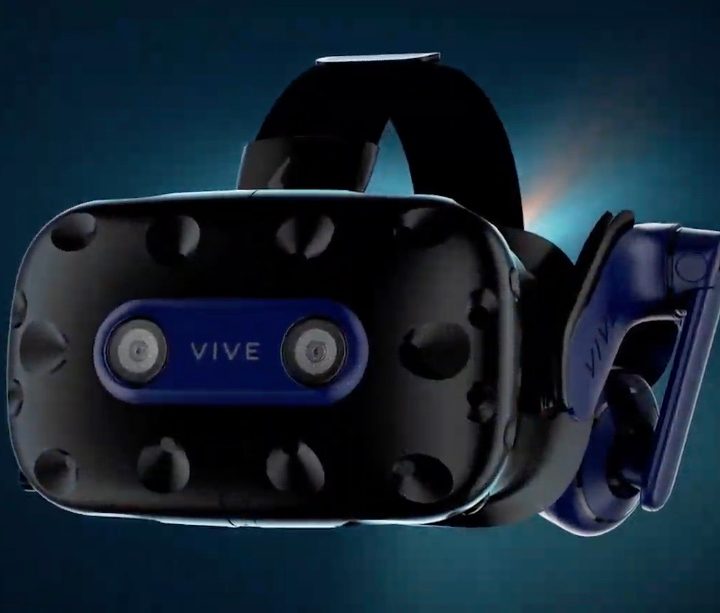
“You can see an amazing amount of detail with Vive Pro 2 to complement the crisp and sharp screen.,” HTC said. And to complement the immersive visuals will be 3D spatial audio support with the integrated headphones.
To get to this level of picture clarity, HTC worked with Nvidia and AMD, and the Pro 2 is the first headset to leverage the Display Stream Compression technology, which is a lossless way of squeezing all of the visual data while maintaining backward compatibility with DisplayPort 1.2, HTC executives said.

“That means if your PC was compatible with the original Vive Pro, it’s also compatible with Vive Pro 2,” HTC stated. “If your graphics card doesn’t support display stream compression, you can still benefit from the panel’s new massively reduced screen door effects. All of this means more details and complex models, or remain sharp and clear, even as you’re moving.”
Like the original Vive Pro, comfort is still a major part of the headset’s design, with padded gaskets that work with eyeglasses, adjustable IPD, and more.

The company also unveiled a new Vive Facial Tracker to bring empathy into the virtual world.
“One of the reasons why VR is so good for social interactions is because of how empathetic it is,” HTC said. “VR allows you to focus and interact together in a more natural way. helping to bring VR to life is Vive Facial Tracker, which has been a big hit since we launched it just a few weeks ago. Capturing 38 different blend shapes across the face, it allows you to create expressive characters and convey those all-important nonverbal cues like the subtleties of the smile.”
HTC said that the Vive Pro 2 is backward compatible with existing trackers and the ecosystem of hardware, so you can mix and match your setup.
The HTC Vive Pro 2 will go on sale on June 3, and pre-orders start today. The Focus 3 will go on sale on June 24. HTC did not announce pricing for either headset during its keynote presentation.
Vive Software solutions for businesses

HTC announced a number of solutions for businesses, but the chief software bundle for enterprises shifting to remote work is that the Vive Sync application is now out of beta. Vive Sync allows teams and organizations to have shared experiences — like meetings and birthday parties — through virtual reality, and the app is now part of the Vive XR Suite.
The company also announced the Vive Business App Store to help users find curated apps, and it is also building an ISV program to help bring more VR tops to the store. To date, more than 50 ISV partners have signed on.
“It is also thanks to the Vive ISV program that we can offer businesses easy access to trusted developer partners for their bespoke VR needs,” HTC stated. “The ISV program has been a priority for us in the development of Vive Business.”
For enterprises managing a fleet of Vive headsets, HTC also announced its Vive Business Device Management system, which works like an MDM system. Rather than have users purchase individual apps, IT managers can manage licenses and seats with the Business Device Management system.

“It’s an entire enterprise VR network at your fingertips,” HTC executives stated. “You can manage licenses, send proprietary or purchase content to devices, assign programs by individual or by group. You can also do batch configuration for setting up new devices efficiently manage software updates securely and get analytics, of how your devices and accessories are performing.”
HTC Vive Focus 3 will come with six months of access to the Business Device Management system and Vive Sync Enterprise for free.

The company also announced Vive Business Training, a tool that can be managed from a tablet and is designed for group training. The trainer will have access to what each person in the group is seeing on their headsets through different windows on the tablet, and highlight an item or move a user through a section.
HTC calls this “the total solution of software and services for an organization, big or small, to get into virtual reality in a scalable, compliant, and secure way.”


