  1. Home
  2. Computing
  3. Web
  4. Legacy Archives

Fake DigiNotar certificates targeting Iranians?

Add as a preferred source on Google
DigiNotar Iranian traffic surge (Trend Micro)
Image used with permission by copyright holder

Computer security firm Trend Micro says fake digital certificates from compromised Dutch certification authority DigiNotar were part of a broad-scale man-in-the-middle attack targeting Iranian Internet users—and may have left political dissidents, activists, and others trying to bypass Iran’s online censorship regime vulnerable to eavesdropping.

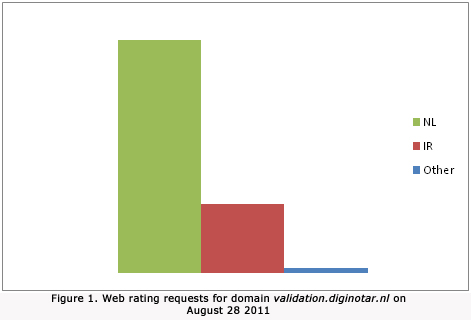
DigiNotar catapulted into the news late last month when it was discovered to have issued a rogue certificate for Google.com, making it possible for third parties to carry out man-in-the-middle attacks on Google services—like Gmail—as if they were trusted and verified systems controlled by Google. Online security professionals tried to react quickly, but Trend Micro noticed something very odd about requests for domain validation through diginotar.nl: it’s a small firm that mostly serves customers in the Netherlands, so one would expect most of its domain validation requests to come from the Netherlands. And that’s true. However, beginning August 28 a significant number of Internet users requesting domain validation through DigiNotar were from Iran. No other countries saw any significant uptick in domain verification requests through DigiNotar.

Recommended Videos

The unusual spike in requests started on August 28, dropped off substantially by August 30, and was all but gone on September 2.

“These aggregated statistics [..] clearly indicate that Iranian Internet users were exposed to a large scale man-in-the-middle attack, where SSL encrypted traffic can be decrypted by a third party,” Trend Micro senior threat researcher Feike Hacquebord wrote.

Trend Micro also notes that several Web proxy systems in the United States—which are widely used by individuals wishing to access sites anonymously and without revealing their IP address or other details—were also sending Web validation requests for DigiNotar. Trend Micro speculates that these proxy services were being used by Iranian citizens seeking to work around government censorship—but the fake trust certificates would have meant their encrypted communications could have been intercepted anyway.

Trend Micro’s analysis is based on the company’s Smart Protection Network, which collects and analyzes data from Trend Micro customers around the world, including what domain names are accessed by customers at particular times.

Geoff Duncan
Former Contributor
Geoff Duncan writes, programs, edits, plays music, and delights in making software misbehave. He's probably the only member…
Topics
The maker of ChatGPT wants to make open-source projects less of a security bargain
OpenAI launches Patch the Planet for open-source security, with over 30 open-source projects on board.
openai-chatgpt-os

OpenAI has launched Patch the Planet, a new initiative aimed at fixing one of the internet's quietest problems – the chronically underfunded security of open-source software.

Patch the Planet pairs OpenAI's most security-capable AI models with Trail of Bits, a security firm that has committed its entire research organization to the effort, alongside support from HackerOne and Calif.

Read more
I sifted through the Prime Day chaos to find the best Apple deals actually worth buying
Apple's about to hike prices. Prime Day 2026 is your last chance to save up to $150 on MacBooks, AirPods, and iPads.
Prime Day Deals on Apple Products

Apple is set to increase the prices for its upcoming iPhones and MacBooks, as the company can no longer offset the rising RAM and storage costs. That means, if you are looking to upgrade your aging device, you should buy the current-generation Apple products rather than wait for the new ones.

And since Amazon Prime Day is offering good discounts on the latest iPhones, iPads, MacBooks, and other Apple accessories, this is the perfect time to buy them. Here are my favorite Amazon Prime Day deals for Apple products. 

Read more
This sneaky photo trick gets AI chatbots to ignore their safety rules
Florida International University researchers built a method that nearly doubled the rate of harmful responses from a tested AI model using nothing but pixel-level edits in an image.
JaiLIP AI chatbot exploit image

A photo that looks completely ordinary to you could carry a hidden instruction to trick an AI chatbot into ignoring its safety rules, according to new research out of Florida International University. The study found that pixel-level alterations in an image that are invisible to the human eye can be enough to confuse the model reading the image and lead it to generate responses it would normally block.

Hacking what the AI sees

Read more