
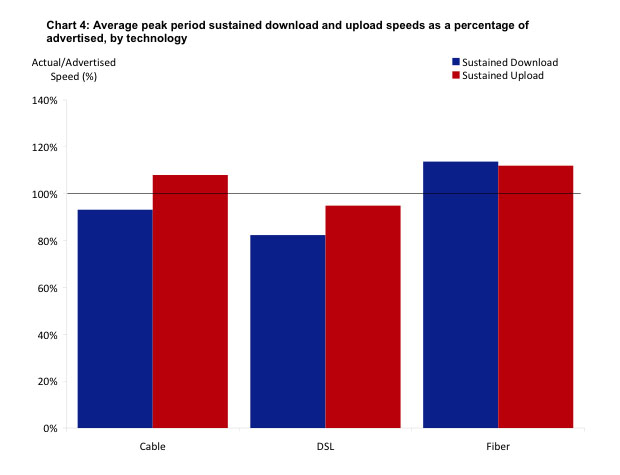
A new FCC report looks at the state of broadband Internet access in the United States and generally finds that providers are improving on actually delivering the upload and download bandwidth they advertise to their customers—but, as a group, they aren’t there yet. The FCC’s Measuring Broadband America report finds that providers are generally delivering 80 to 90 percent of advertised capacity to consumers, with a small number of providers actually over-delivering. Moreover, providers generally did a good job of keeping their networks moving along, even during peak usage period.
“[The results] will enable consumers to compare the actual performance of different broadband offerings with a new level of detail and accuracy,” the FCC wrote in its summary. “In addition, the methodology developed in this study can serve as a tool to help broadband providers, including those that did not participate in this process, measure and disclose accurate information regarding the performance of their broadband services.”
The study looked at broadband service offerings by over a dozen of the largest broadband operators in the United States during March 2011, comparing actual versus advertised bandwidth, sustained download and download speeds, latency, the impact of burst technologies, and application-level performance for Web browsing, streaming video, and VoIP.
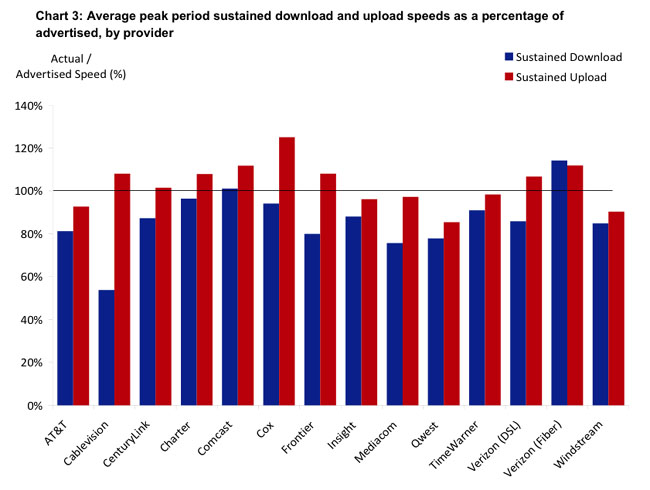
Overall, most providers studied offered actual bandwidth significantly closer to advertised bandwidth compared to similar data from 2009, although performance varied significantly between providers and broadband technologies.
In general, DSL-based services delivered 82 percent of advertised bandwidth during peak periods, where cable-based solutions delivered 93 percent of advertised bandwidth. Fiber-to-the-home services, in comparison, typically delivered 114 percent of advertised bandwidth during peak periods. Fiber-to-the-home services also tended to over-deliver on upload speeds (although no service suffered dramatically during peak periods) as well as the lowest latency—which can have a significant impact on interactive services like games and VoIP.
Verizon’s fiber services and Comcast cable were the only providers to, on average, delivery 100 percent or more of the bandwidth they advertise to consumers. Several providers (Cablevision, CenturyLink, Charger, Cox, Frontier, and Verizon DSL) were able to deliver more upload capacity than advertised, but none were able to consistently deliver 100 percent of advertised download bandwidth during peak periods. In terms of download bandwidth, Cablevision fared the worst during peak periods, delivering just half the bandwidth of its 15Mbps offering, although Qwest and Frontier’s 7Mbps and 3Mbps DSL offerings didn’t fare much better at 67 percent and 69 percent of advertised bandwidth, respectively.
The study did not examine mobile broadband services.


