There’s something so viscerally wrong about seeing Halo on a Mac. Apple’s computers aren’t known for gaming, sure, but Halo, in particular, looks out of place. It’s Microsoft’s star child, and it’s the franchise Microsoft has hung its hat on for 22 years.
But the game was originally designed for the Mac, and now, you can play it right on your MacBook. Apple’s recent Game Porting Toolkit makes all kinds of Windows games playable on the Mac — in theory. Considering the franchise’s storied history with Apple, I gave it a shot to see if the platform is ready for prime time and if I could fulfill the legacy of Halo as a game made specifically for the Mac.
Halo, the Mac exclusive?

It shouldn’t come as a surprise that there’s no official way to play Halo on a Mac. Microsoft doesn’t currently own the game’s developer, Bungie, but it definitely owns Halo, meaning the majority of the franchise has been available exclusively on Xbox and PC over the years. That remains true today with The Master Chief Collection, which has become the de facto way to play through all the updated versions of the games under one roof, short of Halo Infinite.
There’s one part of Halo’s history, though, that Microsoft would rather not celebrate. Specifically, Bungie’s early beginnings as a poster child for Apple’s ecosystem — not Microsoft’s.
The company was founded by Alex Seropian and Jason Jones in 1991. In 1992, the company released its first game: Minotaur. The game was originally developed by Jones, and the duo ported it over to the Macintosh from the Apple II. From there, Bungie turned into an Apple superstar. Most remember Bungie on Apple for its Marathon trilogy, which was built for Apple’s platform as an alternative to PC-exclusive shooters.
Apple’s close partnership with Bungie in the early years of the company didn’t go unnoticed. It all came together at Macworld 1999, where Steve Jobs, wearing his signature black turtleneck, announced a new game exclusively built for Mac: Halo. It’s not the Halo we know today. Master Chief is there, but the game was originally developed as a strategy game, and by the time it was announced at Macworld, it was a third-person shooter.
Then, things changed. Microsoft purchased Bungie in 2000 and introduced its first console exclusive, Halo: Combat Evolved. This reportedly infuriated Jobs. Why? Apparently Jobs wanted to purchase Bungie for himself.
Halo: Combat Evolved released in 2001 exclusively for Microsoft’s new Xbox console. Two years later, in 2003, it was eventually ported to PC and Mac, following on a promise that Ed Fries, former vice president of game publishing at Microsoft, had made. No other Halo game has released on Mac since. The original Mac release is available if you look online, and you can even play it as long as you’re using macOS Mojave or older.
Despite its origins, Halo remains the furthest thing from being associated with Apple as you can imagine. But armed with Apple’s new Game Porting Toolkit, I was about embark in some revisionist history.
The Game Porting Toolkit mess

Apple’s new Game Porting Toolkit is a big deal. If you’re unfamiliar, this toolkit essentially builds a Windows emulation environment inside of macOS itself. It’s made as a developer tool, allowing devs to test their games on Mac within minutes before dedicating to a full port. It also supports DirectX 12, while other virtualization tools like CrossOver don’t. Most importantly, the Game Porting Toolkit is a free resource you can download from Apple’s developer website — and it’s already being celebrated as a way to transform Macs into a legitimate gaming platform.
To my disappointment, setting up the Game Porting Toolkit is quite complicated. For starters, you should be using macOS Ventura, and you need the Xcode 15 beta for it to work. After downloading and mounting the toolkit, Apple offers a write-up for getting it installed, which includes a barrage of commands you need to enter in the Terminal.
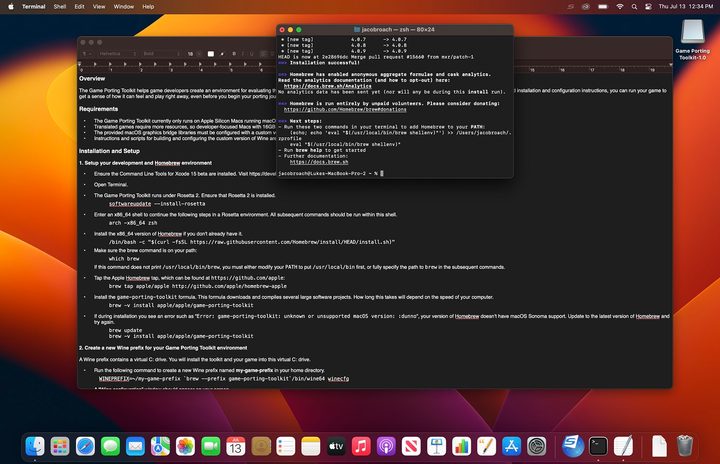
I tried this for hours, but I could never get the Game Porting Toolkit to build properly. Beyond even installing the toolkit, you need to do some work to point it toward the right directory, configure Wine, and install storefronts like Steam, all through the Terminal. It’s a hassle. I guess there’s a reason I’m a writer and not a game developer, huh?
Thankfully, I didn’t need to go through the trouble. An open-source program called Whisky can configure all of this stuff manually, and that’s what I used to get the Game Porting Toolkit working on a M1 Pro MacBook Pro. It creates “bottles” that house different virtual machines, along with a graphics interface for configuring them. I made a Windows 10 bottle, downloaded the Windows installation files for Steam, placed them in the virtual C: drive, and I was off to the races.
Now, it was time to install and boot up The Master Chief Collection. It took a few tries, but after a several minutes, I was hearing the iconic Gregorian chant blasting out of the MacBook Pro’s excellent speakers. Weird.
That’s when things went off the rails, though. Halo Reach comes preinstalled, and it worked decently. I played through a few missions, and outside of some minor stuttering and a few graphics issues, it was smooth, even with the Enhanced graphics preset. Halo CE Anniversary Edition was a different beast entirely.
The only way I could get the game to run was to use the original textures — like, the 2001-era Xbox textures — and even then, the frame rate would tank any time I was in combat. Some levels, such as the final mission, called The Maw, just didn’t load. Other missions, such an expansive outdoor map like The Silent Cartographer, turned into a slideshow even outside of combat.

Performance issues aside, there are definitely a lot of other problems with trying to play the games this way. For starters, anti-cheat software blocks you from playing any online multiplayer. Even if you can live with that, there are a slew of visual bugs and usability issues, and I’m sure I’ve only seen a fraction of those that are present across the six Halo games included in the bundle.
The most annoying thing was the fact that any overlays in the pause menu wouldn’t appear. That meant I couldn’t adjust graphics settings while playing, and that I had to force the program to close if I wanted to quit the game. To put it lightly, all these problems broke the immersion of pretending this game was actually built for the Mac.
Things could have been different
Despite all the hiccups, The Master Chief Collection does technically run on the Mac through the Game Porting Toolkit, and it was a bit surreal to see it up and running — warts and all. That feeling was even stronger when I gave up on Apple’s official toolkit and tried out CrossOver. Because Halo can run on DirectX11, The Master Chief Collection became playable using CrossOver with an update in early 2022. The setup was simpler and performance was far more stable across all the games.
It still had its issues in CrossOver (especially with Halo 2), but for a fleeting moment, I was able to imagine what could have been. I could see the alternate history where Apple bought Bungie and kept Halo as a Mac exclusive. How would Halo as a game franchise been changed? Would it never have achieved groundbreaking success and influenced the future of first-person shooters in the way it did? What would Xbox have been without Halo as its flagship title?
We’ll never know the answer to these questions, but it’s clear to see how Apple owning Bungie could have changed the course of the Mac. If Apple had planted its flag firmly in the world of PC gaming, the Game Porting Toolkit wouldn’t have needed to exist. Who knows how different the Mac brand would have been if it had embraced gaming earlier on.
As it stands, the Game Porting Toolkit is a first step toward regaining all that was lost by Apple more than two decades ago. For now, the ultimate legacy of Halo on Mac will remain just that — a legacy.