  1. Home
  2. Computing
  3. Web
  4. Legacy Archives

Google60 gives your standard search a slow, yet classy, retro makeover

Add as a preferred source on Google
Image used with permission by copyright holder

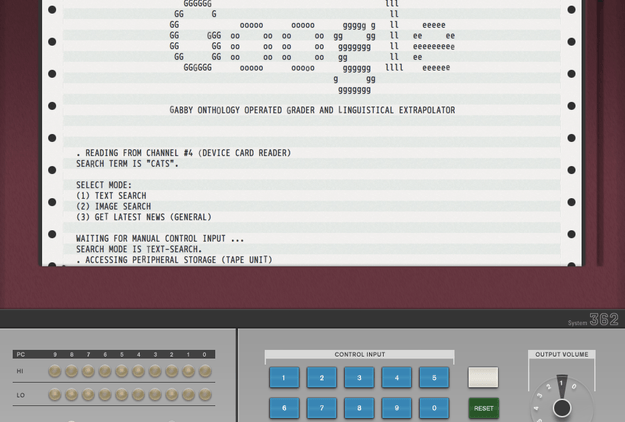
Designer and developer Norbert Landsteiner released an art project imagining what Google might’ve looked like in the 1960s. Google60 puts the search engine into an interface imitating a vintage IBM 360 computer. 

When you type a search term into Google60’s punch card, you’ll next see a slow printout of the Google name, which in this universe stands for Gabby Onthology Operated Grader and Linguistical Extrapolator. Next, you’re prompted to select a text, news, or image search. The system then accesses a tape deck that acts as “peripheral storage” while retrieving your data. After a bit of time, the results print out – one noisy line at a time – on tractor-feed paper. The sound is just as important as the look in creating the retro vibe. Landsteiner sourced the sound effects, which users can control under the Output Volume dial, from real devices including an IBM 129 Keypunch, and a Teletype Model 33.

Recommended Videos

No search data is transmitted to or from the artist’s site, masswerk.at, and instead connects directly to Google. Want to print your results to look like they do on screen? Make sure to enable background-images in your printer settings, and you should see the line-printer output.

It’s a slow, wildly impractical way to actually search for information, but it’s a kooky tool to play with and wander down memory lane. Searching for images is especially entertaining. Though Landsteiner isn’t affiliated with Google, this isn’t his first foray into casting a vintage light on Google. Earlier this year, he introduced Google BBS, which takes a more Technicolor ’80s-style approach to the tool. 

Anna Washenko
Former Contributor
Anna is a professional writer living in Chicago. She covers everything from social media to digital entertainment, from tech…
A simple coding mistake is exposing API keys across thousands of websites
Security gaps that are easier to miss than you think
Computer, Electronics, Laptop

After analyzing 10 million webpages, researchers have found thousands of websites accidentally exposing sensitive API credentials, including keys linked to major services like Amazon Web Services, Stripe, and OpenAI.

This is a serious issue because APIs act as the backbone of the apps we use today. They allow websites to connect to services like payments, cloud storage, and AI tools, but they rely on digital keys to stay secure. Once exposed, API keys can allow anyone to interact with those services with malicious intent.

Read more
AMD’s latest Ryzen 9 9950X3D2 pushes X3D to the limit
Dual 3D V-Cache, higher power, and a focus on enthusiast performance
AMD Ryzen 9 9950X3D2 FEatured

AMD has unveiled what might be its most extreme desktop CPU yet, the Ryzen 9 9950X3D2. And it’s going all-in on one thing: cache.

https://twitter.com/jackhuynh/status/2037159705395491033?s=20

Read more
Next-gen AI breakthrough promises chatbots that can read the room better
Researchers are teaching AI chatbots to read between the lines
Generative AI

Have you ever asked a chatbot something and felt like it completely missed your point? You say something with a bit of nuance, and the AI misses the subtlety entirely. That is exactly the problem researchers are trying to solve.

Even though the emotional connection with AI can feel deeper than human conversation for many users, most AI systems today still treat a sentence as a single block of sentiment. If you mix praise and criticism, the nuance often gets lost.

Read more