  1. Home
  2. Computing
  3. Legacy Archives

HP says Windows 7 is ‘Back by popular demand,’ gives Windows 8 the back seat

Add as a preferred source on Google

Both Microsoft and Windows 8 just got slapped in the face, hard. Who delivered the blow? None other than heavyweight PC manufacturer HP.

HP has launched a brand new effort on its official website to push Windows 7 systems over Windows 8 machines. On its homepage, HP says that laptops and desktops loaded with Windows 7 are “Back by popular demand.” This newly launched campaign to feature Windows 7 systems most prominently on its site is accompanied by details of a promotion where consumers could save up to $150 on a newly configured Windows 7 PC.


Win 7 HP Home

Recommended Videos

We took a look through HP’s site to see if this was a consistent theme throughout. We headed over to the laptops section, and though two of the first three systems featured ship with the 64-bit version of Windows 8.1 by default, stuck in the middle between them is the ENVY 15t-j100 notebook, loaded with the tried, tested and true Windows 7.

 HP win 7 laptops

Then we headed over to desktop-land. Sure enough, the first row of tower-based desktop PCs featured all include Windows 7 as opposed to the polarizing and touch-centric Windows 8.


HP win 7 desktops

Finally, we mozied on over to HP’s all-in-one desktop section, and there was yet another twist. What was the first item that came up? Not a Windows 7 desktop, nor was it a Windows 8 AIO. Instead, we found ourselves staring at the HP Slate 21-k100, an Android 4.2 desktop powered by an Nvidia Tegra 4 processor.
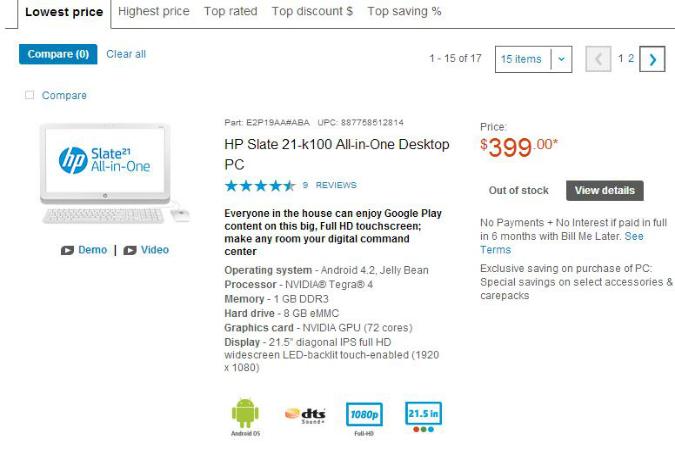
HP android aio

Between HP’s newly launched push to talk up Windows 7 and even Android rigs over Windows 8 machines, whispers of Microsoft employees calling Windows 8 “the new Vista,” and Windows 7 and Windows XP market-share absolutely outclassing Windows 8 adoption numbers, we can’t say we’re all that surprised about the move that HP has decided to make here. 

What do you think? Sound off in the comments below.

(Image source: HD Wallpapers)

Konrad Krawczyk
Former Computing Editor
Konrad covers desktops, laptops, tablets, sports tech and subjects in between for Digital Trends. Prior to joining DT, he…
AI’s chip hunger could keep memory prices painfully high for years
Memory shortages may haunt your next phone, laptop, and GPU for years
Crucial Memory and SSD

While recent reports claimed that memory prices may not fall till 2027, it seems like the memory chip crunch isn't a short-term headache. And that's bad news for anyone hoping phone, laptop, and GPU prices will get cheaper again soon.

Reuters reports that SK Group chairman Chey Tae-won said the global chip wafer shortage is likely to last until 2030, with artificial intelligence demand continuing to outpace the supply. Chey said the current shortage could remain above 20%, largely because AI systems require huge amounts of high-bandwidth memory and therefore burn through a lot of wafers.

Read more
One of the most controversial US agencies is reportedly taste-testing Anthropic uber-powerful Mythos AI
The agency's reported use of Mythos highlights a widening split inside the US government over AI risk
Claude AI on an iPhone.

The US government's AI fight just got harder to square. The National Security Agency is reportedly using Anthropic's Mythos Preview even as senior Pentagon officials keep pushing to cut the company off over supply chain concerns. It shows how quickly real security needs can outrun official policy.

Since February, the Defense Department has been trying to block Anthropic and push vendors to do the same. Yet, according to an Axios report, the NSA appears to be moving ahead with one of the company's most powerful models anyway, suggesting cybersecurity demand is carrying more weight than the feud now playing out inside government.

Read more
AI streaming is going mainstream in China, whether audiences want it or not
IQiyi wants AI to make most of its content someday, and it's already starting.
man holding tablet watching iQiyi

China's Netflix, iQiyi, is making one of the biggest bets in streaming history. The company wants AI to create the bulk of its films and shows someday soon, and it's already restructuring its 16-year-old business to make that happen.

At its annual content showcase in Beijing, founder and CEO Gong Yu announced that iQiyi is pivoting its popular streaming platform into a social media destination built around AI-generated content. 

Read more