

“Currently the king of the mountain in terms of performance, the iBuyPower Erebus delivers an ultra high-end gaming experience at a price to match.”
- Smokin’ performance
- Significant and stable overclocking
- No bloatware
- Looks expensive
- Is expensive
- A few odd design choices and inelegant solutions
- Noisy
“Why you can trust Digital Trends – We have a 20-year history of testing, reviewing, and rating products, services and apps to help you make a sound buying decision. Find out more about how we test and score products.“
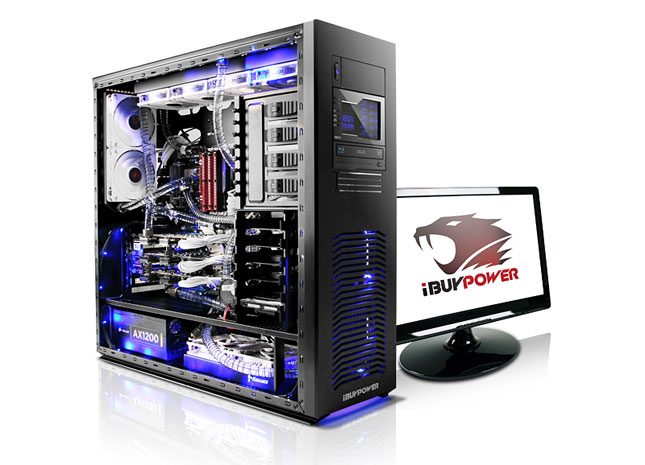
iBuypower’s brand new flagship Erebus system tips the scales at over 80 pounds (our review system arrived on a palette via a forklift) and contains a sampling of some of the best computer hardware available in today’s market. Expertly assembled, the Erebus rightly includes a window on the left side of the chassis to show off the system’s impressive guts, including an elaborate liquid cooling solution.
Note: Our review system is a pre-release review sample and some specs are subject to change. We tested the system as-is, except where as noted.
Specs
Details on the full range of options for the Erebus line weren’t available at press time, but our review model rocked an Intel i7-990X overclocked to a whopping 4.6GHz (up from a stock value of 3.46GHz). The processor sits on an Asus Rampage III Extreme motherboard, a mobo long popular with enthusiasts and DIY overclockers. A trio of “superclocked” NVIDIA GTX 580s push the polygons, and 12GB of DDR3-1600 Kingston HyperX RAM handle the random accessing of memory. The OS hard drive array consists of a pair of 90GB Kingston SSDNow solid-state drives in RAID0 (more on that later) for approximately 178GB of usable space. A conventional 3GB Hitachi Deskstar 7200RPM drive accompanies the SSD array to provide large, inexpensive storage.
 The system gets its juice from a 1200-watt Corsair power supply attached to the custom iBuyPower Erebus chassis. Cooling happens via a custom iBuyPower/Koolance liquid-cooling solution that snakes through the chassis interior. We also get a Sony 12x Bluray reader and Microsoft Windows 7 Home Premium.
The system came with a Thermaltake eSports Challenger gaming keyboard and matching mouse.
A small control module occupying one of the expansion card slots adjusts the brightness of the (tasteful) case lighting.
The Erebus comes with a 3-year limited warranty plus lifetime phone support and lists for $7,650.
Connectivity
The Erebus offers an array of connectivity options that should satisfy even the most accessory-happy among us.
The rear panel sports seven USB2.0 ports, two USB3.0 ports, powered eSATA, 1394, ROG Connect, optical S/PDIF out, and a mini-Bluetooth adapter. Connections on the front consist of two USB2.0 ports, an SD card reader, and two USB3.0 ports.
A note about the USB3.0 ports: the pair on the front of the chassis are connected to the system by a pair of USB cables that run along the top of the chassis, out one of the unoccupied grommet holes for liquid cooling conduit, and into the pair of USB3.0 ports on the rear of the chassis. As configured, you can only use one pair of USB3.0 ports at a time on the Erebus. While it’s nice to have USB3.0 ports on the front — and the cable run does get the job done — the solution looks a little bit not-ready-for-primetime.

An NZXT Sentry-LX fan control panel occupies two of the drive bays on the front of the chassis, displaying the time, radiator fan speed, and component temperatures.
Performance
As we saw with the Maingear Shift (which only had a pair of GTX 580s, compared with the Erebus’ trio), the Erebus utterly destroyed anything we threw at it game-wise. Batman: Arkham Asylum, Battlefield: Bad Company 2, Crysis 2… nothing dropped below 50 FPS, even during the most intense combat and action sequences with every conceivable setting pinned to maximum.
Running most currently popular gaming titles on the Erebus is a bit like shooting tin cans with a Browning M2 — complete overkill.

Running 3DMark Vantage in “performance” mode, the Erebus scored P55491: 49850 for the GPU, and a whopping 84009 for the CPU.
The dual SSD drives in RAID0 make general computing a very pleasant experience. Windows open almost instantaneously, and there’s almost zero lag from when you click on the Windows Start button and when the menu appears. The OS feels light and responsive, an experience confirmed by a PCMark7 score of 5552.
Boot time took a scant 41 seconds, thanks no doubt to the super-speedy HDD array.
Usability
The first thing you’ll notice upon powering on the Erebus is that it’s loud. Really loud. Especially for a liquid-cooled system. Granted, iBuyPower really pushes the overclocking with the Erebus, so perhaps some fan noise is inevitable. It’s just a little surprising that the computer would be almost as loud as the fan on the Viewsonic projector we used in conjunction with the Erebus during testing. That said, the system was completely stable throughout testing—no crashes, hangs or other anomalies.
Our review system also arrived minus any Blu-ray playback software for the Blu-ray drive. A representative from iBuyPower stated that production models will ship with such software already installed, but ours didn’t, which basically left us with an overpriced DVD burner for an optical drive.
Conclusion
No doubt the sticker-shock inducing pricetag will give many gamers pause, but when you get towards the top of the hardware performance curve, the law of diminishing returns takes over, and you start paying more money for only marginally better performance. But if you’ve got the scratch and need the speed, the Erebus certainly delivers. Though we dinged the system for some oversights and minor design quibbles, none of them were deal-breakers, and nothing caused us to have concerns about the long-term viability of the Erebus.
Currently the king of the mountain in terms of performance among the systems we’ve had on the test bench so far, the Erebus delivers an ultra high-end gaming experience at a price to match.
Highs:
- Smokin’ performance
- Significant and stable overclocking
- No bloatware
- Looks expensive
Lows:
- Is expensive
- A few odd design choices and inelegant solutions
- Noisy


