
Intel’s next-generation Xeon processors could come with support for new technologies to make servers fast, according to the latest leaked images. Leaked schematics for an engineering sample of Intel’s 4th-gen Xeon — which has a code name of Sapphire Rapids — indicate that the processor may add support for PCIe 5.0 and new eight-channel DDR5 memory. Support for the former would make Sapphire Rapids the first server processor to add PCIe 5.0 support, while support for the latter would bring Intel’s server into memory parity with its recently unveiled Alder Lake processors, which will arrive later this year.
For its part, Intel has not confirmed any information in the leak, but Wccftech reported that the schematics posted by YuuKi-AnS show that Intel’s powerful server processor can be used in high-performance computing (HPC) systems like exascale computers. In one slide deck, a configuration shows that two Sapphire Rapids processors would be paired with six Intel Xe-based graphics with unified system memory.

The GPU in this system is the Ponte Vecchio GPU that Intel recently unveiled, which shows off the full capabilities of what the company’s Xe architecture can do on the graphics side. The chipset comes in a two-tile design with a total of 8,192 cores capable of 21.1 TFLOPs of power. A separate four-tile design is also being developed that will double the power to 42 TFLOPs. For comparison, the GPU on Microsoft’s Xbox Series X game console is described to be capable of 12 TFLOPs of power.
Intel’s exascale computer system is expected to be delivered in 2021, according to the leaked slide.
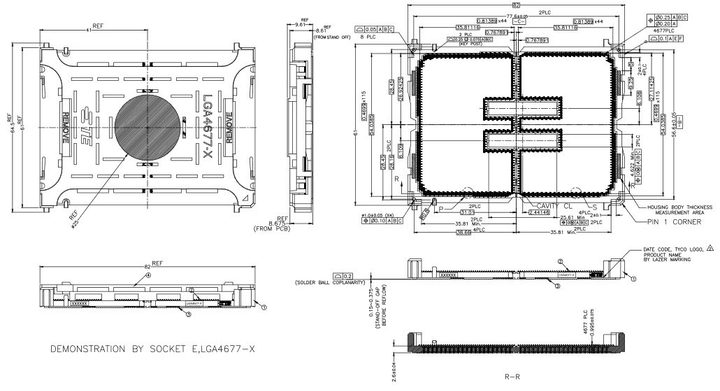
Moving from the Ice Lake SP architecture to the Sapphire Rapids SP, a separate slide noted that Intel will use a new core design, though it’s expected that both Ice Lake SP and Sapphire Rapids SP will be based on a 10nm process and will be used on the Eagle Stream platform. The leaked sample revealed that the Sapphire Rapids chip comes with a base clock speed of 1.3GHz and will be manufactured on Intel’s 10nm Enhanced SuperFin process. The chipset features four compute cores and four HBM stacks. It will use a new LGA4677-X socket.
The star of the show, however, is support for PCI Express 5.0, which brings onboard high-bandwidth memory and Compute Express Link 1.1. Compared to PCIe 4.0, the new standard doubles the throughput bandwidth with a data rate of 32 GT/s. Reduced latency is also a big part of PCI Express 5.0, so you can expect faster data center performance with Intel’s new Xeon processors.


