
Intel announced a fresh line of ninth-generation processors, including a new Core i9 chip made for laptops. The company started its rollout of ninth-generation Core processors in the fall of 2018 with the Core i9-9900K and Core i7-9700K, two powerful desktop chips that came at shockingly high prices.
This new batch of silicon brings the high clock speeds and core counts to laptops, specifically for gamers and content creators. In addition, Intel fleshed out the rest of the Coffee Lake refresh desktop chips in the ninth-generation family as well. They aren’t the 10nm Ice Lake chips we’ve all been waiting for, but they do provide a fresh set of chips to power the new computers launching soon.
Welcoming Core i9 to laptops
Intel is well-aware that gamers are its most important demographic. It might sell more to business and enterprise clients, but no one cares more about its products than gamers. A new talking point among many companies in the computer business is the burgeoning growth of a “content creator” demographic. These are people who might game on the side, but really need a computer that can handle intense applications and workloads such as streaming or 4K video rendering.
This new series of ninth-gen H-series chips are all catered toward both of these groups. Here’s how they break down:
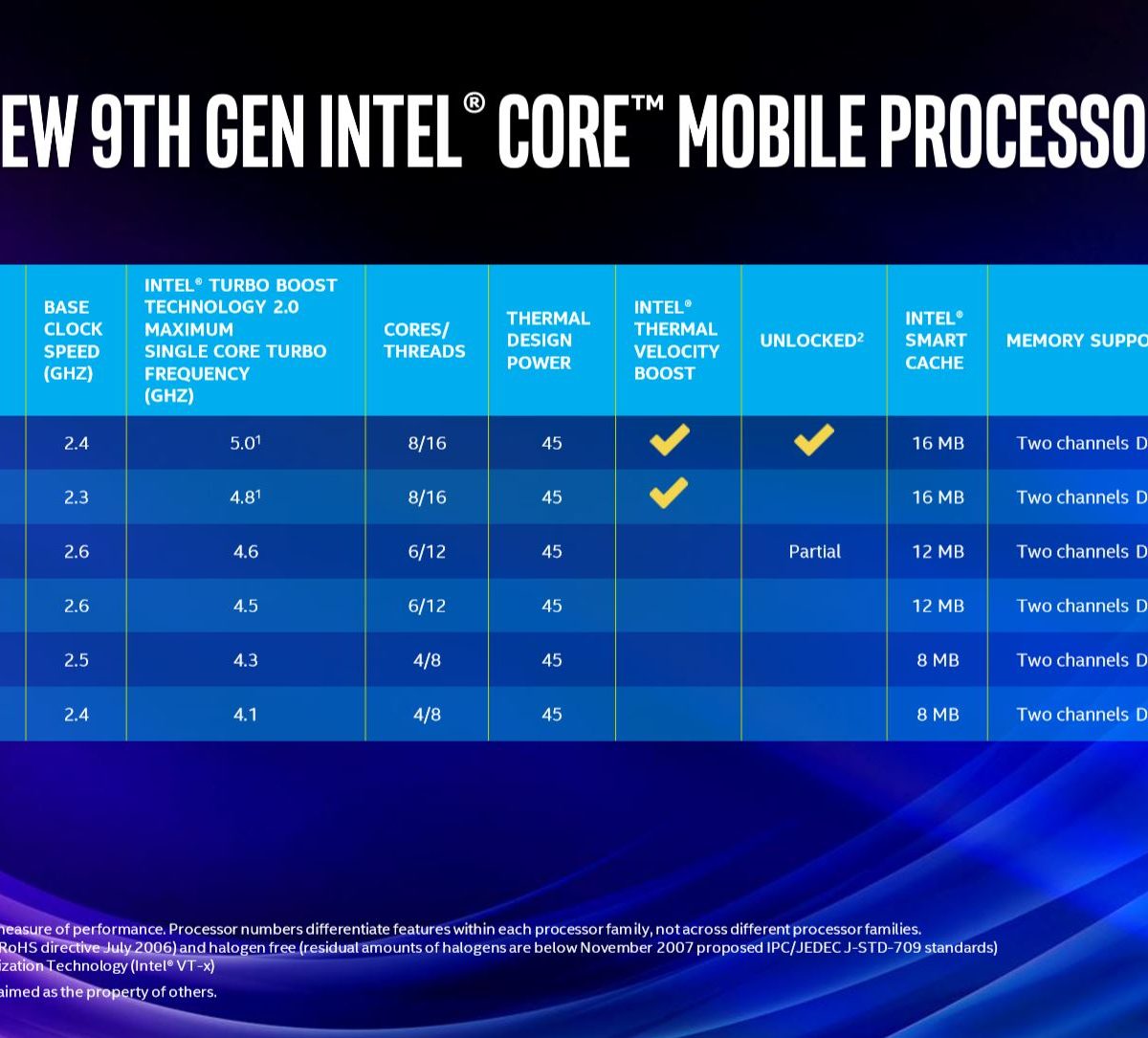
The Core i5, Core i7, and Core i9 are now in three distinct categories of core counts, which makes them a bit more clear for the average person buying a laptop. The previous Core i9 mobile chip, the Core i9-8950HK, was only a six-core processor, which made its improvement over the Core i7 a bit less substantive. The eight-core Core i9-9880H and 9980HK are both eight-core, 16-thread chips, which make it more of a true Core i9 to match the desktop chips.
The Core i9-9980HK is the unlocked version, which is the only ninth-gen mobile chip to hit that envious 5.0GHz clock speed at Turbo Boost on a single core.
The entire series of new chips are in the H-series, meaning they’re made with heavier usage in mind. We’re already seeing the Core i7-9850H show up in gaming laptops like the Razer Blade, while some of the most powerful systems have already featured the Core i9. The Core i7-9750H (and the partially unlocked 9850H) have the same core count, but enjoy an upgrade in single-core clock speed and turbo frequency from last year’s chip.
Whether laptop manufacturers like Apple can squeeze this Core i9 into its super-thin 15-inch laptops will be the true test. At launch, the 2018 MacBook Pro 15 famously throttled that chip so hard it couldn’t even maintain its base clock speed. This is true of many of the non-gaming laptops that attempted to implement the chip into a tiny chassis.
We still haven’t seen the rollout of new U-series processors for standard thin-and-light laptops such as the Dell XPS 13. We’ll probably see these launch later this year, perhaps at Computex or IFA.
Filling out the desktop family
Nothing this year is going to top the Core i9-9900K coming from Intel. Despite some of the concerns about the performance gain that chip gives you over previous generations (or the price compared to AMD’s options), the 9900K is as powerful a processor as they come.
However, Intel announced a swath of new processors that fill out the ninth-gen options a bit more, especially on the lower end of things.


Alongside the Core i9-9900K and the Core i7-9700K are the locked versions of those chips, which come in at lower Turbo Boost speeds and more affordable prices. Like the Core i7-9700K, the 9700 gets the bump up to eight cores over the six cores in the Core i7-8700. As usual, these chips have a lower 65-watt TDP compared to the 95 watts of power output by the unlocked versions.
Intel has also continued the T-series chips, which are low-powered versions of its new processors. This is the first time we’ve seen a T-series Core i9, which squeezes eight cores and 16 threads into a 35-watt TDP. These are commonly used in all-in-one or highly compact systems. In case you’re wondering, the F-series chips are identical to the others, except with the integrated graphics removed. Strangely, despite the fact that they’re missing an entire component, they aren’t a single cent cheaper.
The less outrageously expensive processors also see a nice bump in the ninth-gen refresh. The Core i5-9600 and i5-9500 both hop up to six cores and six threads to join the previously announced i5-9400, each with marginally different base clocks speeds. Meanwhile, the new Core i3 chip remains at four cores but now includes an overclockable version (the Core i3-9300K) and Turbo Boost capability.
Even the Pentium Gold and Celeron processors got some love with increased clock speeds, though they are still stuck at two cores.
Features across the board
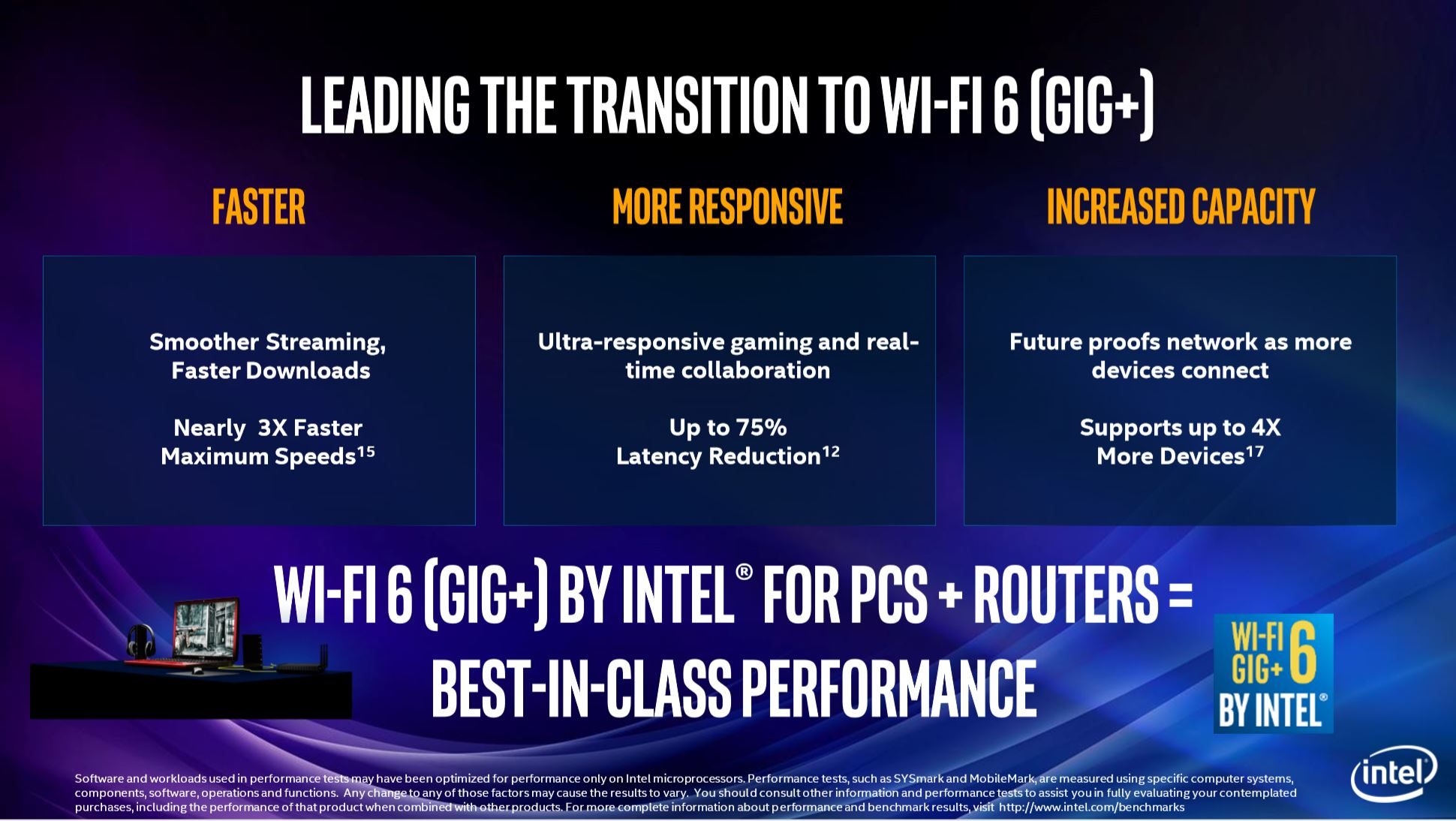
When it comes to new processors, speed is what counts. No doubt about that. But Intel also highlighted some other new features in these new chips, especially in the areas of storage and connectivity.
Although Intel has quietly moved itself from the mobile 5G game, it’s pushing ahead with another important evolution in connectivity: Wi-Fi 6. All ninth-gen processors include Wi-Fi 6 capability in the form of Intel’s Gig Plus solution. Intel claims Gig Plus will allow for connections that max out at almost three times the speed, as well as support for four times as many active devices. Of course, you’ll also need a new Wi-Fi 6 router to allow for those faster speeds.
These new processors also support Intel’s new fast memory solution, Optane H10 with Solid State Storage. Previously only used to speed up hard disk drives, Optane’s caching technology could take SSD storage speeds to the next level. Because Intel has integrated into a single M.2 design, we should start to see it popping up as an option in more and more thin-and-light laptops. As of now, however, this is being limited to pre-built systems.


