
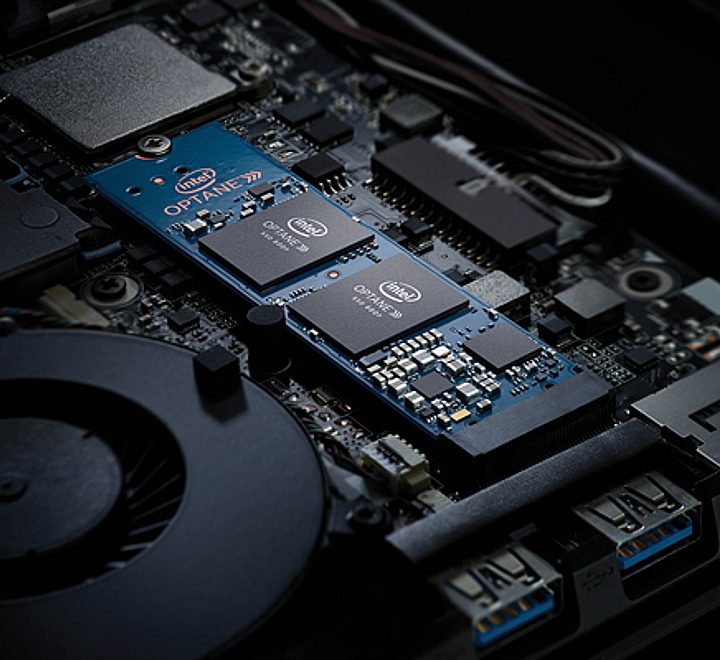
Intel announced its new storage solution, the Optane H10 Memory with SSD. The new Intel Optane H10 memory with SSD combines Intel’s Optane technology and QLC 3D NAND technology into a single solution. It keeps to the traditional M.2 80mm solid state drive form factor and uses the PCIe 3.0 x4 NVMe interface.
Put simply, it’s a small Intel Optane drive combined with a much larger Intel solid state drive. The Optane drive is used as a high-speed cache, offering quick access to commonly used data, while the (still quite quick) solid state storage is used to house everything else. It’s not unlike how Optane is used in existing systems that combine Optane with a separate solid state drive, but Intel is combining both onto a single M.2 80mm drive. This solution will work in a much wider variety of systems, particularly in the laptop arena, where space is always at a premium.
This might sound like a complex pairing, but it’s simple in practice. The Optane and QLC 3D NAND drives won’t appear as separate on your PC. Instead they will be combined and will appear as if you had a single solid state drive installed. Intel’s driver software will manage the relationship between the two drives in the background. You’ll notice better performance without having to manage each drive.
A partnership with Best Buy will bring systems equipped with the drive this spring. To start, Intel’s Optane Memory H10 will only be available in the best laptops or 2-in-1s with 8th-gen Intel Core U-series processors and a PCIe-based M.2 slot. Intel plans to roll out the storage drives to a wider variety of systems at a later point. The last phase of the rollout will also bring the Intel Optane H10 Memory with SSD to the do-it-yourself market. However, Intel’s not providing any timing or pricing for that phase of the roll-out, which likely means we’re (at best) months away from that launch.
Intel’s Optane technology leverages caching technology and is able to provide much faster read and write speeds than the fastest solid-state-drives currently available in the market. The new storage drive will join the family of Optane products, including the performance-focused Intel Optane 900P and 905P range of SSDs.
The drive will come in capacities featuring 16GB of Optane storage and 256GB of QLC storage, 32GB of Optane and 512GB of QLC, or 32GB of Optane and 1TB of QLC. A 5-year warranty will be included, though system and drive pricing remain to be announced.


