
Intel is giving its XeSS upscaling tech a huge makeover. The aptly-named XeSS 2 steals — or borrows, if we’re being generous — a page from Nvidia’s DLSS 3, which has been a staple feature of some of the best graphics cards you can buy. XeSS 2 comes packed with super resolution like the original version, but also frame generation and a latency-reducing feature called XeLL. And it’s launching alongside the new B580 graphics card.
Point-for-point, XeSS 2 is basically identical to DLSS 3. The super resolution portion functions much in the same way as the original XeSS, providing you with various different quality settings to render your game at a lower resolution in order to improve performance. On the upscaling side, the major change is native support for DirectX 12 and Vulkan, which should open up XeSS to more games.
The big update overall is obviously frame generation. This works similarly to other frame generation tools by rendering two frames and comparing them to generate a frame in between. This process, called frame interpolation, is available through features like AMD’s FSR 3 and even third-party tools like Lossless Scaling. However, with XeSS, Intel is running two AI models on the graphics card in real time to support the frame generation, similar to DLSS 3.
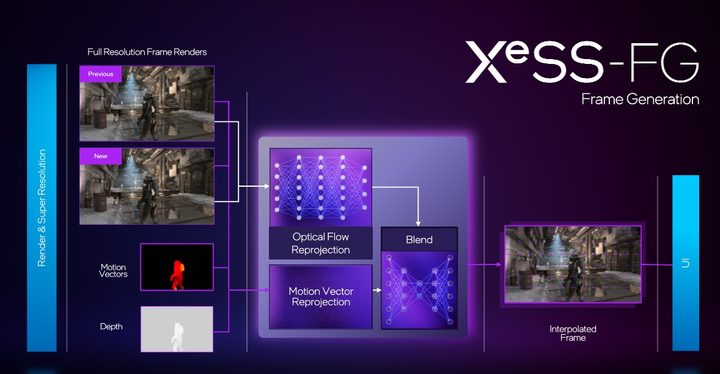
Because of that, frame generation is only available to GPUs with Intel’s dedicated XMX AI accelerators. Unlike DLSS 3, which is restricted to Nvidia’s latest RTX 40-series GPUs, Intel says XeSS 2 will work on all GPUs with XMX cores. That includes discrete graphics like the Arc A770 and A750, as well as integrated GPUs with the additional cores.
The method is interesting here. Basically all frame generation tools use frame interpolation, but Intel has previously researched methods that use frame extrapolation. Instead of comparing two frames, frame extrapolation simply uses previous frames to predict new ones, and given Intel’s previous research on the topic, it could be a big feature in future versions of XeSS Frame Generation.
To go along with XeSS 2, Intel is introducing XeLL, or Xe Low Latency. This feature is similar to Nvidia Reflex in that it sends a frame directly to the GPU after being processed by the CPU, bypassing the typical render queue. Intel says that, by default, XeLL is required for XeSS Frame Generation to work due to the fact that Frame Generation increases latency.

With the new Arc B580, Intel says XeSS 2 can deliver up to 3.9x performance over your native frame rate in a game like F1 24.

Intel hasn’t said what game XeSS 2 will show up in first, though the company says it’ll be included in upcoming titles like Assassin’s Creed Shadows, Marvel Rivals, and Like a Dragon: Pirate Yakuza in Hawaii. Intel says the feature will launch alongside the B580, so it should appear in at least one game when that GPU releases on December 13.


