Ahead of its announcements at CES 2021, Intel shared some important details on its upcoming 11th generation Rocket Lake desktop processors. On the top end of the stack, these new desktop processors will be reduced from 10 cores down to eight in favor of higher frequencies.
As was previously reported, Rocket Lake remains on the 14nm node, which has limitations. Intel is backporting features from its 10nm node in order to beef up the performance of Rocket Lake, but there are restrictions on what it can do. 10nm transistors are smaller, so when features like Intel Xe graphics are brought over to 14nm, it leaves Rocket Lake with less room on the die for additional cores.
Intel has yet to release the full spec table for Rocket Lake, but the company did confirm that the most powerful Core i9-11900K will have eight cores and 16 sixteen threads. The rest of the stack is still unconfirmed.
However, as Intel sees it, this is all in service of “maximizing real-world performance, which is a combination of IPC and frequency.” The increase in IPC (instructions per cycle) comes from the efficiency of 10nm, which Intel says is up 19% over the previous generation. All the while, Intel continues to juice higher clock speeds out of its 14nm.
Of course, “maximizing real-world performance” will always depend on what specific workflows you’re talking about. Intel’s eight-core chips won’t stand up well in multi-core performance next to AMD’s 16-core Ryzen 9 5950X. Tasks like content creation and other heavy loads can use all the cores and threads a CPU can throw at it.
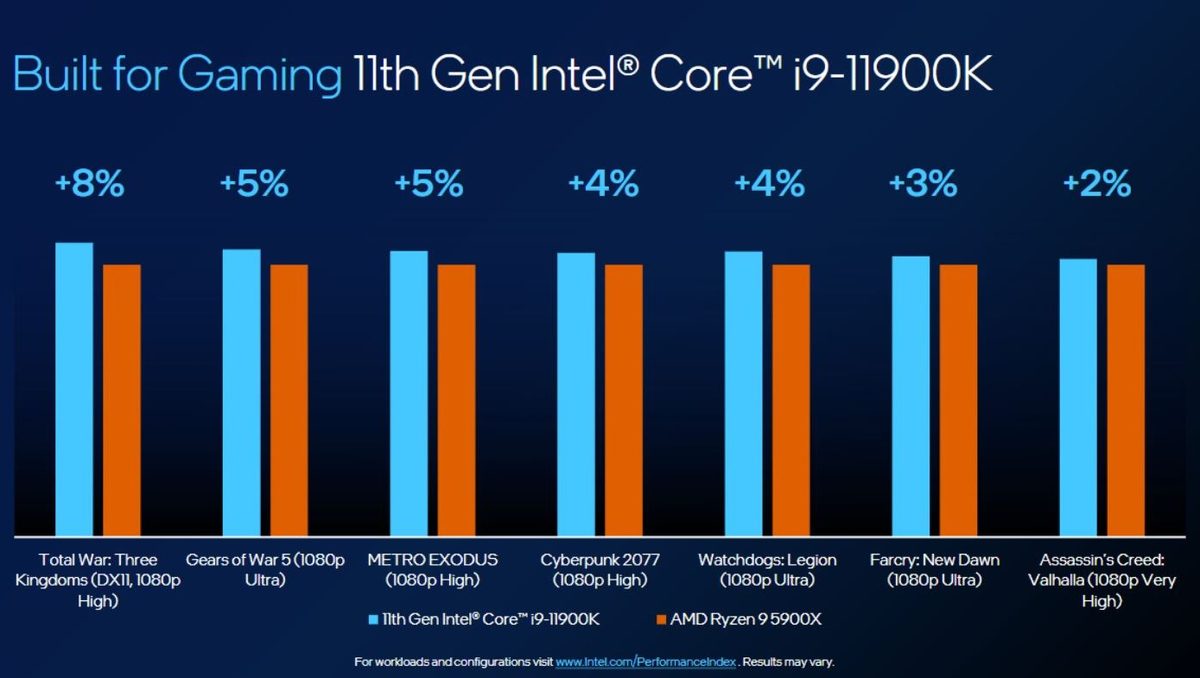
But gaming continues to be the drum Intel beats. This time around, Intel is boasting better gaming performance over the Ryzen 9 5900X, ranging from 2-8% based on the game. The high of 8% was in Total War: Three Kingdoms and the 2% was in Assassin’s Creed Valhalla. These games were tested at 1080p at max settings and with an EVGA Nvidia RTX 3080 graphics card.
Intel also compared Rocket Lake to its predecessor, pointing to the upcoming title Hitman 3 where Rocket Lake performed 7% faster than Comet Lake. Lastly, the company demoed Cyberpunk 2077, saying that paired with an RTX 3080, it can play smoothly at max settings with all the ray tracing effects turned on.
Intel announced a few other important features coming to Rocket Lake, including support for faster DDR4 (now up to 3,200MHz) and AV1 decode support, as well as hinting at some new overclocking features.
Perhaps most importantly, Rocket Lake chips will have up to 20 PCIe 4.0 lanes, up from 16 on Comet Lake. Intel said this would be to allow both your SSD and powerful graphics card to directly attach to the CPU.
Alongside Rocket Lake, Intel has a new 500-series chipset, though the company did address backward compatibility, saying that Rocket Lake would with older 400-series boards.
The first Rocket Lake systems will be launching in the first quarter of 2021. They will be quickly replaced by Alder Lake-S chips in 2021, which will be the company’s first 10nm desktop chips.