  1. Home
  2. Computing
  3. News

Digital Trends may earn a commission when you buy through links on our site. Why trust us?

Intel drops support for DirectX 9, but it may be a good thing

Add as a preferred source on Google

Intel has now officially dropped native hardware support for DirectX 9, and this applies to both integrated Xe graphics on Alder Lake CPUs and discrete Arc Alchemist GPUs.

This doesn’t mean that Intel won’t offer access to DX9. Instead, DirectX 9 will be supported through DirectX 12 via emulation. Will that be sufficient for gamers?
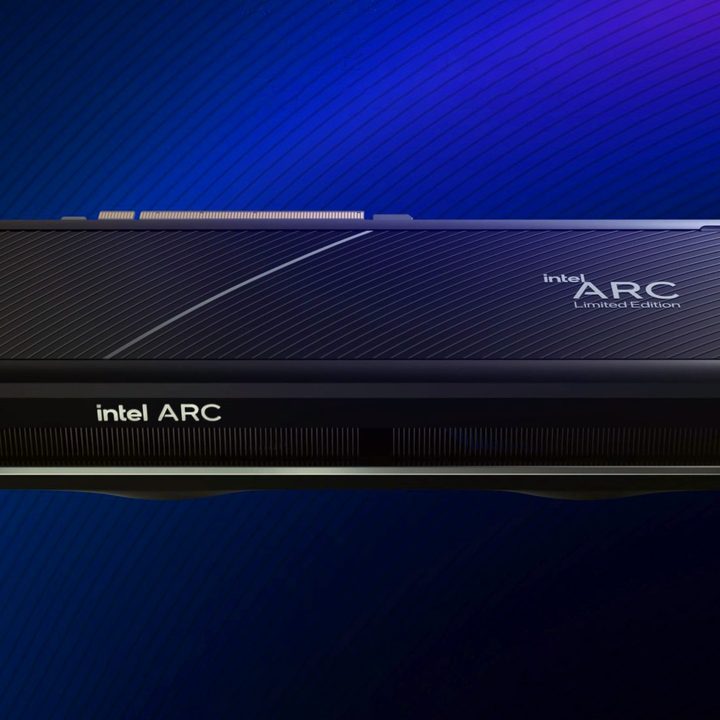
Intel Arc Alchemist reference design render.
Image used with permission by copyright holder

First spotted by SquashBionic on Twitter, this change was quietly announced by Intel on its product support page. It appears that the integrated graphics cards on 12th-generation processors, as well as Intel’s discrete GPU solutions (Arc Alchemist), both no longer support DirectX 9 natively. Instead of dealing with that support on its own, Intel delegated the task to Microsoft, which will redirect DX9 support to DX12 instead.

Recommended Videos

This will be done through emulation using an open-source conversion layer that Microsoft itself has prepared, known as “D3D9On12.” The way it works is that it sends 3D DirectX 9 graphics commands straight to D3D9On12, which then converts these D9 calls into DirectX 12 commands. It kind of replaces the GPU driver here, which would usually handle DirectX 9 calls, and acts as a bridge between the two technologies.

The response to this change has been a bit of a mixed bag, but the change in itself should not be surprising. We’ve already known that Intel Arc GPUs heavily favor DirectX 12, with performance being halved when DirectX 11 is in use. Seeing as DirectX 9 is even older, having launched twenty years ago, it should hardly be a priority for Intel going forward.

Microsoft also seems quite optimistic about the emulation tech in general, claiming that it has become a decent implementation of DirectX 9. While the performance may not be quite as good as natively supporting DX9, it should be close. In some cases, the performance might even be equal to native DX9. However, one side effect of using this emulation process might be an increase in CPU usage.
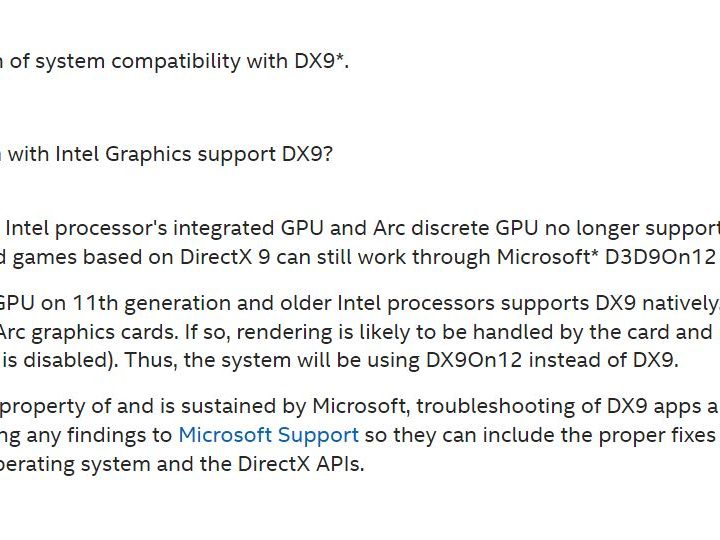
Intel's response to a DirectX 9 question.
Intel

In a way, this means that Intel has completely handed over the handling of DirectX 9 to Microsoft. It even says as much on its support page: “Since DirectX is property of and is sustained by Microsoft, troubleshooting of DX9 apps and games issues require promoting any findings to Microsoft Support so they can include the proper fixes in their next update of the operating system and the DirectX APIs.”

All in all, this change should turn out to be fairly low impact. Most games that are popular these days include support for DirectX 11 or newer, meaning that no conversion will have to take place for Intel GPUs to support them. The older titles that rely solely on DX9 will have to go through Microsoft’s emulation process. On the other hand, if you own an older integrated GPU from Intel (pre-Xe), you will retain DX9 support without emulation.

Let’s hope that outsourcing DX9 matters to Microsoft will free up more room for Intel to work on its DX11 optimization before the global launch of Intel Arc Alchemist.

Monica J. White
Monica is a computing writer at Digital Trends, focusing on PC hardware. Since joining the team in 2021, Monica has written…
A Google Pixel laptop might be on its way, but does anyone actually want one?
A new Google laptop might be coming, and I hate to be the bearer of bad news, but the odds are not in its favor.
Google Pixelbook in silver.

It looks like a new member is joining the Pixel family, adding to its resurgent smartphone lineup. Code analysis of the latest Android beta points toward a new Pixel laptop that Google might be planning to launch in the near future. Google last launched a laptop, the Pixelbook Go, in 2019, an affordable version of the Pixelbook it put on the shelves back in 2017.

Both the Pixelbook and Pixelbook Go, along with the earlier Chromebook Pixel models, were not what you would call a smash hit with the audience or a runaway commercial success. Ultimately, they triggered Big G's departure from the laptop segment and a shift in focus toward Pixel smartphones.

Read more
AI is entering the Skynet debate moment in the social media hype circles
AI might end the world - but first, it’ll trend on social media
Representative Image

A growing wave of online voices warning about the dangers of artificial intelligence—often dubbed “AI doom influencers” - is reshaping how the public and policymakers view the technology. According to a report by The Washington Post, these influencers, including researchers, tech leaders, and content creators, are increasingly highlighting worst-case scenarios, from mass job loss to existential risks posed by advanced AI systems.

While critics argue that some of this messaging borders on alarmism, the conversation is no longer confined to speculation. Real-world developments in AI are beginning to mirror some of the concerns being raised, blurring the line between hype and legitimate risk.

Read more
You won’t believe it, but Motorola actually makes a terrific head-turner of a laptop
Motorola’s Moto Book 60 Pro is surprisingly stylish, and the pricing makes it even better
Moto Book 60 Pro in PANTONE Bronze Green

Motorola is not the name I expect to see on a genuinely good laptop. A stylish phone? Sure. A foldable with some personality? Absolutely. But a thin-and-light notebook that actually feels well judged on both design and value was a genuine surprise. And yet, the Moto Book 60 Pro is one of the more quietly impressive laptops in its segment.

With the broader laptop market being in a mess, Motorola's laptops feel refreshing. It is capable, attractive, and still approachable at a time when pricing elsewhere has become increasingly rough.

Read more