  1. Home
  2. Computing
  3. Legacy Archives

Intel’s 2013 Haswell chip bestows all day battery life to Ultrabooks

Add as a preferred source on Google

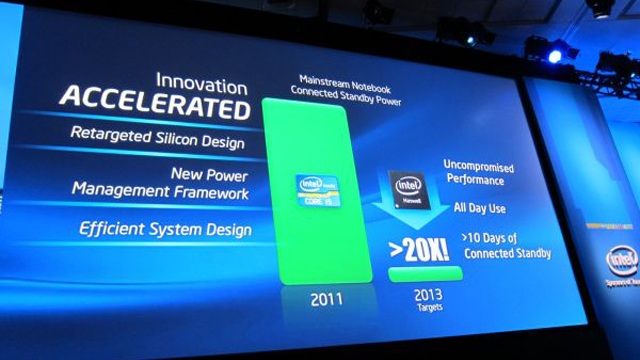
Haswell all dayAt the Intel Development Conference in San Francisco today, CEO Paul Otellini unveiled the company’s vision of new chips that will drastically decrease power consumption in the Ultrabook laptops. Thanks to the chips, Intel believes that by 2013 their laptops will be able to leap a full 24 day with a single charge, and have the ability to go 10 days on “connected” standby.

Intel’s Ultrabooks is an answer to the MacBook Air. Sleek, thin, lightweight and under $1000—the first products should be available by the holiday season. But the two upcoming Ivy Bridge and Haswell processors which will eventually enable Ultrabooks are Intel’s aces.

Recommended Videos

The Ivy Bridge microprocessor will ship in early 2012 and follow the Sandy Bridge processor. The 22nm Ivy Bridge will be manufactured using the 3D transistor process revealed earlier this year. The shrunken processor will pump out 50 percent more power efficiency than the Sandy Bridge with more performance.

The Haswell processor, coming in 2013, will be taking energy efficiency even further than Ivy Bridge. Otellini says that the new design gives all-day power on one charge, and will reduce idle platform power by more than 20 times current designs—which comes to 10 days of connected standby battery life. The MacBook Air has something like 7 hours of power and 30 days of regular standby.
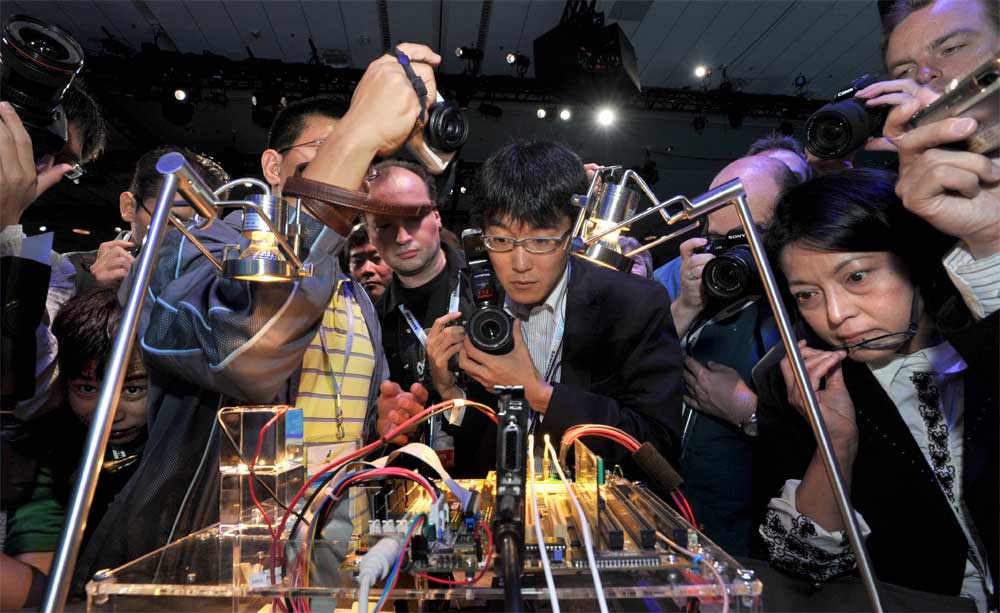
Near Threshold Voltage Core via macobserver
Image used with permission by copyright holder

The 10 days means the Ultrabooks has no display but is running and connected to your network. Intel described this as, “always-on-always-connected computing where Ultrabooks stay connected when in standby mode, keeping the e-mail, social media and digital content up-to-date.”

Intel also showed off a prototype chip called the “Near Threshold Voltage Core”, illustrating the company’s vision of future processors allowing computers to be powered by a solar cell as large as a postage stamp. The prototype allowed a computer to be powered by a light bulb.

Intel via Macobserver

Jeff Hughes
Former Digital Trends Contributor
I'm a SF Bay Area-based writer/ninja that loves anything geek, tech, comic, social media or gaming-related.
Topics
A Google Pixel laptop might be on its way, but does anyone actually want one?
A new Google laptop might be coming, and I hate to be the bearer of bad news, but the odds are not in its favor.
Google Pixelbook in silver.

It looks like a new member is joining the Pixel family, adding to its resurgent smartphone lineup. Code analysis of the latest Android beta points toward a new Pixel laptop that Google might be planning to launch in the near future. Google last launched a laptop, the Pixelbook Go, in 2019, an affordable version of the Pixelbook it put on the shelves back in 2017.

Both the Pixelbook and Pixelbook Go, along with the earlier Chromebook Pixel models, were not what you would call a smash hit with the audience or a runaway commercial success. Ultimately, they triggered Big G's departure from the laptop segment and a shift in focus toward Pixel smartphones.

Read more
AI is entering the Skynet debate moment in the social media hype circles
AI might end the world - but first, it’ll trend on social media
Representative Image

A growing wave of online voices warning about the dangers of artificial intelligence—often dubbed “AI doom influencers” - is reshaping how the public and policymakers view the technology. According to a report by The Washington Post, these influencers, including researchers, tech leaders, and content creators, are increasingly highlighting worst-case scenarios, from mass job loss to existential risks posed by advanced AI systems.

While critics argue that some of this messaging borders on alarmism, the conversation is no longer confined to speculation. Real-world developments in AI are beginning to mirror some of the concerns being raised, blurring the line between hype and legitimate risk.

Read more
You won’t believe it, but Motorola actually makes a terrific head-turner of a laptop
Motorola’s Moto Book 60 Pro is surprisingly stylish, and the pricing makes it even better
Moto Book 60 Pro in PANTONE Bronze Green

Motorola is not the name I expect to see on a genuinely good laptop. A stylish phone? Sure. A foldable with some personality? Absolutely. But a thin-and-light notebook that actually feels well judged on both design and value was a genuine surprise. And yet, the Moto Book 60 Pro is one of the more quietly impressive laptops in its segment.

With the broader laptop market being in a mess, Motorola's laptops feel refreshing. It is capable, attractive, and still approachable at a time when pricing elsewhere has become increasingly rough.

Read more