
It should come as no surprise to anyone that Linksys is bringing a series of routers to CES in 2017. The networking giant has a specialized gaming router, a few home network solutions, and a high-powered USB Wi-Fi connection, all of which will be coming to market in the spring of 2017. Let’s take a look.
Linksys WRT32X
For the gaming crowd, Linksys has teamed up with Rivet Networks, of Killer Network fame. The WRT32X picks up the classic WRT styling and open source firmware adoption, pairing it up with 2.6Gbps of bandwidth across three channels.
What’s special about this router is how it works with systems that have Killer Network installed. The software connection allows for acute control over bandwidth prioritization and signal distribution. At the cost of other devices on your network, you can prioritize devices that need the fastest speeds and the lowest latency — namely, gaming computers.
Those feature additions are mostly skin-deep. The WRT32X sports a 1.8GHz dual-core processor and 512MB of DDR3 memory, which matches other high-end routers at the $300 price point.
Linksys EA8300
Moving on to the more routine routers, the EA8300 brings 802.11ac Wave 2 and up to 2.2Gbps of total bandwidth at the $200 price point. While we haven’t had hands-on time with the device, its bandwidth should be more than enough for small households and personal networks.
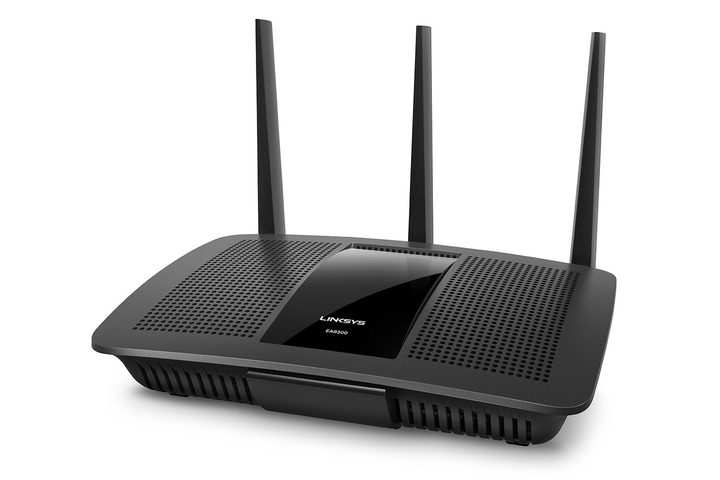
Under the hood, the E8300 is powered by a quad-core 716MHz processor with 256MB of DDR3, allowing for speedy distribution of network signals and any data drives attached to the network.
It carries basically every feature we’d hope to see from a midrange to high-end router, with beamforming, Amazon Alexa, automatic band switching, and bandwidth prioritization for specific devices.
Linksys EA9300
The Linksys EA9300 ups the ante with a 1.8GHz Quad-core processor and twice the RAM, for a total of 512MB. It almost doubles the EA8300’s bandwidth at 4.4Gbps across three channels.
It packs in the same feature set as the EA8300, with Amazon Alexa Skills, beamforming, and per-device bandwidth distribution. It’s hard to ask for much more than that.
That extra power will cost you an extra $100, bringing the total sticker price up to $300.
Linksys WUSB6400M
Since a lot of systems aren’t equipped to take full advantage of the new 802.11ac Mu-MiMo functionality, Linksys is also rolling out a high-end USB Wi-Fi device to help bring them in line.

The USB 3.0 adapter is built with plug-and-play functionality in mind for simple setup, and works with any router, not just Linksys devices.
At just $60, the WUSB6400M is a solid deal on a very capable Wi-Fi adapter, especially consider its advanced feature set and performance promises.


