

Apple just upset everyone, claiming that the 8GB of Unified Memory available in the base MacBook Pro M3 is “probably analogous to 16GB on other systems.”
The MacBook Pro M3 has already come under fire for only including 8GB of Unified Memory in its base configuration, which runs $1,600. MacWorld recently ran a story criticizing the 8GB of memory in the MacBook Pro M3, saying, “If 8GB will be a bottleneck for many today, imagine the performance of that non-upgradeable laptop in a few years’ time.”
Apple’s response is that 8GB on a MacBook Pro M3 is probably closer to 16GB on a Windows laptop. In an interview with Lin YilYi, Apple’s Bob Borchers addressed the 8GB of memory in the MacBook Pro M3:
“Comparing our memory to other systems’ memory actually isn’t equivalent, because of the fact that we have such an efficient use of memory, and we use memory compression, and we have a unified memory architecture. Actually, 8GB on an M3 MacBook Pro is probably analogous to 16GB on other systems. We just happen to be able to use it much more efficiently … I think this is a place where people need to see beyond the specs and actually look at the capabilities.”
Borchers has a point. Due to the fact that the MacBook Pro M3 uses a system-on-a-chip (SoC), it’s able to access memory much more efficiently than a standard Windows laptop. Capacity and speed are two sides of the same coin; if you have faster speeds, you don’t need as much capacity, and vice versa.
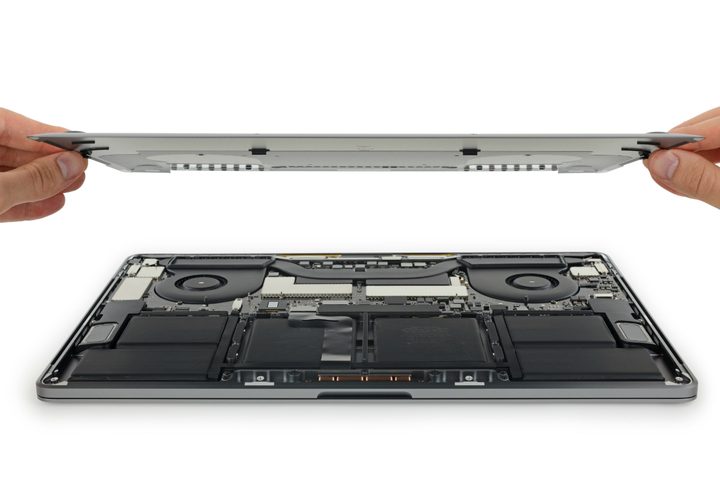
In addition, Apple includes a 512GB SSD with the base MacBook Pro M3, which uses two NAND chips. The previous version showed much slower SSD speeds with only a single NAND chip, and due to swap memory being critical in memory-limited situations, the 256GB SSD combined with the 8GB of memory vastly reduced performance. MaxTech’s early testing on the MacBook Pro M2 showed how big of a problem the 8GB of memory combined with the 256GB, single NAND SSD really was.
In real use, that shouldn’t be as big of a problem on the MacBook Pro M3. Unified Memory allows Apple to get away with lower capacity compared to Windows laptops, and the dual-NAND configuration of the SSD keeps things from being too slow when swap memory comes into play. The problem isn’t 8GB of memory, or even that it comes on a $1,600 laptop in 2023. It’s that adding more memory costs so damn much.
You’ll spend an extra $200 for 16GB of memory and an extra $400 for 24GB. Even ignoring the cost of those memory modules — I’ll let you know it’s far less than what Apple’s charging — you can see how big the upcharge really is just from configuration options. In Apple’s mind, each 8GB module of Unified Memory is worth $200. That’s insane.

If you look at a laptop like the Dell XPS 13 Plus, which comes with 16GB of memory for $1,500, you can upgrade it to 32GB for an extra $150. There’s no issue with Apple selling the MacBook Pro M3 with 8GB of memory, even for $1,600. But it shouldn’t cost an extra $200 just to get to 16GB for users who truly do need that extra capacity.
This really isn’t anything new for MacBooks, though, and it doesn’t just apply to memory. If you look at storage options, you’ll need to spend an extra $200 to upgrade the 512GB SSD to a 1TB SSD, and an extra $600 to upgrade the 512GB SSD to a 2TB SSD. Once again, each 512GB chunk of storage is worth $200 in Apple’s mind, despite the fact that the cost for these components isn’t anywhere remotely near that price.
It could go either way — Apple should have the base MacBook Pro M3 with 8GB of Unified Memory sell for a lower price, or it should make the cost of upgrading to 16GB of RAM much cheaper. It doesn’t really matter if you need that memory or not, either. The upgraded model is the one most people should buy, even if they only occasionally go over capacity.
At the very least, that pricing scenario would be a minor annoyance, with Apple nickel and diming people to get the RAM they need (definitely not uncharacteristic of Apple). As it stands now, with the high base price and huge cost of upgrades, it is hard to say the MacBook Pro M3 truly starts at $1,600 when a critical upgrade is locked behind a $200 paywall.


