
It has been a year since Facebook became Meta, and began deliberately pushing us toward embracing the metaverse. Since then, it’s all been building up to this, the launch of the Meta Quest Pro at this year’s Meta Connect keynote.
Zuckerberg excitedly walked us through his vision of the metaverse, powered by new headsets like the Quest Pro.

The keynote presentation was about far more than just a new headset though. Meta expounded upon its vision for the metaverse as a whole and its potential for impact on society at large.
The virtual keynote started at 10 a.m. PT, and you can watch the stream here.
Quest Pro finally hits

Meta spent the last half of the keynote focused on the announcement of the Quest Pro. It’s officially here. The long-anticipated new VR headset has finally been announced, previously known as Project Cambria. A lot of the specs weren’t confirmed in the keynote, but sites are reporting a resolution of 1800 x 1920 pixels per eye at 90Hz. This doesn’t match the claimed 37% increase in pixel count over the Quest 2, though, so we’ve reached out to Meta for the official specs.
Zuckerberg did mention the use of local dimming for the mini-LED displays but didn’t include a number of zones. It also runs on the Qualcomm Snapdragon XR2+ chip, comes with 12GB of memory, and 256GB of storage.

That increased fidelity is extremely important, but it’s the new features and controls that really make this a new experience. The Quest Pro is the first Meta headset to include eye tracking as a new method of navigation and controls. The inward-facing cameras are also super important for registering facial expressions for avatars.
While the Quest Pro is heavier than the Quest 2 at 733 grams, the headset should more balanced and comfortable — but we’ll have to wait to try it out ourselves.

The other big feature is full-color passthrough. Again, we’ve heard this has been in the works, but this is what allows this headset to be more than just a VR headset. It can now include AR experiences and allow for a more seamless transition between virtual and real-world environments. So, if you’re in VR and need to put it on pause to do something in the real world, you won’t have to take off the headset. Of course, Meta spoke about the potential for developers to use AR for lots of new experiences too, even if this isn’t a dedicated AR headset.
The headset will cost $1,600 and will begin shipping on October 25. That price includes the new Touch Pro Controllers bundled in, which have a new stylus tip that allows you to use the controller as a pen in VR, better balancing without the ring, and improved tracking.
New avatars, now with legs

Avatars were a big focus of the event, whether for updates to current technology or futuristic demos for real-life avatars. To demo this, Zuckerberg gave part of his keynote within Horizon Workrooms, showing off the more life-like avatars, which now include fully operational legs. But beyond legs, the avatars certainly have an improved look. Meta even announced that the Avatar Shop can now be experienced in VR.
Meta also talked about bringing its avatars to its other social media platforms, such as Reels, WhatsApp, and Facebook Messenger. These avatars are even coming to Zoom calls.
Toward the end of the event, Meta talked about its work on creating photorealistic avatars, or Codec Avatars. The second generation takes the technology much further, allowing for more realistic facial expressions, the ability to move around a light source, and change outfits on the fly.

Meta even showed a simplified version of the technology, called “Instant Avatar,” which can be done with your phone and processed in just a couple of hours. As mentioned in the keynote, these don’t have the same level of detail as the Codec Avatars but were still impressively realistic.
Of course, these are still very much in the research phase, but it’s not hard to see Instant Avatars becoming a more accessible technology in the near future.
EMG prototypes

One of the more interesting prototypes shown at the keynote was an EMG (electromyography) demo. The connected headset powering this experience wasn’t shown, but the demo demonstrated how the gentlest flick of a wrist or hand gesture could control the interface. The first demo was just a video of Zuckerberg selecting different conversation options with the sensors located on his wrist or taking a photo.
But the demos take the technology further, even showing how this type of control can be used in a game. The person’s hand was barely moving at all, using the same neural EMG technology. The interesting part is that the minutia of the controls is unique to each person, since no two hand gestures are exact.
While it’s all still in the research phase, it’s obvious that building out these new ways of controlling computers will be essential for making the AR and VR devices of the future less rudimentary.
Quest 2 updates and gaming announcements

Quest Pro is the big announcement, but if you’re a gamer, the Quest 2 is still king as the more affordable and accessible device. Meta spent a large portion of its keynote showing continued support for the platform. Meta celebrated its over 400 apps in the Quest Store, many of which have earned over $10M in gross revenue.
Beyond that, Meta also announced that in partnerships with Camouflaj and Sony, Marvel’s Iron Man VR is coming to Meta Quest 2 on November 3. Even further, Meta has announced that Camouflaj has recently joined Oculus Studios, along with other dev teams Twisted Pixel and Armature Studio.

Other announcements include a release date of November 10 for Among Us VR, as well as a new trailer for it. We also got a release date for The Walking Dead: Saints & Sinners Chapter 2 Retribution, which will land on the Quest 2 on December 1. The team behind that Walking Dead is also working on a mystery game called Behemoth, which we got a very brief glimpse of.
Microsoft 365 and Teams in VR

Because the Quest Pro is a headset made for the working world, the collaboration announced with Microsoft makes a lot of sense. You can now access Teams meetings entirely in VR on Quest headsets, and can even launch Teams meetings from within a Horizon Workroom. Meta avatars will eventually be supported in these “immersive” Teams meetings as well. This same functionality is also coming to Zoom.
Microsoft 365 is coming to Quest, allowing you to access all those applications completely in VR. That means you can stream the entire Windows experience all within a Quest 2 or Quest Pro headset. These headsets can now even be managed and secured in a large organization in the same way a laptop can. That goes a long way toward making these headsets more capable of replicating the true work experience.
Quest 2 Active Pack
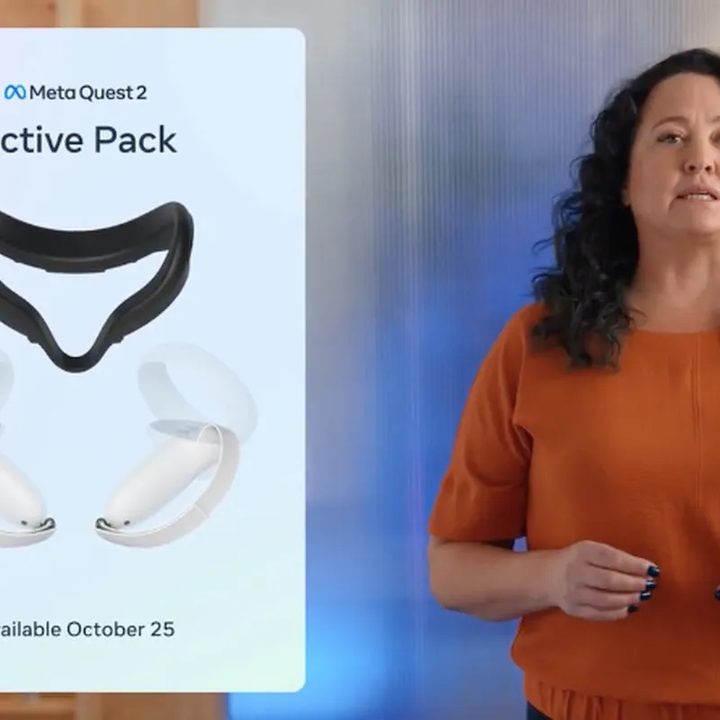
Meta talked up the current availability of fitness apps in the Quest Store. Some new apps were announced, such as Gym Class, which is an interesting-looking basketball game.
The sweat problem with VR is no joke though. Meta announced the Quest 2 Active Pack to help solve that problem, which is a bundle of fitness-focused accessories, including a wipeable facial interface, wrist straps for the controllers, and adjustable knuckle straps. The pack is available for sale on October 25, but no price was provided.
Meta also announced a new Fitness API Beta that would allow an expansion of fitness tracking to other apps, though it’ll only be available for select partners to begin with.


